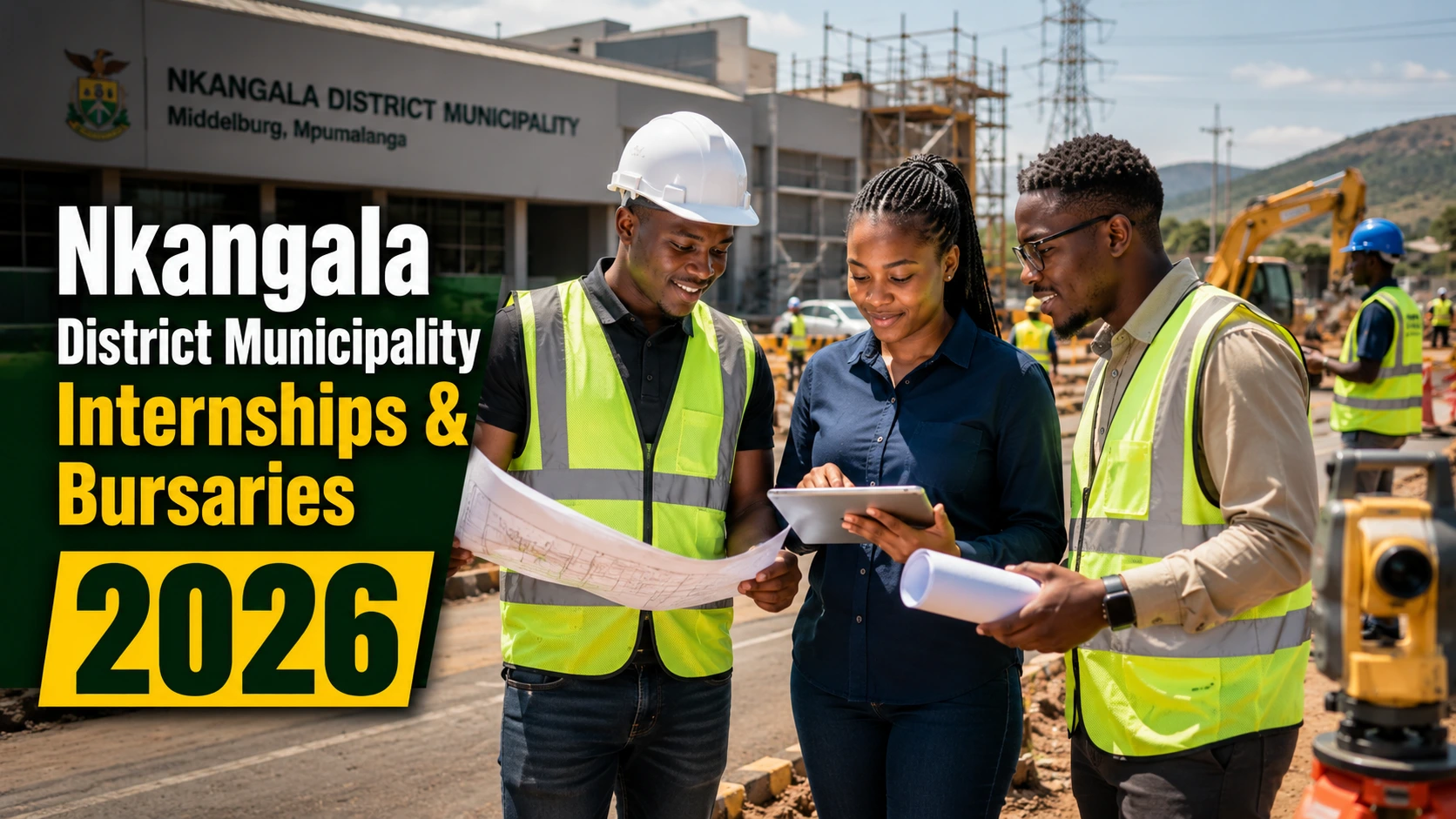
The Nkangala District Municipality Graduate Internship and Bursary Programme 2026 offers internships and bursary funding for South Africans studying or qualified in construction-related fields.
On most mornings in Middelburg, construction vehicles begin moving long before office lights switch on across the town. Roads are repaired, electrical systems are upgraded, and municipal infrastructure projects quietly continue in the background while residents prepare for another day.
Behind every functioning municipality sits a network of engineers, planners, technicians, project managers and administrators responsible for keeping infrastructure operational. But across South Africa, one major challenge continues slowing the sector down: a shortage of practical workplace opportunities for young graduates trying to enter the industry.
For many graduates, earning a qualification is only the beginning. The harder part often comes afterward — finding an employer willing to provide workplace exposure.
That reality is part of what makes the Nkangala District Municipality Graduate Internships and Bursary Programme 2026 important for young South Africans pursuing careers in construction and the built environment sector.
Launched in partnership with the Construction Education and Training Authority (CETA), the programme combines workplace internships and bursary funding aimed at strengthening skills development while supporting economic transformation and infrastructure growth.
The municipality is offering:
- 20 graduate internship opportunities
- 50 bursary opportunities
- Internship stipends of R60,000 per annum
- Bursary funding valued at R80,000 per beneficiary
Applications close on 29 May 2026.
Quick Facts About the Nkangala District Municipality Graduate Internships and Bursary Programme 2026
- Organisation: Nkangala District Municipality
- Programme: Graduate Internship & Skills Development Bursary Programme 2025/26
- Location: Middelburg, Mpumalanga
- Internship Duration: 12 months
- Internship Beneficiaries: 20
- Bursary Beneficiaries: 50
- Internship Stipend: R60,000 per annum
- Bursary Value: R80,000 per beneficiary
- Closing Date: 29 May 2026
Why the Nkangala District Municipality Graduate Internships and Bursary Programme 2026 Matters
South Africa’s unemployment crisis continues affecting graduates across multiple sectors, but the challenge is particularly visible in technical and infrastructure-related fields.
Many graduates leave universities or TVET colleges with qualifications but struggle to secure practical experience required by employers. This “experience barrier” has become one of the biggest frustrations facing young professionals entering the labour market.
Municipality-linked internship programmes help address that gap.
The Nkangala District Municipality Graduate Internships and Bursary Programme 2026 offers more than temporary financial support. It creates structured access to industries linked directly to infrastructure development — an area South Africa continues prioritising through roads, housing, municipal upgrades and energy projects.
In practical terms, infrastructure investment cannot happen without skilled people managing projects behind the scenes.
Civil engineers, quantity surveyors, construction managers and electrical specialists all play roles in maintaining and expanding public infrastructure systems. Opportunities that support training in these fields therefore carry wider national importance.
For many young graduates, municipal internship programmes also offer something private-sector opportunities sometimes do not: exposure to public infrastructure systems that affect real communities directly.
Inside the Graduate Internship Programme
The graduate internship component focuses specifically on unemployed graduates who need workplace exposure and industry-related experience.
This is especially relevant in South Africa’s current labour market, where many employers expect practical experience even for junior positions.
According to the programme details, selected graduates will participate in:
- A 12-month internship programme
- Practical workplace exposure
- Built environment and construction-related activities
- Structured industry learning under CETA conditions
The annual stipend of R60,000 translates to approximately R5,000 per month before deductions, depending on payment structures used by the municipality.
For graduates entering the workforce for the first time, this type of support can help reduce transport and living pressures while allowing them to focus on gaining experience.
More importantly, workplace exposure linked to municipalities often introduces graduates to large-scale operational environments where projects affect communities directly.
The Fields of Study Reflect South Africa’s Infrastructure Priorities
One of the strongest aspects of the programme is its focus on fields tied directly to infrastructure and economic development.
Priority qualifications include:
- Civil Engineering
- Construction Management
- Electrical Engineering
- Quantity Surveying
- Other construction-related qualifications
These fields remain essential to South Africa’s long-term development goals.
Across provinces, municipalities continue dealing with infrastructure backlogs involving roads, electricity systems, sanitation projects and public facilities. The country therefore needs skilled professionals capable of managing, maintaining and expanding infrastructure networks.
Graduates entering these sectors are not simply searching for office jobs. Many are entering industries tied directly to public service delivery and economic recovery.
This makes opportunities like the Nkangala District Municipality Graduate Internships and Bursary Programme 2026 especially valuable because they connect skills development with real operational needs inside municipalities.
A Closer Look at the Skills Development Bursary Programme
While the internship programme targets unemployed graduates, the bursary component focuses on employed individuals who want to continue their studies.
This distinction matters because many working South Africans struggle to further their education due to financial pressure.
The Skills Development Bursary Programme includes:
- 50 bursary beneficiaries
- Funding valued at R80,000 per beneficiary
The funding may help cover:
- Tuition fees
- Registration costs
- Academic materials
- Textbooks
- Other study-related expenses
In a country where higher education costs continue creating financial strain for families, bursary programmes linked to infrastructure sectors can significantly improve access to skills development.
The municipality also indicated that preference will be given to youth, women, persons with disabilities and first-generation university or college entrants.
That reflects broader transformation objectives aimed at increasing participation in sectors historically less accessible to disadvantaged communities.
Expert Insight: Why Infrastructure Skills Are Becoming More Valuable
One of the most important long-term trends in South Africa’s labour market is the growing importance of infrastructure-related skills.
While digital industries receive significant public attention, municipalities and government departments continue facing shortages in technical and construction-related professions.
Infrastructure projects require skilled professionals capable of managing budgets, overseeing projects, understanding regulations and coordinating operational systems.
At the same time, many experienced professionals in engineering and construction are approaching retirement age, creating future demand for younger professionals entering the sector.
Programmes like the Nkangala District Municipality Graduate Internships and Bursary Programme 2026 therefore serve two purposes simultaneously:
- Supporting youth employment
- Strengthening future infrastructure capacity
That combination makes these opportunities strategically important beyond individual beneficiaries alone.
Who Qualifies for the Internship Programme?
Applicants interested in the graduate internship programme must meet several requirements.
Internship applicants must:
- Be South African citizens
- Be between 18 and 35 years old
- Hold an NQF Level 6 to 8 qualification
- Be currently unemployed
- Not be participating in another internship or learnership programme
The municipality also stated that applicants above 35 years may still be considered.
Priority consideration will be given to:
- Women
- Persons with disabilities
- Previously disadvantaged groups
- Graduates with limited work experience
These priorities reflect ongoing government transformation and inclusion goals within public-sector development programmes.
Bursary Programme Eligibility Requirements
Applicants interested in the bursary programme must:
- Be employed South African citizens
- Hold a Grade 12 certificate
- Be accepted or registered at:
- A public university
- An accredited TVET college
Applicants must also demonstrate commitment to career progression and skills development in construction-related fields.
The municipality’s focus on employed applicants reflects the reality that many workers continue studying part-time while balancing financial responsibilities.
Document Preparation Could Affect Application Success
One of the most overlooked parts of application processes is document presentation.
Applicants for the internship programme must submit:
- Completed CETA application form
- CV
- Certified copy of South African ID
- Certified matric certificate
- Certified qualifications
- Latest academic transcript
Bursary applicants must additionally submit:
- Motivation letter
- Proof of registration at an accredited institution
The motivation letter may seem like a small requirement, but it can become one of the most important parts of the application.
Strong motivation letters usually explain:
- Career goals
- Reasons for choosing the field
- Long-term ambitions
- How funding will support educational progress
Simple, clear writing often performs better than overly formal language.
see also: Department of Health Graduate Internships 2026: Complete Guide for South African Graduates
Where To Apply
Applications can be submitted via email or hand delivery.
Email Applications
Email Address: Mgobozimsg@nkangaladm.co.za
Hand Delivery Address
Nkangala District Municipality
2A Walter Sisulu Street
Middelburg
1050
Enquiries
Mr. Mgobozi
Telephone: 013 249 2128
Email: Mgobozimsg@nkangaladm.gov.za
Mr. Edwin Mametja
Telephone: 013 249 2160
Email: mametjae@nkangaladm.gov.za
Closing Date
Applications close on:
29 May 2026
Late applications may not be considered.
FAQ About the Nkangala District Municipality Graduate Internships and Bursary Programme 2026
Who can apply for the graduate internship programme?
South African graduates with NQF Level 6 to 8 qualifications in construction-related fields who are currently unemployed may apply.
How much is the internship stipend?
The internship stipend is R60,000 per annum.
Which fields of study are prioritised?
Priority fields include Civil Engineering, Electrical Engineering, Construction Management, Quantity Surveying and other construction-related qualifications.
Final Thoughts
The Nkangala District Municipality Graduate Internships and Bursary Programme 2026 arrives at a time when many young South Africans are searching for more than qualifications — they are searching for access.
Access to experience. Access to funding. Access to industries where long-term career growth remains possible.
Infrastructure and construction sectors continue shaping South Africa’s future quietly but consistently. Roads, electrical systems, public facilities and municipal services all depend on skilled professionals working behind the scenes.
Programmes like this help strengthen that future while giving graduates and students a realistic opportunity to build careers in sectors linked directly to national development.
For some applicants, this programme may provide the first meaningful workplace experience after years of studying.
For others, the bursary support may help continue an educational journey that financial pressure could otherwise interrupt.
Either way, opportunities connected to skills development and infrastructure remain deeply important — not only for individual careers, but for the broader future of South Africa itself.
About The Author
