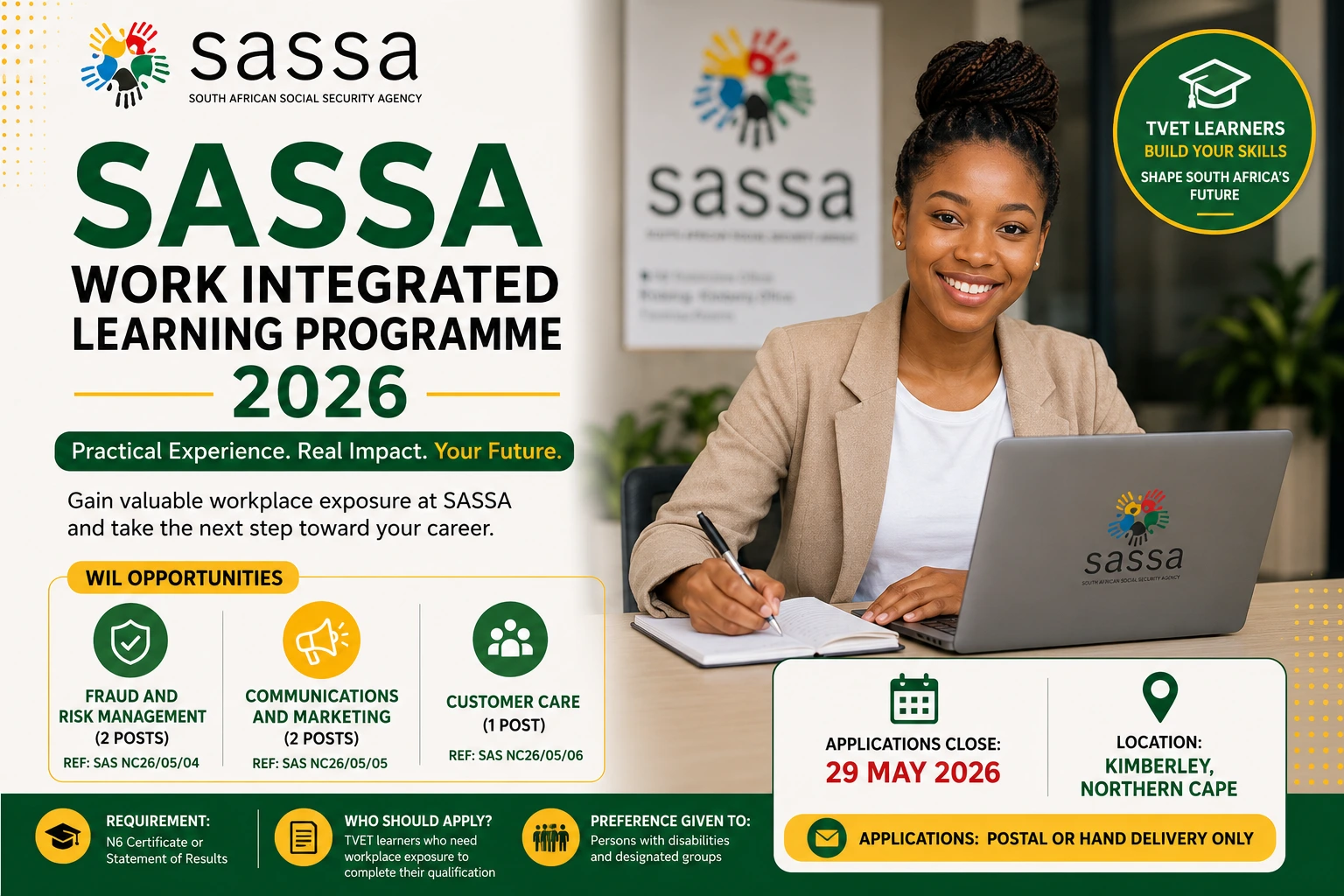
The South African Social Security Agency Work Integrated Learning Programme 2026 is an important opportunity for South African TVET College learners who need workplace experience to complete their qualifications and improve their employability.
For many students, finishing theoretical studies is only one part of earning a qualification. Practical workplace exposure is often required before learners can receive their National Diploma. This is where Work Integrated Learning programmes become valuable.
The SASSA Work Integrated Learning Programme 2026 gives eligible TVET learners the chance to gain professional experience in a government working environment while learning practical skills related to administration, customer service, communications, and risk management.
For learners interested in public service careers, government administration, or social development, this programme can provide valuable real-world exposure that strengthens both experience and confidence.
What You Should Know First
The SASSA Work Integrated Learning Programme 2026 is designed for TVET College learners who have completed their N6 theoretical studies and require workplace training to complete their National Diploma.
The programme offers:
- Workplace experience at SASSA’s Regional Office in Kimberley
- Exposure to public sector operations
- Professional administrative experience
- Training in customer service and communication
- Practical learning opportunities in government departments
Applications close on 29 May 2026, and only postal or hand-delivered applications will be accepted.
Understanding the SASSA Work Integrated Learning Programme 2026
Work Integrated Learning, commonly known as WIL, is a structured programme that combines classroom learning with workplace experience.
In many TVET College programmes, students must complete a period of workplace training before receiving their final qualification. This practical exposure allows learners to apply their academic knowledge in real working environments.
The SASSA Work Integrated Learning Programme 2026 is specifically designed to support learners who still need this workplace exposure.
Unlike short job-shadowing experiences, WIL programmes typically involve active participation in workplace activities. Learners may assist with administration, communication, customer support, compliance tasks, or operational duties depending on their placement area.
Because the programme takes place within South African Social Security Agency, participants also gain insight into how public institutions operate and deliver services to South African citizens.
Why Work Integrated Learning Is Important for TVET Learners
One of the biggest challenges many graduates face is the lack of practical experience.
Employers often look for candidates who already understand workplace systems, communication standards, and professional responsibilities. WIL programmes help close that gap.
Practical Experience Improves Employability
Many learners complete their studies without direct workplace exposure.
Work Integrated Learning helps learners:
- Understand professional environments
- Gain confidence in workplace communication
- Learn administrative systems
- Build teamwork skills
- Improve time management
This experience can strengthen future job applications.
Government Experience Adds Value
Experience within the public sector can be especially beneficial for learners interested in:
- Government administration
- Public management
- Social development
- Customer service
- Compliance and risk management
Working within a government institution also helps learners understand public service responsibilities and operational procedures.
Learners Build Professional Networks
Another major advantage of WIL programmes is networking.
Participants interact with:
- Supervisors
- Administrative professionals
- Government officials
- Customer service teams
- Human resource personnel
Professional connections can sometimes create future employment opportunities or references.
Available Opportunities in the SASSA Work Integrated Learning Programme 2026
The programme includes several placement areas designed for learners from different academic backgrounds.
Each placement area focuses on specific workplace functions.
Fraud and Risk Management
Reference Number: SAS NC26/05/04
This division has two available posts.
Required Qualifications
Applicants must have an N6 National Certificate or Statement of Results in:
- Risk Management
- Internal Audit
- Policing
What Learners May Experience
Learners placed in this division may gain exposure to:
- Compliance procedures
- Risk assessment processes
- Administrative investigations
- Fraud prevention systems
- Internal monitoring procedures
For example, learners may assist with document verification or support administrative compliance activities.
This exposure helps learners understand how organisations identify and manage risks.
Communications and Marketing
Reference Number: SAS NC26/05/05
This division also offers two available posts.
Required Qualifications
Applicants need an N6 qualification or Statement of Results in:
- Public Relations
- Media Studies
Skills Learners May Develop
Participants may gain experience in:
- Professional communication
- Public engagement
- Internal communication processes
- Customer information systems
- Administrative support
Learners interested in media or public communication careers can benefit from understanding how government institutions communicate with the public.
Customer Care
Reference Number: SAS NC26/05/06
This category offers one available post.
Required Qualifications
Applicants need an N6 qualification or Statement of Results in:
- Public Management
- Public Administration
Workplace Exposure in Customer Care
Learners may gain experience in:
- Public service support
- Client communication
- Administrative systems
- Customer service operations
- Government workflow processes
Customer care is an important function within government institutions because many citizens rely on effective communication and assistance when accessing services.
What Learners Will Gain From the Programme
The SASSA Work Integrated Learning Programme 2026 is designed to provide more than basic office exposure.
Participants are expected to gain practical professional development.
Exposure to Government Administration Systems
Government organisations use structured administrative systems and procedures.
Learners may gain understanding of:
- Filing systems
- Record management
- Public service processes
- Organisational workflows
- Internal communication structures
This knowledge can be useful for future public sector employment.
Professional Communication Skills
Workplace communication differs from classroom communication.
Participants may learn how to:
- Write professional emails
- Handle customer queries
- Communicate formally
- Work within teams
- Interact with supervisors
Strong communication skills are valuable in almost every career field.
Customer Service Experience
Customer service skills are highly transferable.
Learners may improve their ability to:
- Handle client interactions
- Resolve basic problems
- Provide accurate information
- Work professionally under pressure
These skills can support future employment opportunities beyond government institutions.
Administrative Support Experience
Administrative skills remain important across many industries.
Learners may assist with:
- Scheduling
- Data capturing
- Documentation
- Reporting
- Office coordination
Practical office experience often improves workplace readiness significantly.
Who Should Apply for the SASSA Work Integrated Learning Programme 2026?
This programme is best suited for TVET College learners who meet specific academic and professional requirements.
Learners Who Have Completed N6 Studies
Applicants should already have completed their N6 theoretical studies.
This is important because WIL programmes are designed to provide the practical component needed for qualification completion.
Learners Requiring Workplace Exposure
Students who still need workplace learning hours to qualify for their National Diploma should consider applying.
Without workplace exposure, many learners cannot finalise their qualification requirements.
Learners Interested in Public Sector Careers
The programme may be particularly valuable for learners interested in:
- Government administration
- Public management
- Risk management
- Public communication
- Customer support
Exposure to government systems can strengthen future public-sector applications.
Employment Equity and Preference Categories
The programme states that preference will be given to:
- Persons living with disabilities
- African Male/Female
- Coloured Male/Female
- White Male/Female
- Indian Male/Female
This aligns with Employment Equity objectives within South African public institutions.
Employment Equity policies aim to promote fairness, diversity, and representation in workplaces.
Documents Required for the Application
Applicants must submit several important documents.
Incomplete applications may not be considered.
Required Documents Include
- Updated CV
- New Z83 Application Form
- Qualification documents or statement of results
- Certified copy of South African ID
- References with contact details
What Should Be Included in the CV?
The CV should clearly indicate:
- Qualifications
- Institution attended
- Work experience
- Duties performed
- Employment dates
- Identity number
- Race and gender
- References
A well-structured CV can improve professionalism and make applications easier to review.
Important Application Rules Learners Should Understand
Many applicants lose opportunities because they overlook application instructions.
The SASSA Work Integrated Learning Programme 2026 has strict submission requirements.
No Faxed Applications
Applications sent by fax will not be accepted.
Postal or Hand Delivery Only
Applicants must submit applications either:
- By post
- By hand delivery
Online applications are not accepted for this programme.
Late Applications Will Not Be Considered
Submitting applications before the deadline is extremely important.
Waiting until the last minute may increase the risk of delays or missing documents.
Incomplete Applications May Be Disqualified
Missing documents can result in automatic disqualification.
Applicants should carefully review all documents before submission.
See also: Discovery Long Term Insurance Learnerships 2026: Complete Educational GuideSEO Title
See also: Exxaro Graduate Internships 2026: Everything South African Graduates Should Know
Step-by-Step Guide to Applying Successfully
Applying correctly can improve your chances of consideration.
Step 1: Prepare Your Documents
Collect all required documents and ensure copies are certified where necessary.
Step 2: Update Your CV
Ensure your CV is professional, accurate, and clearly organised.
Step 3: Complete the Z83 Form Correctly
Government applications usually require accurate completion of official forms.
Incorrect or incomplete forms may delay processing.
Step 4: Submit Before the Deadline
Avoid last-minute submissions.
Deliver applications early if possible.
Step 5: Keep Copies of Everything
Retain copies of:
- Your CV
- Application forms
- Qualification documents
- Proof of submission
This helps if follow-up is required later.
For more information visit Sassa – Home
Common Misunderstandings About SASSA Work Integrated Learning Programme 2026
“This is a permanent job”
The programme is primarily a workplace learning opportunity designed for qualification completion.
It is not automatically permanent employment.
“Only administration students can apply”
Different placement areas accept different qualifications, including Risk Management, Internal Audit, Public Relations, and Media Studies.
“Online applications are accepted”
The programme specifically requires postal or hand-delivered applications only.
“Workplace exposure is not important”
Practical experience is often essential for completing TVET qualifications and improving employability.
Key Takeaways
- The SASSA Work Integrated Learning Programme 2026 supports TVET learners needing workplace experience.
- The programme is based in Kimberley, Northern Cape.
- Available placements include Fraud and Risk Management, Communications and Marketing, and Customer Care.
- Applicants must have completed N6 theoretical studies.
- Only postal or hand-delivered applications will be accepted.
- Required documents include a CV, Z83 form, ID copy, and qualification documents.
- Applications close on 29 May 2026.
Frequently Asked Questions
Who can apply for the SASSA Work Integrated Learning Programme 2026?
TVET College learners who have completed their N6 studies and require workplace exposure may apply.
Is this programme permanent employment?
No. The programme is designed to provide practical workplace learning experience for qualification completion.
Where is the programme located?
The programme takes place in Kimberley, Northern Cape, South Africa.
Can applications be submitted online?
No. Applications must be submitted through postal or hand delivery only.
Final Thoughts
The South African Social Security Agency Work Integrated Learning Programme 2026 offers valuable workplace exposure for TVET College learners preparing to enter the professional world.
For many learners, practical experience is the missing step between academic studies and employment opportunities. Through exposure to public administration systems, customer service operations, communication processes, and workplace professionalism, participants can strengthen both their qualifications and employability.
Learners interested in government administration, public service, risk management, or customer support should consider applying early and ensuring all application requirements are completed correctly.
About The Author
