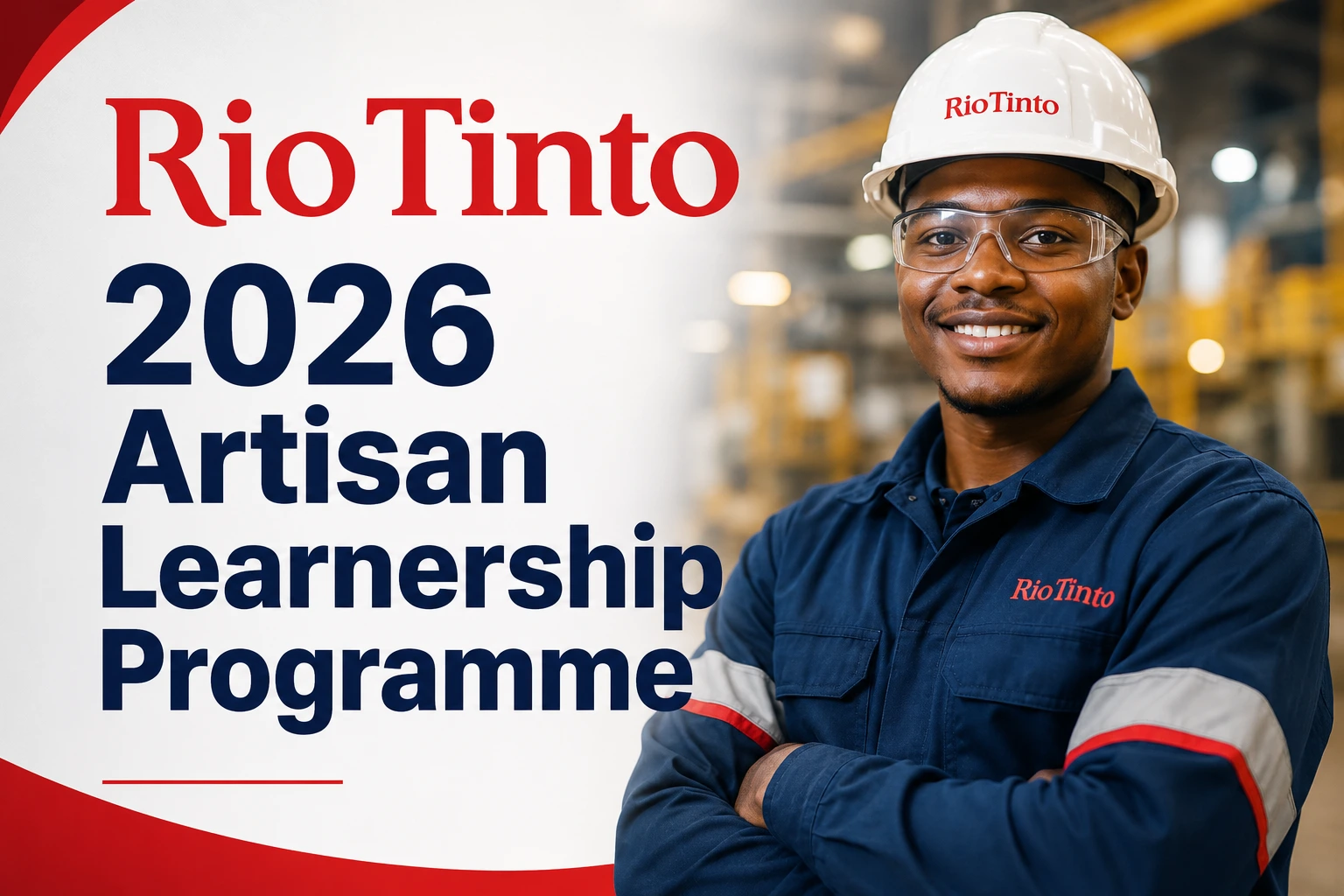
Apply for the Rio Tinto 2026 Artisan Learnership Programme in Richards Bay, KwaZulu-Natal. Learn about requirements, trades offered, closing date, and application details.
On a cold morning in Richards Bay, long before the factories begin humming and trucks line up near industrial routes, many young people in KwaZulu-Natal are already thinking about the same thing: how to secure stable work in an economy where opportunities often feel out of reach. For some, that search leads to short-term jobs. For others, it means enrolling in courses with no guarantee of employment afterward.
But every year, a small number of structured technical training programmes stand out because they offer something more practical — a pathway into scarce and respected trades that continue to power South Africa’s industrial economy. The Rio Tinto 2026 Artisan Learnership Programme is one of those opportunities.
The programme, based in Richards Bay, is aimed at unemployed young South Africans who want to build careers in technical and engineering-related trades. More importantly, it arrives at a time when South Africa continues to face a shortage of qualified artisans across sectors such as mining, manufacturing, maintenance, and infrastructure development.
For many applicants, this is not simply another learnership advert. It represents a chance to enter industries where technical skills still carry long-term value.
Quick Facts About the Rio Tinto 2026 Artisan Learnership Programme
| Details | Information |
|---|---|
| Closing Date | 29 May 2026 |
| Location | Richards Bay, KwaZulu-Natal |
| Reference Number | R57649 |
Why the Rio Tinto 2026 Artisan Learnership Programme Matters
South Africa’s unemployment crisis has created intense competition for entry-level opportunities, especially among young people. Yet while many sectors struggle to absorb new graduates, artisan-related fields continue to show demand for technically trained workers.
Mining companies, manufacturing plants, logistics firms, and engineering contractors all rely heavily on artisans to keep operations running. Electricians, millwrights, mechanical fitters, and diesel mechanics remain essential across industrial environments.
That is partly why programmes like the Rio Tinto 2026 Artisan Learnership Programme attract strong interest. Unlike many classroom-only training initiatives, this programme combines theory, practical instruction, and workplace experience in one structured qualification path.
Successful learners will work toward occupational trade certificates registered on the National Qualifications Framework (NQF), with certification issued through the Quality Council for Trades and Occupations (QCTO).
This is significant because employers increasingly value practical competency alongside academic qualifications.
Trades Included in the Programme
Applicants can pursue training in several technical trades linked to industrial operations and maintenance:
- Diesel Mechanic
- Boiler Maker
- Millwright
- Refractory Mason
- Electrician
- Mechanical Fitter
- Instrumentation
Each of these trades plays a different role within heavy industry and mining operations.
Millwrights, for example, are often responsible for maintaining complex machinery systems, while instrumentation specialists work with automated control systems that are becoming more important in modern industrial environments.
Electricians and diesel mechanics continue to remain among the most employable technical trades nationally, particularly in sectors connected to energy, transport, and mining.
A Programme Designed Around Workplace Skills
One reason artisan learnerships continue to hold value is that they are closely connected to actual industry requirements.
In South Africa, many employers have raised concerns about graduates leaving institutions without sufficient practical exposure. Occupationally directed qualifications attempt to address this gap by integrating hands-on workplace learning directly into the training process.
The Rio Tinto programme follows this approach by combining:
- Theoretical learning
- Practical technical training
- Workplace-based experience
That structure allows learners to develop real-world competencies while gaining exposure to operational environments.
For someone entering the job market without previous industry experience, this type of exposure can become a major advantage later when applying for permanent technical roles.
The Local Impact in Richards Bay and King Cetshwayo District
The learnership is specifically targeted toward applicants whose domicile address falls within the King Cetshwayo District Municipality in KwaZulu-Natal.
That local focus matters.
Richards Bay remains one of South Africa’s major industrial hubs, driven by mining exports, heavy manufacturing, logistics activity, and port operations. Yet surrounding communities continue to experience high youth unemployment despite living close to large industrial operations.
Programmes that prioritize local applicants are often viewed as attempts to strengthen community participation within regional industries.
For young people living in areas surrounding Richards Bay, Empangeni, Esikhawini, and nearby communities, access to technical training linked directly to a global mining company can potentially change long-term career prospects.
Minimum Requirements Applicants Must Meet
The programme is aimed at unemployed South African youth who meet specific academic and administrative requirements.
Applicants must have:
- Grade 12/Matric
- Core Mathematics
- Physical Science or Technical Matric
- A trade-related qualification
- A valid South African driver’s license (minimum Code B)
Candidates must also:
- Not currently be registered on another learnership or apprenticeship funded by a SETA or private organisation
- Reside within King Cetshwayo District Municipality
Rio Tinto has also listed several required supporting documents, including certified copies of qualifications, identification documents, proof of residence, and an affidavit confirming the applicant is not part of another funded learning programme.
Because applications for large learnerships often attract thousands of submissions, incomplete documentation can quickly disqualify candidates during screening stages.
Expert Insight: Why Artisan Careers Are Regaining Importance
Over the past decade, South Africa has seen growing discussions around the importance of vocational and technical skills development.
While university degrees remain valuable, many industries are facing shortages in practical technical fields. Infrastructure projects, energy development, industrial maintenance, and manufacturing all depend on skilled artisans.
Industry analysts have repeatedly pointed out that South Africa’s future economic growth may depend partly on rebuilding technical skills pipelines that weakened over previous years.
What makes artisan careers particularly important today is their adaptability. Qualified artisans are often able to work across multiple industries rather than remaining tied to one sector alone.
A trained electrician or mechanical fitter, for example, may find opportunities in mining, construction, manufacturing, renewable energy, or transport industries.
That flexibility is becoming increasingly important in a changing labour market.
Rio Tinto’s Broader Position in South Africa’s Mining Sector
Rio Tinto is one of the world’s largest mining and materials companies, operating across multiple countries and commodities.
The company has emphasized sustainability, inclusion, and skills development as part of its broader workforce strategy. In South Africa, training programmes linked to large mining companies often serve dual purposes:
- Developing future technical talent
- Supporting community and regional economic participation
The company’s messaging around diversity and inclusion is also notable in this programme. Rio Tinto specifically encourages applications from women, people with disabilities, LGBTQIA+ communities, and individuals from diverse cultural backgrounds.
That reflects a wider shift happening across parts of the mining sector, where historically male-dominated technical environments are gradually becoming more inclusive.
Competition for Learnerships Is Becoming More Intense
One reality applicants should understand is that artisan learnerships at major companies are highly competitive.
South Africa’s youth unemployment rate continues to place enormous pressure on entry-level opportunities. Well-known programmes often receive far more applications than available spaces.
That means applicants should avoid rushing their submissions.
Small mistakes — missing certified documents, incorrect contact details, or incomplete affidavits — can reduce chances before interviews even begin.
Candidates selected for the next stages will also need to complete interviews and assessments before final acceptance into the programme.
Preparation matters.
Applicants who understand the specific trade they are applying for and who can explain their interest in technical careers may stand out more during recruitment stages.
SEE ALSO: Woodlands Dairy Millwright Apprenticeships 2026: Complete Guide for South African Youth
What Makes Artisan Training Different From Other Learnerships?
Many learnerships focus heavily on administrative or customer-service-related roles. Artisan programmes differ because they train candidates for highly specialised technical occupations.
These roles often involve:
- Equipment maintenance
- Fault diagnosis
- Industrial safety procedures
- Engineering systems
- Mechanical or electrical problem-solving
The learning process is usually more demanding physically and technically than standard office-based training programmes.
However, the long-term career value can also be stronger because qualified artisans remain needed in both public and private sectors.
In some cases, experienced artisans eventually move into supervisory, planning, or technical specialist positions after gaining industry experience.
Frequently Asked Questions
Who can apply for the Rio Tinto 2026 Artisan Learnership Programme?
The programme is open to unemployed South African youth who meet the listed academic and residency requirements, including living within the King Cetshwayo District Municipality.
When is the closing date for applications?
Applications close on 29 May 2026.
What qualification will learners receive?
Successful learners who complete the programme will receive a Trade Certificate issued by the Quality Council for Trades and Occupations (QCTO).
Where to Apply
Applications for the Rio Tinto 2026 Artisan Learnership Programme can be submitted through the official Rio Tinto careers platform under reference number R57649.
APPLY HERE: Rio Tinto 2026 Artisan Learnership Programme
Applicants should ensure that all required certified documents are included before submission.
The Bigger Picture Behind Technical Skills Development
Across South Africa, conversations around employment often focus on university education, white-collar careers, and digital industries. Yet beneath those discussions lies another reality: the country still depends heavily on technical workers who keep industrial systems functioning every day.
Factories cannot operate without maintenance teams. Mining operations cannot continue without skilled artisans. Infrastructure projects depend on technical expertise long after construction begins.
That is why programmes like the Rio Tinto 2026 Artisan Learnership Programme continue to matter beyond individual applications.
For some young people in KwaZulu-Natal, this opportunity may become the first step toward stable technical careers in industries that remain central to South Africa’s economy. For employers, it is part of rebuilding a skilled workforce capable of supporting future industrial growth.
And for the broader economy, artisan development remains one of the few areas where training can still connect directly to practical, long-term demand.
About The Author
