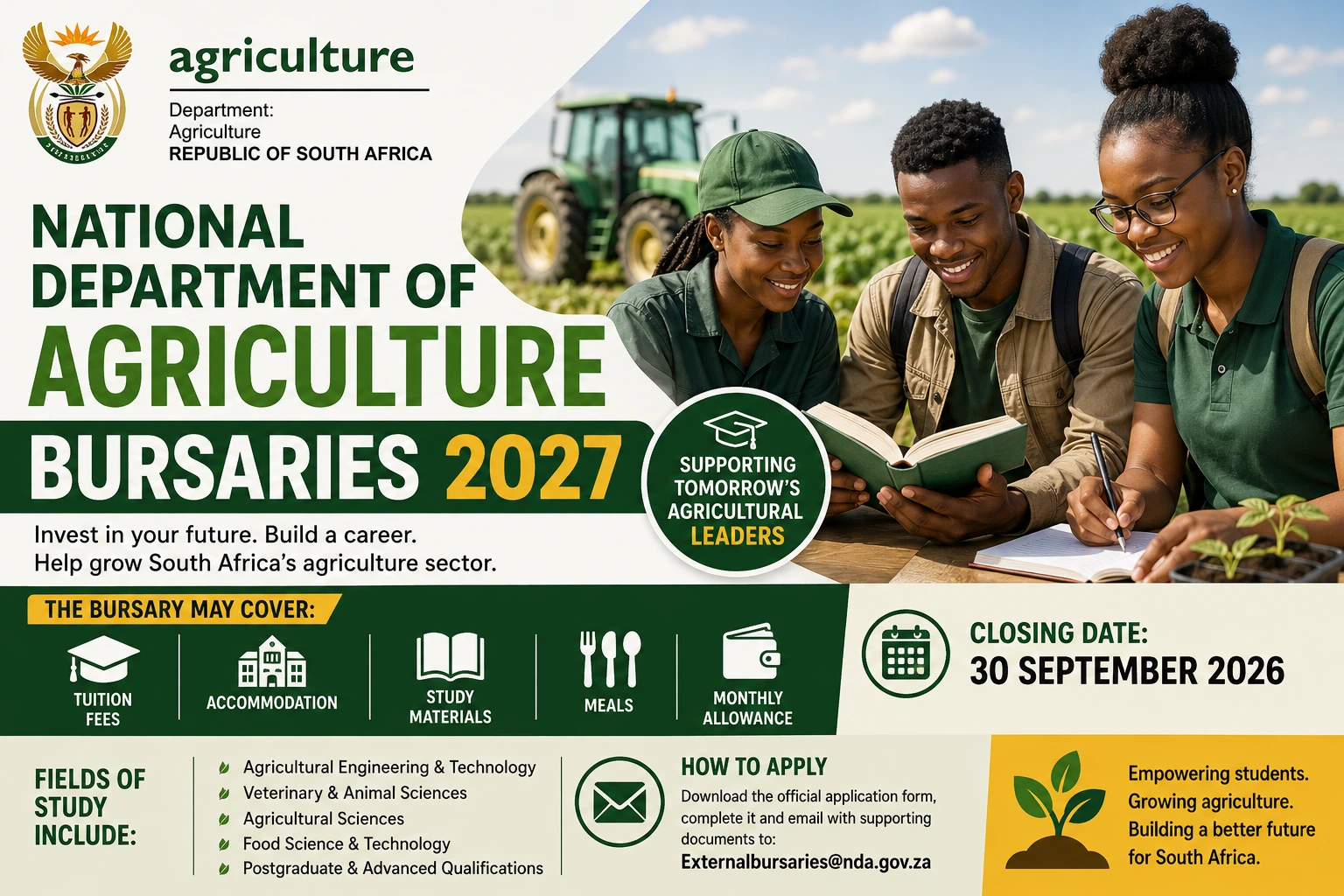
The National Department of Agriculture Bursaries 2027 programme offers financial support to South African students who want to study agriculture-related qualifications at accredited institutions. For many students, especially those from disadvantaged backgrounds, higher education can feel financially impossible. This bursary programme aims to reduce that burden by helping cover important study costs such as tuition, accommodation, meals, and study materials.
Agriculture remains one of the most important sectors in South Africa. It supports food production, rural development, environmental sustainability, and economic growth. As technology and climate challenges continue changing the industry, the country increasingly needs skilled graduates in agricultural science, veterinary studies, food technology, and agricultural engineering.
The National Department of Agriculture Bursaries 2027 programme creates opportunities for students who are passionate about agriculture and want to contribute to the future of food security, sustainability, and innovation in South Africa.
This guide explains everything applicants should know about the bursary, including eligibility requirements, funded qualifications, application steps, required documents, and common mistakes to avoid.
What You Should Know First
The National Department of Agriculture Bursaries 2027 programme supports South African students studying approved agriculture-related qualifications.
Important details include:
- Application closing date: 30 September 2026
- Location: South Africa
- Applications must be submitted by email
- The bursary may cover tuition, accommodation, meals, study materials, and monthly allowances
- Both current students and future university students may apply
- Grade 12 learners awaiting final results may still apply
The programme focuses on fields linked to agriculture, veterinary science, food technology, environmental sustainability, and agricultural engineering.
Students must meet academic requirements specific to their chosen qualification.
Why Agriculture Bursaries Matter in South Africa
Agriculture affects almost every part of daily life. Food production, livestock farming, crop management, water use, and environmental conservation all depend on skilled professionals.
However, studying agriculture-related qualifications can be expensive. Many students struggle with:
- Tuition fees
- Accommodation costs
- Textbooks and study materials
- Transport expenses
- Food and living costs
Bursaries help remove financial barriers so students can focus more on their studies.
The National Department of Agriculture Bursaries 2027 programme is especially important because it supports fields that directly impact South Africa’s economy and food security.
As climate change, droughts, and technological advancements continue affecting agriculture, the country needs qualified professionals who understand modern agricultural systems and sustainability practices.
Understanding the National Department of Agriculture Bursaries 2027 Programme
The bursary programme is designed to support students pursuing approved agriculture-related qualifications at tertiary institutions.
Unlike student loans, bursaries generally do not require repayment if students meet the programme conditions and academic expectations.
The National Department of Agriculture focuses funding on qualifications that help develop critical agricultural skills needed in South Africa.
The programme supports:
- Agricultural engineering
- Food technology
- Veterinary sciences
- Agricultural sciences
- Postgraduate agricultural studies
The goal is to help produce skilled graduates who can contribute to agricultural development, innovation, sustainability, and food production.
Fields of Study Funded by the Bursary
One of the most important parts of the bursary application process is understanding which qualifications qualify for funding.
The National Department of Agriculture Bursaries 2027 programme only supports specific agriculture-related fields.
Agricultural Engineering and Technology
This category focuses on combining engineering principles with agricultural systems.
Funded qualifications include:
- BSc Engineering Agricultural
- Bachelor of Engineering in Agricultural and Biosystems Engineering
- BSc Food Science and Technology
- Diploma in Food Technology
Students in these programmes may study:
- Irrigation systems
- Agricultural machinery
- Food processing
- Water management
- Sustainable farming technology
- Agricultural infrastructure
Agricultural engineering is becoming increasingly important as farming becomes more technology-driven.
Veterinary and Animal Sciences
Animal health is essential for agriculture and food production.
Funded qualifications include:
- Bachelor of Veterinary Nursing
- BHSc Veterinary Technology
- BSc Agricultural Animal Health
Students in these programmes learn about:
- Animal diseases
- Veterinary support
- Livestock management
- Animal nutrition
- Animal welfare
- Disease prevention
These qualifications help support South Africa’s livestock and agricultural industries.
Agricultural Sciences
Agricultural science qualifications focus on understanding plants, soil, crops, insects, and farming systems.
Funded programmes include:
- BSc Agricultural Entomology
- BSc Agricultural Food Science
- BSc Agricultural Plant Pathology
- BSc Agricultural Plant Science
- BSc Agricultural Soil Science
- BSc Agricultural Agronomy
- BSc Agricultural Viticulture and Oenology
These fields play important roles in improving crop production, managing pests, protecting soil quality, and supporting sustainable farming.
For example:
A plant pathology student may study diseases affecting crops and learn how to reduce agricultural losses.
An agronomy student may focus on improving farming methods and crop yields.
Postgraduate and Advanced Qualifications
The bursary also supports advanced agricultural studies.
These include:
- Advanced Diplomas in agriculture-related fields
- BSc Agricultural Honours in Plant Pathology
- BSc Agricultural Honours in Entomology
Postgraduate qualifications help students develop specialized expertise and research skills.
Academic Requirements Explained Simply
Many students become confused by academic level requirements. Understanding these requirements early can help applicants determine whether they qualify.
Engineering-Related Agricultural Qualifications
Applicants must have:
- Mathematics Level 6 (70–79%)
- Physical Science Level 6 (70–79%)
These requirements are higher because engineering programmes involve advanced mathematics and scientific concepts.
Veterinary and Agricultural Science Qualifications
Applicants must have:
- Mathematics Level 5 (60–69%)
- Physical Science Level 5 (60–69%)
These programmes still require strong science skills but may not involve the same level of advanced engineering mathematics.
Food Technology Qualifications
Applicants must have:
- Mathematics Level 4 (50–59%)
- Physical Science Level 4 (50–59%)
Food technology combines science with food production and processing systems.
Advanced Diploma and Honours Programmes
Applicants must already possess a relevant undergraduate qualification.
For example:
A student applying for Agricultural Honours in Plant Pathology would first need a related undergraduate agricultural degree.
Who Can Apply for the National Department of Agriculture Bursaries 2027?
The bursary programme is open to a wide range of South African students.
South African Citizens
Applicants must be South African citizens.
Students should provide certified copies of identification documents as proof.
Current and Future Students
The programme accepts applications from:
- Students already studying approved qualifications
- Grade 12 learners planning tertiary studies
- Students waiting for final matric results
- Students awaiting university acceptance letters
This flexibility helps more students access opportunities even before all documents become available.
Students From Disadvantaged Backgrounds
The bursary particularly aims to support students who need financial assistance to continue their education.
Education costs can prevent talented students from studying agriculture-related fields, and bursaries help address this challenge.
Persons With Disabilities
Persons with disabilities are encouraged to apply.
This supports broader educational inclusion and equal opportunity within the agricultural sector.
What the Bursary May Cover
The National Department of Agriculture Bursaries 2027 programme may cover several important educational expenses.
These include:
- Tuition fees
- Accommodation
- Meals
- Study materials
- Monthly allowance
This support can significantly reduce financial pressure on students and families.
For example:
Instead of worrying constantly about accommodation or textbooks, students can focus more energy on academic performance and practical learning.
Step-by-Step Guide to Applying
Many bursary applications fail because applicants miss important steps. Understanding the process carefully improves the chances of successful submission.
Step 1: Download the Official Application Form
Applicants must first obtain the official Department of Agriculture bursary application form.
Only official forms should be used.
Click here to apply for National Department of Agriculture Bursary Programme 2027.
Step 2: Complete the Form Carefully
Every section should be completed clearly and accurately.
Applicants should avoid:
- Missing signatures
- Incorrect contact details
- Incomplete sections
- Unclear handwriting
Small mistakes can delay or affect applications.
Step 3: Prepare Supporting Documents
Required documents include:
- Certified ID copy
- Latest academic results
- Matric certificate if completed
- Proof of university application or acceptance
- Additional required documents
Applicants should ensure documents are clear and properly certified where required.
Step 4: Submit Before the Deadline
Applications must be submitted before 30 September 2026.
Late applications will not be accepted.
Students should avoid waiting until the last minute because missing documents or email problems can create delays.
Step 5: Send the Application to the Correct Email Address
Completed applications and supporting documents must be emailed to:
Applicants should also keep proof of submission after emailing their documents.
Common Mistakes Applicants Should Avoid
Small mistakes can sometimes cause strong applications to fail.
Submitting Incomplete Documents
Missing documents are one of the most common reasons applications are unsuccessful.
Applicants should double-check everything before submission.
Using Incorrect Academic Information
Students must ensure all marks and qualification details are accurate.
False or inconsistent information may affect credibility.
Applying for Non-Approved Qualifications
Only listed agriculture-related qualifications qualify for funding.
Applications outside approved fields may not be considered.
Waiting Too Long to Apply
Applying early reduces stress and allows time to correct problems if needed.
Common Misunderstandings About National Department of Agriculture Bursaries 2027
Many students misunderstand how government bursaries work.
“Only Top Students Can Apply”
Strong marks help, but the bursary also focuses on supporting students who are passionate about agriculture and meet the minimum requirements.
“You Must Already Be Accepted at University”
Grade 12 learners waiting for final results or acceptance letters may still apply.
Missing documents can be submitted later within the allowed timeframe.
“Agriculture Careers Only Involve Farming”
Modern agriculture includes:
- Engineering
- Biotechnology
- Environmental science
- Food technology
- Veterinary studies
- Research
- Sustainability systems
The industry is far broader and more advanced than many people realize.
“Bursaries Cover Everything Automatically”
Coverage depends on bursary terms and approval conditions.
Students should still manage finances carefully and understand their responsibilities.
See also: Northlink College WIL Internships 2026: A Complete Guide for NCV Graduates
See also: Digby Wells Environmental Bursaries 2027: A Complete Guide for South African Students
Key Takeaways
The National Department of Agriculture Bursaries 2027 programme offers important financial support for South African students studying agriculture-related qualifications.
Key points include:
- Applications close on 30 September 2026
- The bursary supports approved agricultural qualifications
- Funding may cover tuition, accommodation, meals, study materials, and allowances
- Grade 12 learners and current students may apply
- Students must meet subject-specific academic requirements
- Applications must be emailed with all supporting documents
- Persons with disabilities are encouraged to apply
The programme helps develop future agricultural professionals who can contribute to food security, sustainability, and innovation in South Africa.
Frequently Asked Questions
Can Grade 12 learners apply before receiving final results?
Yes. Grade 12 learners waiting for final results or university acceptance letters may still apply. Outstanding documents must later be submitted within the required timeframe.
Does the bursary only support university degrees?
No. The programme also funds diplomas, advanced diplomas, and honours qualifications in approved agriculture-related fields.
What happens if I submit my application late?
Late applications are generally not accepted, so students should apply well before the closing date.
Can students already studying agriculture-related qualifications apply?
Yes. Current students studying approved agricultural programmes may also apply for funding.
Final Thoughts on National Department of Agriculture Bursaries 2027
The National Department of Agriculture Bursaries 2027 programme provides more than financial assistance. It creates opportunities for students to build careers in one of South Africa’s most important sectors.
Agriculture continues evolving through science, sustainability, engineering, and innovation. Skilled graduates are needed to help improve food systems, environmental management, and agricultural productivity across the country.
For students passionate about agriculture and looking for educational support, this bursary may become an important stepping stone toward long-term academic and career success.
About The Author
