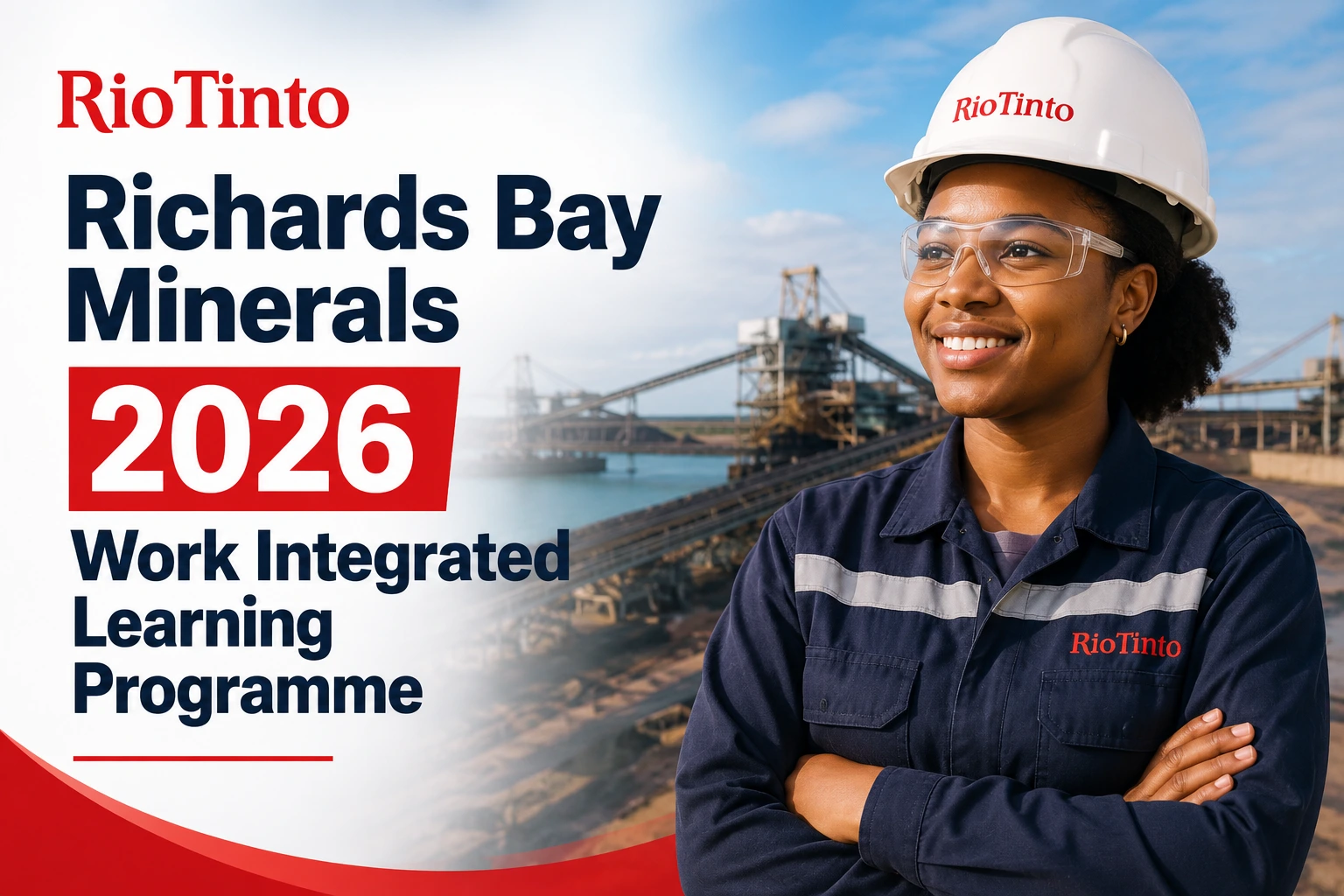
Apply for the Richards Bay Minerals 2026 Work Integrated Learning Programme (P1/P2) in KwaZulu-Natal. Learn about requirements, closing date, and application details.
Just after sunrise in Richards Bay, buses carrying students and workers move steadily through the industrial roads surrounding one of KwaZulu-Natal’s most important mining and processing regions. For many young South Africans studying engineering or technical disciplines, these facilities represent more than large industrial operations. They represent possibility.
Across the country, thousands of students at Universities of Technology are approaching graduation with one major challenge still standing in their way: practical workplace experience. In many diploma programmes, completing P1 and P2 training is not optional. Without it, students cannot graduate, regardless of how well they performed academically.
That reality has made structured workplace programmes increasingly valuable in South Africa’s difficult graduate employment environment. The 2026 Work Integrated Learning Programme at Richards Bay Minerals is one of the opportunities now attracting attention from students hoping to bridge the gap between academic study and industry experience.
Based in Richards Bay and linked to global mining company Rio Tinto, the programme aims to provide practical workplace exposure to qualifying students from Universities of Technology. At a time when employers continue to prioritise experience alongside qualifications, initiatives like this carry growing importance for students trying to enter South Africa’s mining, engineering, and industrial sectors.
Quick Facts About the 2026 Work Integrated Learning Programme
| Details | Information |
|---|---|
| Closing Date | 29 May 2026 |
| Location | Richards Bay, KwaZulu-Natal |
| Reference Number | R57647 |
Why Work Integrated Learning Has Become So Important
In South Africa, one of the biggest frustrations among graduates is the experience barrier. Many students complete their studies only to discover that employers expect practical workplace exposure before offering permanent roles.
For University of Technology students, especially those in engineering and technical fields, Work Integrated Learning programmes help solve that problem by creating structured industry placements linked directly to academic requirements.
The 2026 Work Integrated Learning Programme at Richards Bay Minerals is designed specifically for students who still need P1/P2 practical experience to graduate.
Unlike informal internships that sometimes leave students doing administrative tasks unrelated to their qualifications, workplace-integrated programmes are usually aligned with institutional learning outcomes. That means students gain practical exposure connected to the theories and technical skills learned during their studies.
For many learners, this becomes their first experience inside a large-scale industrial environment.
Inside the Richards Bay Minerals Learning Environment
Richards Bay Minerals operates within one of South Africa’s most strategically important industrial regions. The area combines mining activity, mineral processing, logistics operations, and export infrastructure connected to global markets.
Students accepted into the programme will be placed within this operational environment, where they can observe how industrial systems function beyond textbooks and lecture halls.
The programme includes exposure to both technical and professional competencies, allowing students to experience real workplace expectations, safety procedures, teamwork structures, and operational processes.
That matters because transitioning from academic life into industrial work environments can often be overwhelming for first-time learners.
The structured nature of the programme is intended to ease that transition while helping students build confidence in practical settings.
Fields of Study Eligible for the Programme
Richards Bay Minerals has opened applications to students in:
- Engineering disciplines
- Humanities disciplines
While engineering placements are often the primary focus in industrial learning programmes, the inclusion of humanities-related fields reflects how modern mining and industrial operations increasingly rely on broader professional functions beyond technical maintenance alone.
Large organisations require expertise in areas such as communication, administration, human resources, environmental coordination, training support, and operational planning.
That broader inclusion may create opportunities for students whose qualifications connect indirectly to mining and industrial operations.
The Local Focus Behind the Programme
One important aspect of the programme is its emphasis on local community participation.
Applicants must reside within the King Cetshwayo District Municipality in KwaZulu-Natal. This requirement reflects a wider trend across mining and industrial companies operating near local communities.
In regions where large industrial operations exist alongside high youth unemployment, companies often face pressure to support local economic participation and skills development.
For students from communities surrounding Richards Bay, Empangeni, Esikhawini, and nearby areas, workplace exposure opportunities linked to international companies can provide a critical first step into industries that are otherwise difficult to access.
This local prioritisation also helps reduce some of the financial strain students often face when relocating for workplace training opportunities.
Minimum Requirements Applicants Must Meet
To qualify for the 2026 Work Integrated Learning Programme, applicants must meet several academic and administrative requirements.
Candidates must be:
- Unemployed South African youth
- Final-year students at a University of Technology
- In need of P1/P2 training to graduate
Applicants must also have:
- Grade 12/Matric
- A valid South African driver’s license (minimum Code B)
- No previous P1/P2 or vacation work experience funded by a SETA or company
In addition, applicants must provide a stamped letter from their University of Technology confirming that P1/P2 practical training is required for graduation and must last a minimum of 12 months.
This requirement is particularly important because many programmes only accept students whose institutions formally require workplace experience.
Documentation Could Determine Who Advances
One overlooked reality of large recruitment programmes is that many applicants are screened out before interviews even begin.
Missing certified documents, incomplete applications, or incorrect information often become immediate disqualifiers.
Applicants are expected to submit:
- Curriculum Vitae
- Certified Matric certificate
- Certified university statement of results
- Certified South African ID copy
- Certified driver’s license
- Certified proof of residence
- Official university letter confirming P1/P2 requirement
Given the competitiveness of these programmes, preparation and attention to detail matter significantly.
Students who organise their applications professionally often improve their chances of progressing further in recruitment stages.
The Bigger Problem Facing South African Graduates
The demand for programmes like this highlights a deeper challenge within South Africa’s education and employment system.
Many graduates struggle not because they lack qualifications, but because they lack exposure to workplace environments where technical knowledge is applied practically.
Universities and Universities of Technology continue producing graduates across multiple fields, yet industry absorption remains uneven.
In sectors like mining, engineering, and manufacturing, employers frequently look for candidates who already understand workplace systems, safety procedures, reporting structures, and operational discipline.
That gap between education and employability is exactly where Work Integrated Learning programmes become valuable.
Instead of entering the job market with only classroom knowledge, students gain practical context that employers often prioritise during recruitment.
Expert Insight: Why Industrial Experience Still Matters in 2026
As industries continue adopting automation, digital monitoring systems, and advanced operational technologies, some people assume traditional workplace learning has become less important.
In reality, the opposite may be happening.
Modern industrial environments require workers who can combine technical knowledge with practical problem-solving, communication skills, and operational awareness.
Mining and minerals sectors especially continue evolving toward more technologically integrated systems. Students entering these environments today are expected to adapt quickly to changing processes and multidisciplinary teamwork.
Workplace-integrated programmes therefore serve another purpose beyond graduation requirements: they help learners understand how industries themselves are changing.
That exposure can shape future career direction and improve long-term employability.
Rio Tinto’s Role in Skills Development
Rio Tinto, the global mining and materials company connected to Richards Bay Minerals, operates across dozens of countries and multiple resource sectors.
The company has increasingly positioned itself around sustainability, operational improvement, and workforce development.
Its focus on inclusion and diversity is also reflected in the programme. Rio Tinto has encouraged applications from women, people with disabilities, LGBTQIA+ communities, and individuals from different cultural backgrounds.
This reflects broader changes occurring within mining and industrial sectors globally.
Historically, mining industries were often associated with narrow workforce demographics and limited diversity. But as companies compete for skilled talent and modernise operations, inclusive recruitment has become more central to workforce strategies.
For young South Africans entering these industries, workplace culture is gradually evolving alongside technical expectations.
SEE ALSO: Woodlands Dairy Millwright Apprenticeships 2026: Complete Guide for South African Youth
Why Students Should Not Wait Until the Last Minute
Every year, thousands of students apply for structured work experience programmes across South Africa. Many only begin preparing documents shortly before deadlines close.
That approach creates avoidable problems.
Certified documents may expire, university confirmation letters can take time to obtain, and technical issues sometimes affect online submissions near deadlines.
Because applications for the 2026 Work Integrated Learning Programme close on 29 May 2026, students should ideally begin preparing documentation well in advance.
Applicants selected for further stages will also need to complete interviews and assessments before final acceptance into the programme.
Frequently Asked Questions
Who can apply for the Richards Bay Minerals P1/P2 Programme?
The programme is open to unemployed South African final-year University of Technology students who require P1/P2 workplace training to graduate.
Is previous work experience allowed?
No. Applicants must not have previously completed P1/P2 or vacation work funded by a SETA or company.
Where must applicants live?
Applicants must reside within the King Cetshwayo District Municipality in KwaZulu-Natal.
Where to Apply
Applications for the 2026 Work Integrated Learning Programme (P1/P2) – Richards Bay Minerals can be submitted through the official Rio Tinto careers platform using reference number R57647.
Applicants should ensure all certified supporting documents are included before submission.
A Wider Reflection on Opportunity and Access
For many South African students, the hardest part of education begins after the classroom.
The transition between studying and working remains one of the country’s most difficult career stages, particularly for young people trying to enter technical and industrial sectors. Qualifications alone no longer guarantee opportunity.
That is why structured workplace learning programmes continue to matter.
The 2026 Work Integrated Learning Programme at Richards Bay Minerals represents more than practical training hours required for graduation. For some students, it may become the first real introduction to industries capable of shaping long-term careers.
It also reflects a larger truth about South Africa’s economy: meaningful skills development still depends heavily on partnerships between education institutions and industries willing to invest in workplace learning.
As competition for graduate opportunities continues growing, programmes that combine education with real operational experience may become even more important in the years ahead.
About The Author
