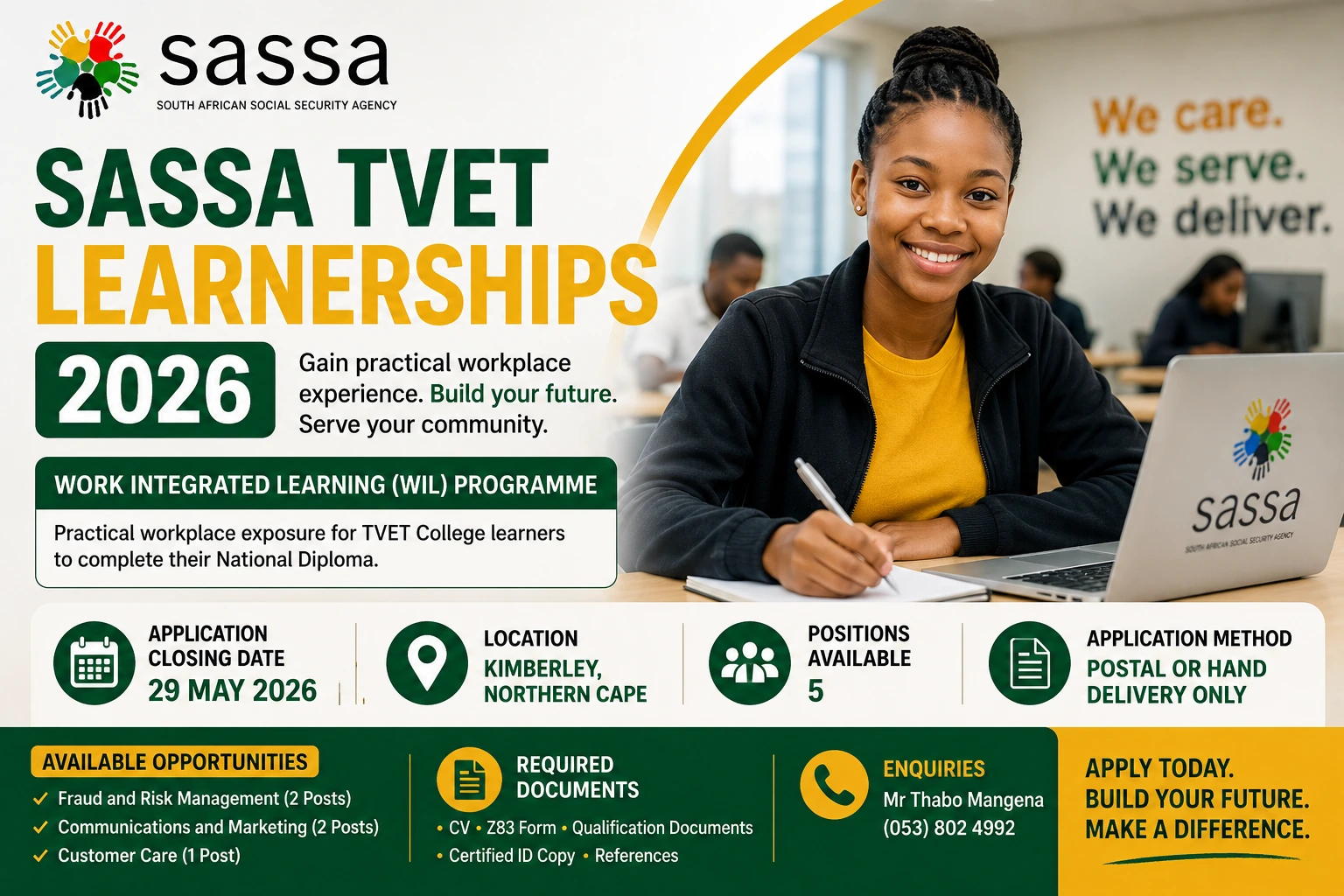
The South African Social Security Agency has officially opened applications for the SASSA TVET Learnerships 2026 programme, giving Technical and Vocational Education and Training (TVET) College learners an opportunity to gain practical workplace experience through its Work Integrated Learning (WIL) Programme.
For many South African students, completing an N6 qualification is only one step toward earning a National Diploma. Workplace exposure is often required before graduates can fully qualify. This is where the SASSA WIL Programme becomes valuable. It helps learners bridge the gap between classroom theory and real-world professional experience.
The programme is based in Kimberley, Northern Cape, and provides learners with hands-on exposure to government administration, customer service, communication systems, and risk management operations.
If you are a TVET learner searching for public sector workplace training opportunities, understanding how the SASSA TVET Learnerships 2026 programme works can improve your chances of submitting a strong application.
What You Should Know First
The SASSA TVET Learnerships 2026 programme is a Work Integrated Learning (WIL) opportunity for TVET College learners who need practical workplace experience to complete their qualifications.
Here are the most important details:
- Application closing date: 29 May 2026
- Location: Kimberley, Northern Cape
- Number of positions available: 5
- Application method:
- Postal applications
- Hand-delivered applications only
- Faxed applications will not be accepted
- Applicants must have completed N6 theoretical studies
The programme gives learners exposure to real government workplace systems and professional public service environments.
Understanding the SASSA TVET Learnerships 2026 Programme
The SASSA Work Integrated Learning Programme is designed to help TVET learners gain practical experience aligned with their studies.
In South Africa, many TVET qualifications require students to complete workplace training before they can receive a National Diploma. This practical component allows learners to apply classroom knowledge in a real work environment.
The SASSA TVET Learnerships 2026 programme focuses on helping learners develop:
- Workplace communication skills
- Administrative abilities
- Public sector knowledge
- Customer service experience
- Risk management understanding
- Professional confidence
Unlike ordinary academic learning, WIL programmes expose learners to the daily operations of professional institutions.
This experience can become extremely valuable when applying for future jobs because employers often prefer candidates who already understand workplace procedures.
Why Work Integrated Learning Matters for TVET Learners
Many students underestimate how important practical exposure is in today’s job market.
Employers frequently look for candidates who can demonstrate both theoretical understanding and workplace readiness.
Practical Experience Builds Confidence
A classroom environment is very different from a professional workplace.
During WIL programmes, learners experience:
- Office communication
- Team collaboration
- Workplace reporting
- Time management
- Professional conduct
These experiences help students become more confident in professional settings.
Public Sector Exposure Creates Career Opportunities
Government institutions like South African Social Security Agency provide insight into how public administration works in South Africa.
Learners gain exposure to:
- Government procedures
- Administrative systems
- Service delivery operations
- Compliance processes
- Public communication systems
This knowledge can improve future employability in both government and private sector careers.
Workplace Learning Supports National Diploma Completion
For many TVET programmes, workplace exposure is mandatory before learners can qualify for their National Diploma.
Without practical training, students may struggle to complete qualification requirements.
The SASSA TVET Learnerships 2026 programme helps learners meet this important requirement while gaining valuable experience.
Available WIL Opportunities
The programme includes several learning areas connected to administration, communication, and public service.
Each placement is designed to align with specific N6 qualifications.
Fraud and Risk Management Opportunities
Reference Number: SAS NC26/05/04
Number of Posts: 2
Required qualifications include:
- Risk Management
- Internal Audit
- Policing
Applicants must hold:
- N6 National Certificate
- Or Statement of Results
What Learners May Experience
Learners in this placement may gain exposure to:
- Compliance monitoring
- Risk assessment procedures
- Administrative investigations
- Fraud prevention systems
- Reporting processes
Risk management is important in government institutions because it helps protect public resources and maintain accountability.
Communications and Marketing Opportunities
Reference Number: SAS NC26/05/05
Number of Posts: 2
Required qualifications include:
- Public Relations
- Media Studies
Applicants must have:
- N6 National Certificate
- Or Statement of Results
Skills Learners Can Develop
Communication and marketing placements may involve:
- Public communication
- Administrative support
- Customer engagement
- Media-related tasks
- Internal communication systems
Strong communication skills are valuable in almost every professional environment.
Customer Care Opportunity
Reference Number: SAS NC26/05/06
Number of Posts: 1
Required qualifications include:
- Public Management
- Public Administration
Applicants must hold:
- N6 National Certificate
- Or Statement of Results
Why Customer Care Experience Matters
Customer care is a major part of public service delivery.
Learners may gain experience in:
- Assisting members of the public
- Administrative support
- Service delivery procedures
- Problem-solving
- Communication systems
Public administration professionals often work closely with communities and government systems.
Step-by-Step Guide to Applying Successfully
Many applicants lose opportunities because they fail to follow instructions carefully.
Understanding the process step-by-step can improve your chances significantly.
Step 1: Prepare the Required Documents
Applicants must submit several important documents.
These include:
- Updated CV
- New Z83 Application Form
- Qualification documents or statement of results
- Certified copy of ID
- References with contact details
Missing documents may result in disqualification.
Find more information here: sassa
Step 2: Ensure Your CV Includes All Required Information
The programme specifically states that your CV must clearly indicate:
- Qualifications
- Institution attended
- Work experience
- Duties performed
- Employment dates
- Identity number
- Race and gender
- References
Many applicants forget important information, which can weaken their applications.
Step 3: Choose the Correct Application Method
Unlike many online applications, this programme only accepts:
- Postal applications
- Hand-delivered applications
No faxed applications will be considered.
This means applicants should prepare their documents carefully and submit them early.
Step 4: Submit Before the Closing Date
Late applications will not be accepted.
Waiting until the last minute can create problems such as:
- Courier delays
- Transport issues
- Missing paperwork
- Administrative mistakes
Submitting early reduces unnecessary risk.
Skills Learners Can Gain Through the Programme
The SASSA TVET Learnerships 2026 programme focuses heavily on workplace development.
Learners may gain several valuable skills during the programme.
Administrative Skills
Government offices rely on accurate documentation and organized systems.
Learners may gain experience with:
- Filing systems
- Record management
- Administrative procedures
- Professional reporting
Administrative abilities are transferable to many industries.
Professional Communication
Communication is essential in every workplace.
Learners may improve their ability to:
- Write professional emails
- Interact with clients
- Answer workplace queries
- Handle public communication
These skills remain useful throughout a career.
Customer Service Experience
Customer service exposure helps learners understand public needs and service delivery expectations.
This may include:
- Assisting clients
- Managing enquiries
- Problem resolution
- Professional interaction
Strong customer service experience can improve employability significantly.
Teamwork and Workplace Collaboration
Modern workplaces depend heavily on teamwork.
Learners often develop:
- Collaboration skills
- Time management
- Accountability
- Workplace discipline
These professional habits are highly valued by employers.
Common Application Mistakes to Avoid
Many applicants are rejected because of avoidable errors.
Understanding these common mistakes can improve your chances.
Incomplete Applications
Missing documents are one of the biggest reasons applications fail.
Always double-check that all required paperwork is included.
Incorrect CV Information
Some applicants forget to include:
- Identity numbers
- Employment dates
- References
- Qualification details
Carefully reviewing your CV before submission is important.
Ignoring Submission Instructions
The programme specifically states that applications must be submitted through:
- Postal delivery
- Hand delivery
Sending applications through other methods may lead to disqualification.
Poor Document Presentation
Untidy or difficult-to-read applications create a negative impression.
Your documents should be:
- Clear
- Organized
- Professional
- Easy to read
First impressions matter during recruitment.
Common Misunderstandings About SASSA TVET Learnerships 2026
There are several misconceptions about government workplace learning programmes.
“Learnerships and WIL Programmes Are the Same”
Although similar, WIL programmes focus specifically on workplace exposure required for qualification completion.
Some learnerships include formal employment contracts and additional training structures.
“Only Top Academic Students Are Selected”
While academic performance matters, departments also value:
- Professionalism
- Correct applications
- Communication skills
- Motivation
- Attention to detail
A strong, complete application can improve your chances significantly.
“Public Sector Experience Is Not Valuable”
Government workplace experience can strengthen a CV considerably.
Many employers value candidates who understand:
- Administration systems
- Public communication
- Compliance procedures
- Professional office operations
“Applications Can Be Submitted Online”
This programme clearly requires postal or hand-delivered applications only.
Ignoring this instruction could result in automatic disqualification.
How to Improve Your Chances of Being Selected
Competition for workplace learning opportunities can be high.
Here are practical ways to strengthen your application.
Prepare a Professional CV
Your CV should be:
- Well-structured
- Error-free
- Updated
- Relevant to the opportunity
Even limited volunteer experience can strengthen your application.
Follow Instructions Carefully
Government programmes often reject incomplete or incorrect submissions immediately.
Pay close attention to:
- Required documents
- Submission methods
- Reference numbers
- Application deadlines
See also: Northlink College WIL Internships 2026: A Complete Guide for NCV Graduates
See also: Digby Wells Environmental Bursaries 2027: A Complete Guide for South African Students
Submit Your Application Early
Early submissions help avoid unexpected problems such as transport delays or missing documents.
They also show professionalism and preparation.
Highlight Relevant Skills
Even if you lack formal work experience, you can still mention:
- Leadership roles
- Group projects
- Volunteer activities
- Communication skills
- Computer skills
These experiences can strengthen your application.
Frequently Asked Questions
Who can apply for the SASSA TVET Learnerships 2026 programme?
The programme is open to TVET College learners who have completed N6 theoretical studies and require workplace experience to complete their qualifications.
Where is the programme located?
The programme takes place in Kimberley, Northern Cape, at the SASSA Regional Office.
Can applications be emailed?
No. Applications must be submitted through postal delivery or hand delivery only.
What documents are required?
Applicants must submit:
Updated CV
Z83 form
Qualification documents
Certified ID copy
References with contact details
Key Takeaways
- The SASSA TVET Learnerships 2026 programme provides workplace exposure for TVET learners.
- The programme is based in Kimberley, Northern Cape.
- Learners can gain experience in risk management, communication, and customer care.
- Applicants must have completed N6 theoretical studies.
- Applications must be submitted through postal or hand delivery only.
- Strong applications require complete documents and careful attention to instructions.
Final Summary
The SASSA TVET Learnerships 2026 programme offers valuable workplace learning opportunities for TVET College learners who need practical experience to complete their qualifications. Through exposure to government systems, communication processes, customer service operations, and administration, learners can develop important professional skills that improve future employability.
For many students, this programme may become an important first step toward long-term career growth in the public or private sector. Careful preparation, complete documentation, and early submission can greatly improve the chances of being selected.
About The Author
