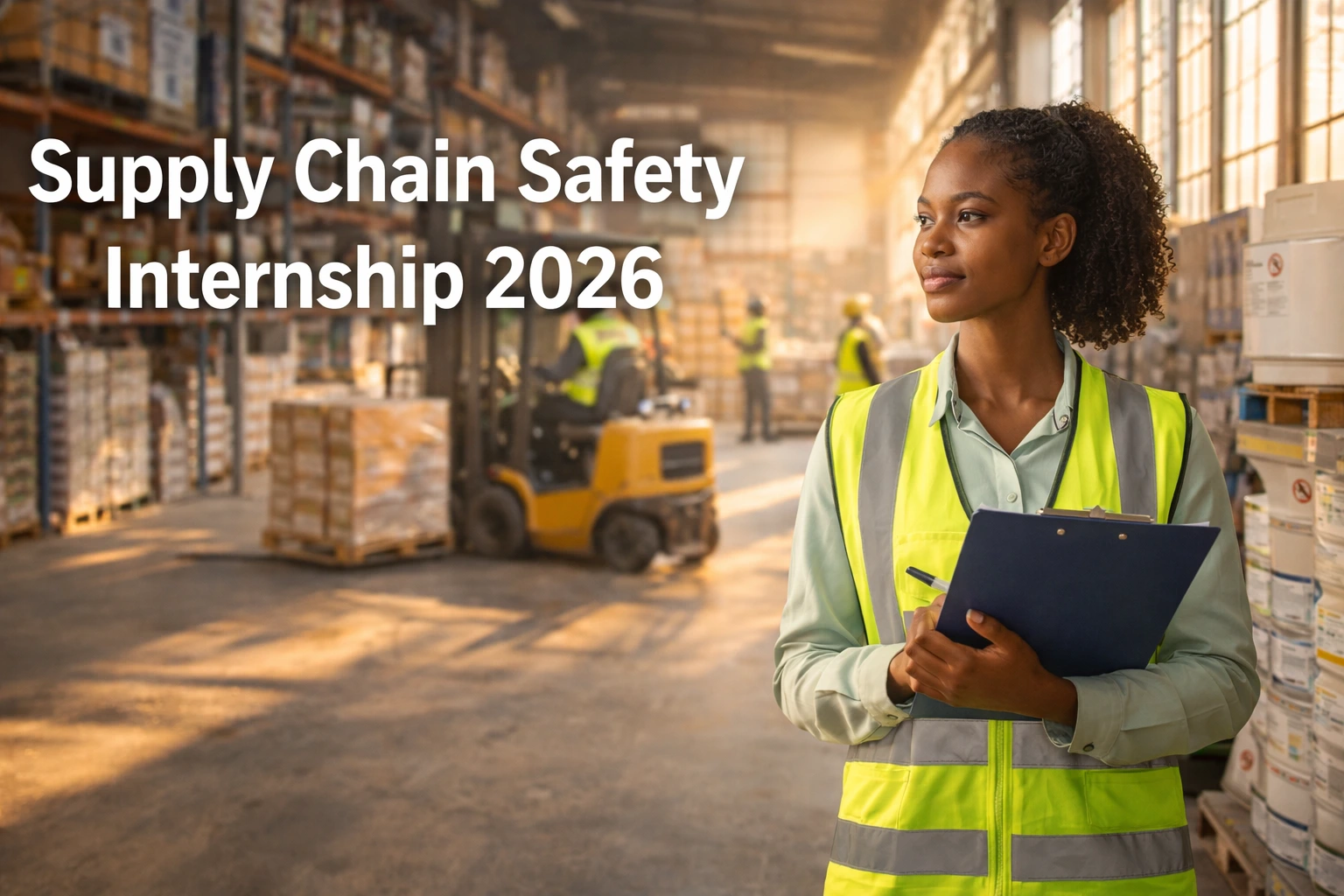
Explore the Supply Chain Safety Internship at Corteva Agriscience 2026 in Kempton Park. Learn about requirements, safety training exposure, and career benefits.
On a busy weekday morning in Kempton Park’s industrial zone, forklifts move steadily between loading bays while workers scan inventory against digital manifests. Amid the organised rhythm of supply chain activity, a new intern stands beside a warehouse supervisor, observing closely. Her job today is not to move stock or manage logistics schedules. Instead, she is looking for something less visible but far more critical — potential safety risks.
This is the reality facing participants in the Supply Chain Safety Internship: Corteva Agriscience 2026, a programme that reflects how modern workplaces are placing greater emphasis on proactive safety culture and environmental responsibility.
Offered by global agricultural science company Corteva Agriscience, the internship is based in Kempton Park, Gauteng. It introduces interns to the intersection between supply chain operations and SHE coordination — safety, health, and environmental compliance — within a warehouse environment that supports agricultural production across regions.
A ground-level view of safety in motion
For many graduates and early-career professionals, safety management may appear abstract when studied in lecture halls. Policies, regulations, and compliance frameworks often feel disconnected from real-world scenarios.
Inside an active supply chain facility, however, safety becomes tangible.
Interns in this programme learn how daily operations — from chemical storage to equipment movement — can present risks if not carefully monitored. In South Africa’s agricultural sector, where logistics networks support everything from seed distribution to crop protection products, safety oversight is essential to prevent incidents that could affect workers, communities, and the environment.
The internship therefore offers more than observation. Participants actively contribute to risk assessments, safety audits, and workplace training processes designed to maintain a zero-harm environment.
Understanding warehouse dynamics beyond logistics
Supply chains are frequently discussed in terms of efficiency, speed, and cost reduction. Yet behind these metrics lies a complex human ecosystem where compliance with occupational health and safety regulations can determine whether operations run smoothly or face costly disruptions.
Reporting directly to a warehouse supervisor, interns gain exposure to how standard operating procedures shape behaviour across teams. This includes ensuring contractors follow site-specific safety requirements, monitoring adherence to protective equipment guidelines, and reviewing documentation linked to hazard management.
In a country like South Africa, where regulatory enforcement around workplace safety has intensified in recent years, such experience carries significant professional value. Companies across industries — from manufacturing to mining — increasingly seek individuals who can help embed safety thinking into everyday operational decisions.
Why agricultural supply chains require specialised safety skills
Agricultural businesses operate within environments that present unique challenges.
Chemical handling risks, temperature-sensitive storage conditions, and seasonal demand fluctuations can create pressure points in logistics systems. Interns at Corteva are therefore introduced to root cause investigation techniques such as the “5 Whys” methodology or fishbone diagram analysis.
These tools enable safety teams to move beyond reactive incident reporting and instead identify systemic weaknesses. For example, a minor warehouse injury might reveal deeper issues related to workflow design or communication breakdowns between departments.
By participating in such investigations, interns gain a practical understanding of how continuous improvement processes enhance both safety performance and organisational resilience.
A short look at key responsibilities
While the internship offers broad exposure, certain tasks form the foundation of the experience:
- Assisting with safety training sessions and induction programmes for new employees
- Supporting risk assessments to identify hazards before incidents occur
- Participating in compliance checks linked to Occupational Health and Safety standards
- Helping update safety documentation, work instructions, and SOP frameworks
These responsibilities allow interns to develop confidence in applying theoretical knowledge within dynamic operational contexts.
The role of Lean principles in workplace protection
Another defining aspect of the programme is its emphasis on Lean manufacturing concepts, particularly the 5S framework — Sort, Set in Order, Shine, Standardise, Sustain.
While originally developed to improve efficiency, Lean principles have proven highly effective in enhancing workplace safety. Cluttered aisles, poorly organised storage areas, or inconsistent labelling systems often contribute to accidents that could otherwise be prevented.
By learning how to implement 5S initiatives, interns begin to recognise the relationship between organisational discipline and human wellbeing. This perspective is increasingly relevant as companies strive to balance productivity targets with responsible labour practices.
Expert insight: Why safety careers are gaining strategic importance
From an industry perspective, internships focused on supply chain safety signal a broader shift in corporate priorities.
As global supply networks become more interconnected, disruptions caused by workplace incidents can ripple across markets. Investors, regulators, and consumers now expect companies to demonstrate accountability not only for financial performance but also for environmental and social outcomes.
Safety professionals therefore play a crucial strategic role. They contribute to risk mitigation, protect organisational reputation, and help organisations comply with evolving regulatory frameworks.
For interns entering this field, early exposure to international safety standards and continuous improvement cultures can significantly influence long-term career prospects.
Meeting the programme requirements
Applicants interested in the Supply Chain Safety Internship at Corteva must hold a Grade 12 certificate alongside a recognised Environmental, Health and Safety qualification.
Knowledge of occupational hygiene and completion of a SAMTRAC course are considered essential foundations for success in the role. These qualifications indicate that candidates understand core safety principles and can engage meaningfully in risk management activities.
Technical skills also matter. Proficiency in tools such as Microsoft Excel, Word, and Outlook supports effective reporting and communication within cross-functional teams.
Although not mandatory, a valid driver’s licence and familiarity with continuous improvement methodologies can strengthen an application — particularly in logistics-focused environments where mobility and adaptability are valuable assets.
Global exposure within a local context
One of the programme’s most compelling aspects is the opportunity to work within a multinational organisation that operates research and development facilities worldwide.
For South African interns, this exposure offers insight into how global agricultural companies navigate regional challenges while maintaining consistent operational standards. It also highlights the importance of cultural intelligence and collaboration across geographically dispersed teams.
At a time when many young professionals are seeking meaningful career paths, internships that combine local relevance with international perspective can serve as powerful stepping stones.
Navigating the application process
Applications for the 2026 intake are handled through Corteva’s digital recruitment platform.
Candidates are encouraged to align their CVs carefully with programme expectations. Highlighting safety certifications, training experience, or participation in continuous improvement initiatives can demonstrate readiness for the role.
Submitting applications early may also improve visibility during initial screening stages, particularly as competitive internships often attract large applicant pools shortly after posting.
Ultimately, the recruitment process reflects a performance-driven corporate culture that values initiative, curiosity, and collaboration.
APPLY HERE: Supply Chain Safety Internship
ALSO APPLY FOR: Munich Re Life Claims Graduate Learnership 2026: A Real Stable Path Into Insurance Careers
Frequently Asked Questions
What type of contract does the internship offer?
The programme is structured as a fixed-term internship within the warehouse and SHE department.
Is prior workplace experience required?
Not necessarily. However, relevant training in occupational health and safety significantly strengthens an application.
Can the internship lead to permanent employment?
While not guaranteed, internships often provide valuable exposure and networking opportunities that can support future job prospects.
Conclusion: Safety as a foundation for sustainable growth
The Supply Chain Safety Internship: Corteva Agriscience 2026 reflects a growing recognition that workplace protection is not merely a compliance requirement but a cornerstone of responsible business practice.
In fast-moving supply chain environments, where efficiency pressures can overshadow human considerations, safety professionals help maintain balance. They ensure that productivity gains do not come at the expense of employee wellbeing or environmental stewardship. Supply Chain Safety Internship.
For aspiring interns, the programme offers more than technical training. It provides an opportunity to develop critical thinking, resilience, and a systems-level understanding of how organisations function.
As South Africa continues to navigate economic transformation and industrial modernisation, roles focused on safety and sustainability are likely to become increasingly significant.
In this context, stepping into a warehouse with a fresh perspective and a commitment to continuous improvement may represent the beginning of a career that shapes not only operational outcomes but the broader future of work. 🌱
About The Author
