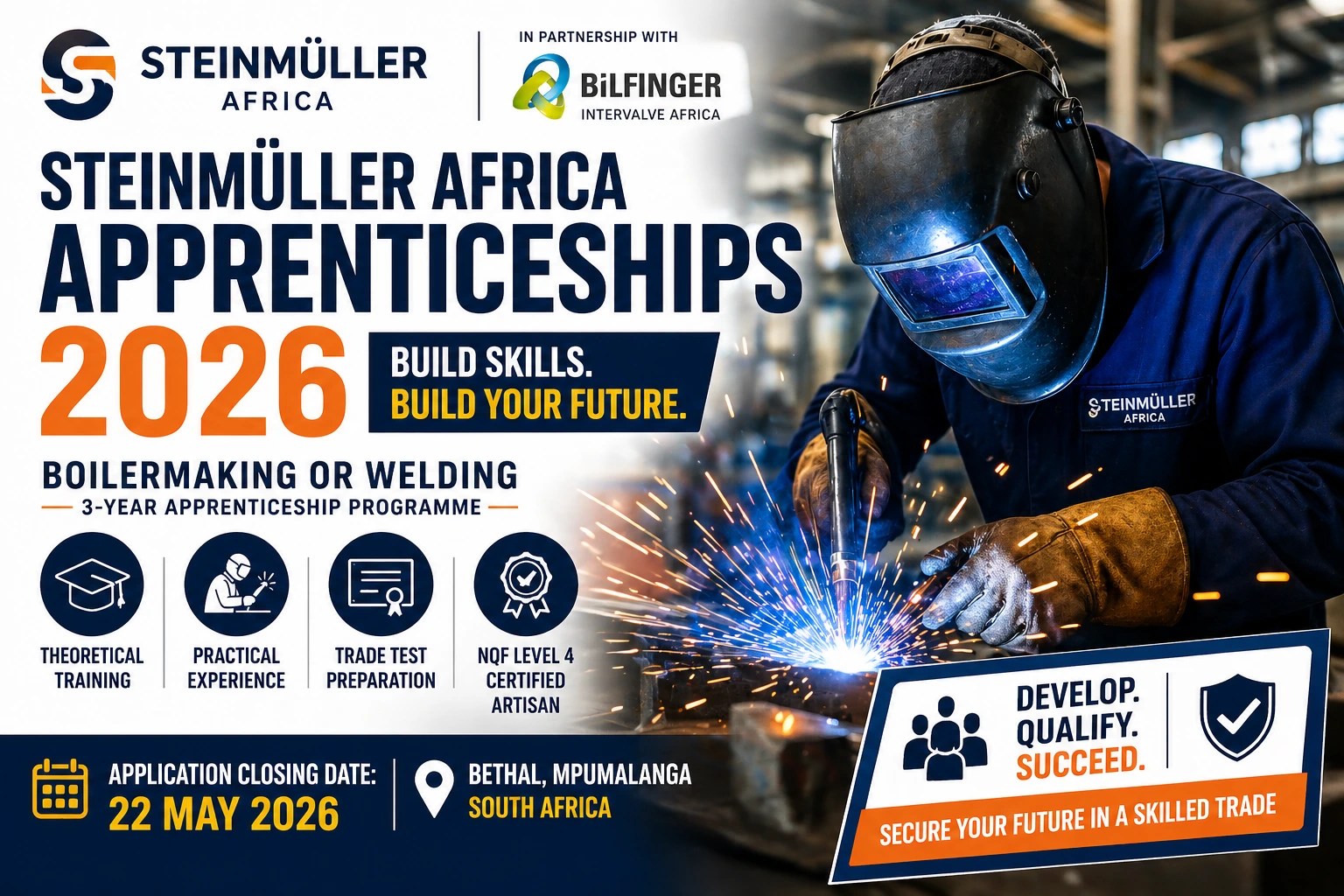
The Steinmüller Africa Apprenticeships 2026 offer a powerful opportunity for South African youth to gain practical skills, earn industry-recognised qualifications, and build a long-term career in engineering trades.
If you’re interested in becoming a boilermaker or welder, this programme provides structured training that combines classroom learning with real workplace experience. In a country where skilled artisans are in high demand, opportunities like this can open the door to stable employment and career growth.
In this guide, you’ll learn everything you need to know about the apprenticeship—from eligibility requirements to application tips—so you can apply with confidence.
What You Should Know First
The Steinmüller Africa Apprenticeships 2026 are a 3-year structured training programme designed to help unemployed youth qualify as certified artisans.
The programme focuses on boilermaking and welding, combining theory, practical training, and workplace experience. By the end, successful candidates can achieve an NQF Level 4 artisan qualification, which is widely recognised in South Africa.
Understanding the Steinmüller Africa Apprenticeship Programme
The apprenticeship is offered by Steinmüller Africa in partnership with Bilfinger Intervalve Africa.
Why This Programme Matters
South Africa faces a shortage of skilled technical workers. Programmes like this aim to:
- Develop qualified artisans
- Provide hands-on industry experience
- Improve employment opportunities for youth
The training is linked to real industry needs, especially in energy and infrastructure sectors.
Where the Programme Takes Place
The apprenticeship is based near Kriel Power Station, with training activities in Bethal, Mpumalanga.
Why Location Matters
Being close to an operational power station means:
- Exposure to real industrial environments
- Practical learning opportunities
- Experience with large-scale engineering systems
However, applicants must either live nearby or be willing to relocate.
Fields of Training: Boilermaking and Welding
The Steinmüller Africa Apprenticeships 2026 focus on two key artisan trades.
1. Boilermaking
Boilermakers work with heavy metal structures such as:
- Boilers
- Tanks
- Pressure vessels
Example of Tasks
- Reading engineering drawings
- Cutting and shaping metal
- Assembling large structures
2. Welding
Welders join metal parts using specialized techniques.
Example of Skills Learned
- Arc welding
- MIG and TIG welding
- Safety procedures
- Equipment handling
Both fields are highly technical and require precision, making them valuable in industries like construction, mining, and energy.
Programme Structure (Step-by-Step)
The apprenticeship runs for a minimum of 36 months (3 years) and follows a structured learning path.
Step 1: Theoretical Training
You’ll complete modules accredited by merSETA.
These modules cover:
- Engineering theory
- Safety standards
- Technical knowledge
Step 2: Practical Training
You’ll apply what you’ve learned in real-world environments.
Examples include:
- Working on actual equipment
- Assisting in production tasks
- Learning under supervision
Step 3: Workplace Experience
You’ll gain on-the-job exposure by:
- Supporting production teams
- Completing assigned tasks
- Working with mentors
Step 4: Trade Test
At the end of the programme, you’ll complete a trade test.
Passing this test means you become a:
- Certified Artisan (NQF Level 4)
This qualification is highly respected and improves your chances of employment.
Key Responsibilities During the Apprenticeship
Participants are expected to:
- Complete all training modules
- Participate actively in practical work
- Follow instructions from mentors
- Assist with site duties
- Maintain discipline and safety standards
This is not just a learning programme—it’s also a professional work environment.
Eligibility Requirements Explained
To apply for the Steinmüller Africa Apprenticeships 2026, you must meet strict criteria.
Academic Requirements
- Grade 12 with Mathematics (not Mathematical Literacy)
- Physical Science
OR
- N2 qualification with relevant subjects
Advantage
Having N2 subjects like Engineering Science or Platers Theory improves your chances.
Personal Requirements
- Age 35 years or younger
- Physically and medically fit
- Clear criminal record
Location Requirement
- Must live within 50 km of Kriel Power Station
- Or be willing to relocate to Bethal
Employment Equity Requirement
The programme is open to Employment Equity (EE) candidates, supporting inclusive workforce development.
Required Documents (Checklist)
Make sure you prepare these documents before applying:
- Updated CV
- Certified Grade 12 certificate
- N2 certificate (if applicable)
- South African ID
- Proof of residence (mandatory)
Missing documents can result in immediate disqualification.
Important Notes You Should Not Ignore
- No accommodation is provided
- No transport is provided
- You will not be asked to pay for the application
If anyone asks for payment, it is likely a scam.
Application Process for Steinmüller Africa Apprenticeships 2026
Applying is simple but requires attention to detail.
Steps to Apply
- Ensure you meet all requirements
- Prepare your documents
- Complete the online application
- Submit before the deadline
Click here to apply for the Steinmüller Africa Apprenticeships 2026
Deadline
- 22 May 2026
Late applications are usually not considered.
Why Apprenticeships Are a Smart Career Choice
Many students overlook apprenticeships, but they offer major advantages.
Key Benefits
- Earn while you learn
- Gain real work experience
- Develop in-demand skills
- Avoid large student debt
Long-Term Opportunities
Qualified artisans can:
- Work in large companies
- Start their own businesses
- Work internationally
In many cases, skilled trades offer faster career growth than traditional academic paths.
Common Misunderstandings About Steinmüller Africa Apprenticeships 2026
1. “Apprenticeships are for people who didn’t do well in school”
This is false. Apprenticeships require strong technical understanding, especially in Mathematics and Science.
2. “You don’t need qualifications”
You must meet strict academic requirements, including Maths and Physical Science.
3. “It’s just manual labor”
These careers involve advanced technical skills, problem-solving, and precision work.
4. “There’s no career growth”
Many artisans progress into supervisory roles, engineering support, or business ownership.
see also: Old Mutual Actuarial Science Bursary 2026: A Complete Guide for South African Students
see also: SAICA Thuthuka Bursary 2027: A Complete Guide for South African Students
Tips to Increase Your Chances of Selection
Be prepared
Have all documents ready and certified.
Be accurate
Ensure your application details are correct.
Highlight relevant subjects
Show strong performance in Maths and Science.
Show commitment
Employers look for candidates who are serious about long-term careers.
Key Takeaways
- The Steinmüller Africa Apprenticeships 2026 offer 3-year artisan training
- Focus areas include boilermaking and welding
- Training combines theory, practical work, and workplace experience
- Successful candidates qualify as NQF Level 4 artisans
- Applicants must meet academic, physical, and location requirements
- Deadline for applications is 22 May 2026
- No fees are required to apply
Frequently Asked Questions (FAQs)
1. Can I apply without Physical Science?
No. Physical Science is required unless you have a relevant N2 qualification.
2. Will I get paid during the apprenticeship?
Most apprenticeships include a stipend, but details may vary depending on the programme.
3. Can I apply if I live far from Kriel Power Station?
You must either live within 50 km or be willing to relocate to Bethal.
4. What happens after I complete the programme?
You can qualify as a certified artisan and apply for jobs in industries like energy, construction, and manufacturing.
Final Thoughts
The Steinmüller Africa Apprenticeships 2026 are more than just a training programme—they’re a pathway into a stable and rewarding career. With the right preparation and commitment, you can gain valuable skills that are in demand across multiple industries.
If you’re serious about building a future in engineering trades, this opportunity is worth pursuing. Start preparing your documents, meet the requirements, and apply before the deadline to give yourself the best chance of success.
Ready to publish.
About The Author
