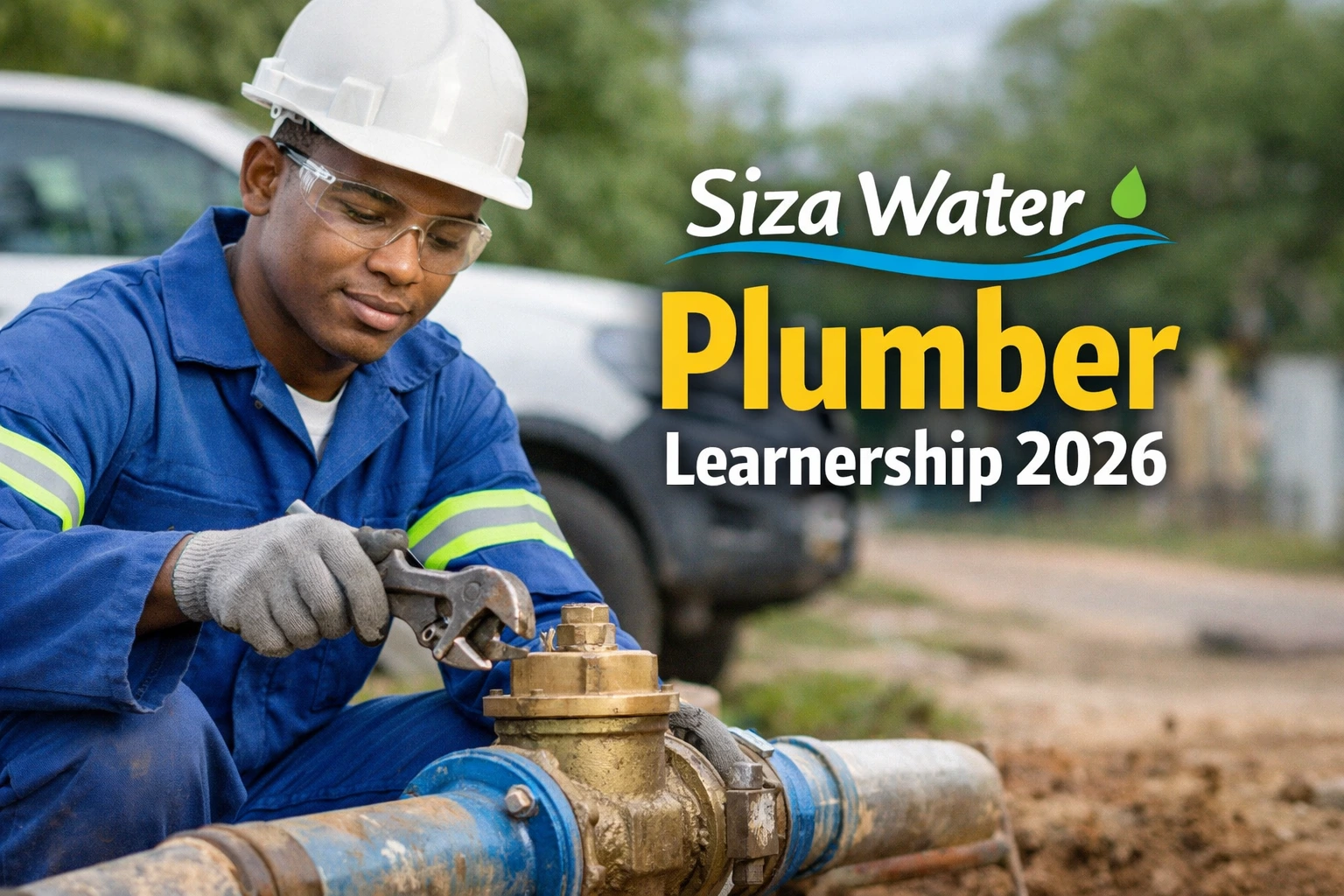
The Siza Water Plumber Learnership 2026 offers hands-on training in water infrastructure. Learn requirements, how to apply, and why it matters now.
The sun hasn’t fully risen over Ballito yet, but a municipal utility vehicle is already parked beside a quiet stretch of road. Two technicians are bent over an open manhole, listening carefully for the faint hiss of a leak beneath the surface. A young trainee stands nearby, notebook in hand, watching every move. It’s not glamorous work. But it’s essential.
This is the kind of environment the Siza Water Plumber Learnership 2026 prepares you for — real-world, hands-on, and deeply connected to how communities function every day.
At a time when South Africa is grappling with water losses, aging infrastructure, and skills shortages, opportunities like this are more than just learnerships. They are entry points into a system that quite literally keeps towns alive.
Quick Facts: Siza Water Plumber Learnership 2026
- Closing Date: 23 April 2026
- Location: Ballito / Dolphin Coast, KwaZulu-Natal
- Duration: Not explicitly stated (typically 12–18 months for artisan learnerships)
- Positions Available: 2
- Reference Number: NET/02/2026
- Stipend: Not specified
A Learnership Rooted in Real Infrastructure
Unlike many entry-level programmes that keep learners confined to classrooms or offices, the Siza Water Plumber Learnership 2026 places participants directly into the field. This is where valves are turned, leaks are detected, and systems are maintained under real pressure.
Siza Water operates one of the most advanced water systems in the country, particularly within the Ilembe District. Their role as a concessionaire means they don’t just maintain infrastructure — they manage it with performance standards that often exceed public-sector norms.
For a young person trying to break into technical work, this distinction matters.
You’re not just learning how to fix pipes. You’re learning how a modern water network functions — from diagnostics to response times, from safety protocols to long-term sustainability.
Who This Opportunity Is Really For
On paper, the requirements are straightforward: Matric, a valid Code 8 driver’s license, and a willingness to work outdoors. But in reality, the learnership demands a particular mindset.
This is for someone who doesn’t mind getting their hands dirty. Someone who can follow instructions precisely but also stay alert when things don’t go according to plan. Someone who understands that technical work is as much about discipline as it is about skill.
There’s also a strong local component. Preference is given to residents within Siza Water’s service areas — places like Shakashead, Nkobongo, and Salt Rock. This isn’t just a logistical decision. It reflects a broader shift toward community-based skills development, where local talent is trained to maintain local infrastructure.
In a country where unemployment remains high, especially among youth, this approach carries real weight.
Why the Driver’s License Requirement Matters More Than You Think
At first glance, the requirement for a Code 8 driver’s license might seem like a minor detail. In reality, it’s a defining feature of the programme.
Water infrastructure doesn’t sit in one place. Teams move constantly — from residential leaks to industrial faults, from planned maintenance to emergency repairs. Being able to drive isn’t just convenient; it’s operationally necessary.
It also signals something deeper: this is not a passive learning environment. You are expected to be mobile, responsive, and part of an active service network.
For many applicants, this requirement becomes the deciding factor. Those who meet it immediately stand out.
The Artisan Pathway: More Than Just a Learnership
There’s a long-term trajectory embedded in the Siza Water Plumber Learnership 2026. It’s not always stated explicitly, but it’s there.
This programme can serve as the first step toward becoming a qualified artisan — potentially leading to a Red Seal certification. That qualification is recognized across South Africa and opens doors in construction, municipal services, and private industry.
In a labour market flooded with general qualifications but short on technical skills, artisans are increasingly valuable. Plumbers, in particular, play a critical role in water conservation, sanitation, and infrastructure resilience.
What starts as a learnership can evolve into a stable, recession-resistant career.
The “Local Technical” CV Strategy That Could Make the Difference
Siza Water has made it clear: applications should be concise, focused, and relevant. A two-page CV is not a suggestion — it’s an expectation.
But beyond length, there’s a strategic angle many applicants overlook.
Your CV should reflect two things clearly:
- Your connection to the local area
- Your technical interest or exposure
This isn’t the place for generic statements. It’s the place to show that you understand the environment you’re applying to work in.
For example, mentioning that you’ve assisted in local construction projects or that you’ve handled basic tools already adds weight to your application. Even informal experience counts — as long as it’s presented clearly.
What You’ll Actually Learn on the Job
While the official description highlights pipeline maintenance and leak detection, the learning experience goes deeper.
You’ll likely be exposed to:
- Reading and interpreting technical drawings
- Using diagnostic tools for underground systems
- Understanding pressure systems and flow dynamics
- Applying safety standards in high-risk environments
These are not skills you pick up casually. They require repetition, observation, and guidance — all of which this programme is designed to provide.
Expert Insight: Why Water Infrastructure Skills Are Becoming Critical
South Africa loses a significant portion of its treated water through leaks and inefficiencies. In some municipalities, losses exceed 40%. This isn’t just a technical issue — it’s an economic and environmental one.
Training programmes like the Siza Water Plumber Learnership 2026 address a key gap: the shortage of skilled technicians who can maintain and repair infrastructure effectively.
As climate variability increases and water resources become more strained, the demand for these skills will only grow. In this context, a plumbing learnership is no longer just a trade opportunity — it’s part of a national resilience strategy.
Required Documents Checklist
To avoid disqualification, make sure your application includes:
- A concise CV (maximum 2 pages)
- Certified copy of your ID
- Certified Matric certificate
- Copy of your Code 8 driver’s license
- Proof of residence (e.g., letter from a ward councillor)
Missing even one of these can result in your application being overlooked.
SEE ALSO: Bidvest Protea Coin Security Learnerships 2026: Complete Guide for South African Youth
Where to Apply
Siza Water provides two application methods:
Online Application:
Visit the official Siza Water vacancy portal and upload your documents under the Plumber Learnership listing.
Hand Delivery:
Submit your application in person at:
Siza Water Head Office
Reypark House (Rey’s Place)
Ballito, KwaZulu-Natal
APPLY ONLINE HERE: Siza Water Plumber Learnership 2026
Hand delivery can sometimes give applicants an edge, especially when documentation needs to be verified quickly.
Why This Learnership Matters Right Now
Timing matters. And right now, South Africa is at a point where infrastructure development and maintenance are becoming urgent priorities.
Water shortages, service delivery challenges, and urban expansion are all putting pressure on existing systems. At the same time, there’s a growing recognition that technical skills — not just academic qualifications — are essential to solving these problems.
The Siza Water Plumber Learnership 2026 sits at the intersection of these realities. It offers young people a way in, while also strengthening the systems communities depend on.
FAQ: Siza Water Plumber Learnership 2026
1. Do I need prior plumbing experience to apply?
No, prior experience is not mandatory. However, any exposure to construction or manual work can strengthen your application.
2. Is the learnership paid?
A stipend is typically offered in learnership programmes, but the exact amount has not been specified in this case.
3. Can I apply if I don’t live in the Dolphin Coast area?
You can apply, but preference is given to residents within Siza Water’s service areas. Proof of residence is important.
A Closing Reflection: Small Opportunities, Big Impact
Standing next to a leaking pipeline at dawn might not seem like the start of something significant. But in many ways, it is.
Every repaired leak saves water. Every maintained system supports a community. And every trained artisan adds to a workforce that South Africa urgently needs.
The Siza Water Plumber Learnership 2026 is not a flashy opportunity. It doesn’t promise instant success or easy money. What it offers is something more durable: a skill, a pathway, and a chance to be part of something that matters.
With the deadline set for 23 April 2026, the window to apply is narrow. But for those who are ready — practically, mentally, and locally — it could be the beginning of a career built on real work and real impact.
About The Author
