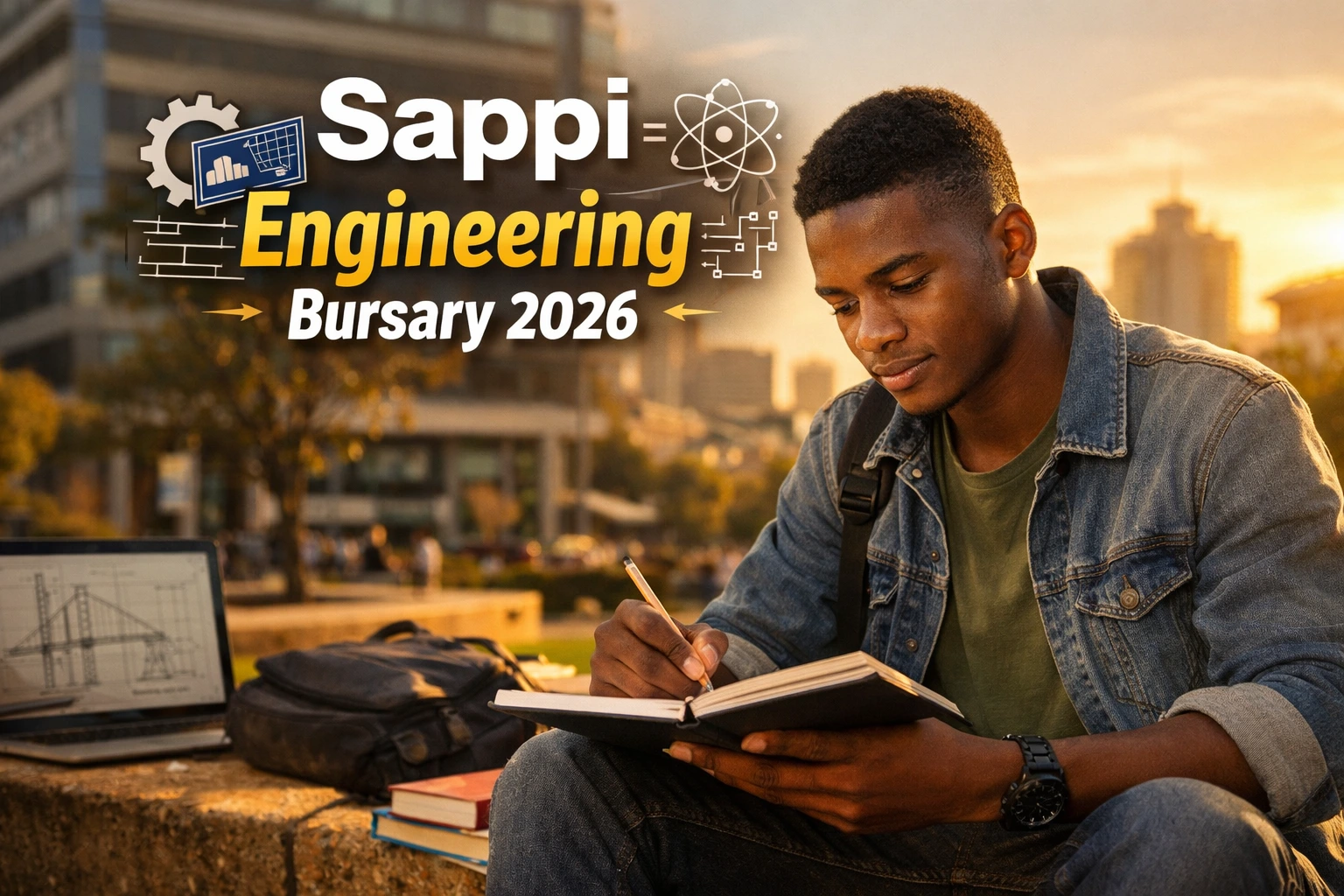
Discover how the Sappi Engineering Bursary 2026 supports South African students with funding, training, and career pathways in engineering fields.
Sappi Engineering Bursary 2026: A Pathway from Classroom Dreams to Real Industry Experience
On a quiet afternoon in Rosebank, a Grade 12 learner scrolls through opportunities on a borrowed smartphone. The pressure is familiar — final exams looming, university acceptance uncertain, and finances a constant worry. Engineering has always been the dream, sparked by a fascination with how things work, from power stations to paper mills. But dreams, in South Africa, often come with a price tag.
Then something stands out: the Sappi Engineering Bursary.
It’s not just another funding option. For many students, it represents a rare bridge between academic ambition and real-world industry access — a chance to move from theory into practice, from uncertainty into structured opportunity.
Why the Sappi Engineering Bursary Matters Right Now
South Africa continues to face a critical shortage of skilled engineers, particularly in sectors tied to infrastructure, energy, and manufacturing. At the same time, thousands of capable students are locked out of higher education due to financial constraints.
The Sappi Engineering Bursary arrives at this intersection — not as a quick fix, but as part of a broader ecosystem aimed at building long-term capacity.
Unlike many bursaries that simply cover tuition, this one goes further. It acknowledges that student success is influenced by multiple factors: housing, textbooks, and even daily living expenses. By addressing these, it removes barriers that often derail promising careers before they begin.
And in a country where inequality still shapes educational outcomes, targeted support like this has ripple effects — not just for individuals, but for communities.
What the Sappi Engineering Bursary Covers
For students considering engineering or forestry science, financial support is often the biggest hurdle. The Sappi bursary attempts to remove that barrier in a comprehensive way.
Depending on household income, the bursary may include:
- Tuition fees
- Prescribed textbooks
- Accommodation
- A living allowance
This structure matters. Many bursaries only cover tuition, leaving students to juggle part-time work or debt to survive. Here, the intention is different — to allow students to focus fully on their studies.
But perhaps more importantly, the bursary is not just about funding. It’s about integration into industry.
Recipients gain access to vacation work during July and December. These periods aren’t just internships in name — they offer exposure to real engineering environments, bridging the gap between classroom theory and industrial practice.
Engineering Fields Supported by the Sappi Engineering Bursary
One of the strengths of the Sappi Engineering Bursary is its breadth. It doesn’t limit students to a narrow specialization but instead reflects the diverse needs of South Africa’s industrial landscape.
Supported fields include:
- Chemical Engineering
- Civil Engineering
- Electrical Engineering
- Forestry and Wood Science
- Industrial Engineering
- Mechanical Engineering
- Mechatronics Engineering
This range signals something important: the future of engineering in South Africa is interconnected. From sustainable forestry to automated systems, the industries of tomorrow require multidisciplinary thinking.
For students, this means flexibility — the ability to pursue a path aligned with both personal interests and market demand.
Who Qualifies — And Why the Criteria Matter
At first glance, the eligibility requirements for the Sappi Engineering Bursary may seem strict. But each criterion reflects a deeper intention.
Applicants must:
- Be South African citizens aged 17–25
- Be in Matric or have completed it
- Achieve at least 70% in Mathematics and Physical Science
- Achieve at least 60% in English
- Plan to study full-time at a recognized university
There is also a clear preference: students from communities near Sappi operations.
This is not arbitrary. It reflects a localized development strategy — investing in talent within communities that are directly connected to Sappi’s operations. In practice, this creates a cycle where education feeds into employment, and employment feeds back into community growth.
Still, the academic thresholds are significant. They highlight a broader truth: while funding is essential, preparedness matters just as much. The bursary is not just about access — it’s about ensuring students can thrive once they get there.
From Bursary to Career: The Engineer-in-Training Pipeline
One of the most compelling aspects of the Sappi Engineering Bursary is what happens after graduation.
Successful students may enter the Sappi Engineer-in-Training programme — a structured pathway into professional engineering roles.
This transition is critical. In South Africa, many graduates struggle not because they lack qualifications, but because they lack experience. The gap between graduation and employment can stretch into years.
By linking bursary support to a training programme, Sappi effectively shortens that gap.
It creates continuity:
- Study
- Practical exposure
- Structured workplace training
- Potential long-term employment
For students, this isn’t just funding — it’s a roadmap.
Expert Insight: Why Industry-Linked Bursaries Are Changing the Game
Industry-linked bursaries like the Sappi Engineering Bursary are quietly reshaping how talent development works in South Africa.
Traditionally, education and employment have operated in silos. Universities produce graduates, and companies later absorb them — often after long delays. But this model has limitations, especially in a fast-changing economy.
By integrating funding with practical exposure and post-study pathways, companies are essentially co-creating their future workforce.
The implications are significant:
- Students graduate with relevant, hands-on experience
- Employers reduce onboarding and training costs
- Skills shortages are addressed more strategically
In the long run, this model may prove more sustainable than traditional bursaries that stop at graduation.
Quick Facts: Sappi Engineering Bursary 2026
- Closing Date: 30 September 2026
- Location: Rosebank, Gauteng, South Africa
- Fields Covered: Multiple engineering disciplines and forestry science
- Stipend: Included (based on financial need)
Where to Apply
APPLY HERE: Sappi Engineering Bursary 2026
ALSO APPLY FOR: Fine Music Radio Bursaries 2026: Full Guide for Music Students in South Africa
Frequently Asked Questions
1. Can I apply if I am currently in Matric?
Yes. Students who are currently in Matric can apply using their Grade 11 results, provided they meet the academic requirements.
2. Does the bursary guarantee a job after graduation?
Not automatically, but successful completion can lead to entry into the Engineer-in-Training programme, which significantly improves employment prospects.
3. What happens if my marks drop after applying?
Final acceptance may depend on maintaining the required academic performance, so consistent results are important.
The Bigger Picture: Opportunity Beyond Funding
The story of the Sappi Engineering Bursary is not just about financial aid. It’s about access — to education, to experience, and ultimately, to opportunity.
For many South African students, the journey into engineering is not limited by talent, but by circumstance. Programmes like Sappi Engineering Bursary 2026 begin to shift that reality, offering a structured path where there was once uncertainty.
But the impact goes beyond individual success. Each funded student represents potential progress — new infrastructure, improved systems, stronger industries.
And somewhere, perhaps in a small township or a busy urban classroom, another learner is scrolling through opportunities, wondering if engineering is within reach.
For some, this bursary might be the answer that turns possibility into something real.
About The Author
