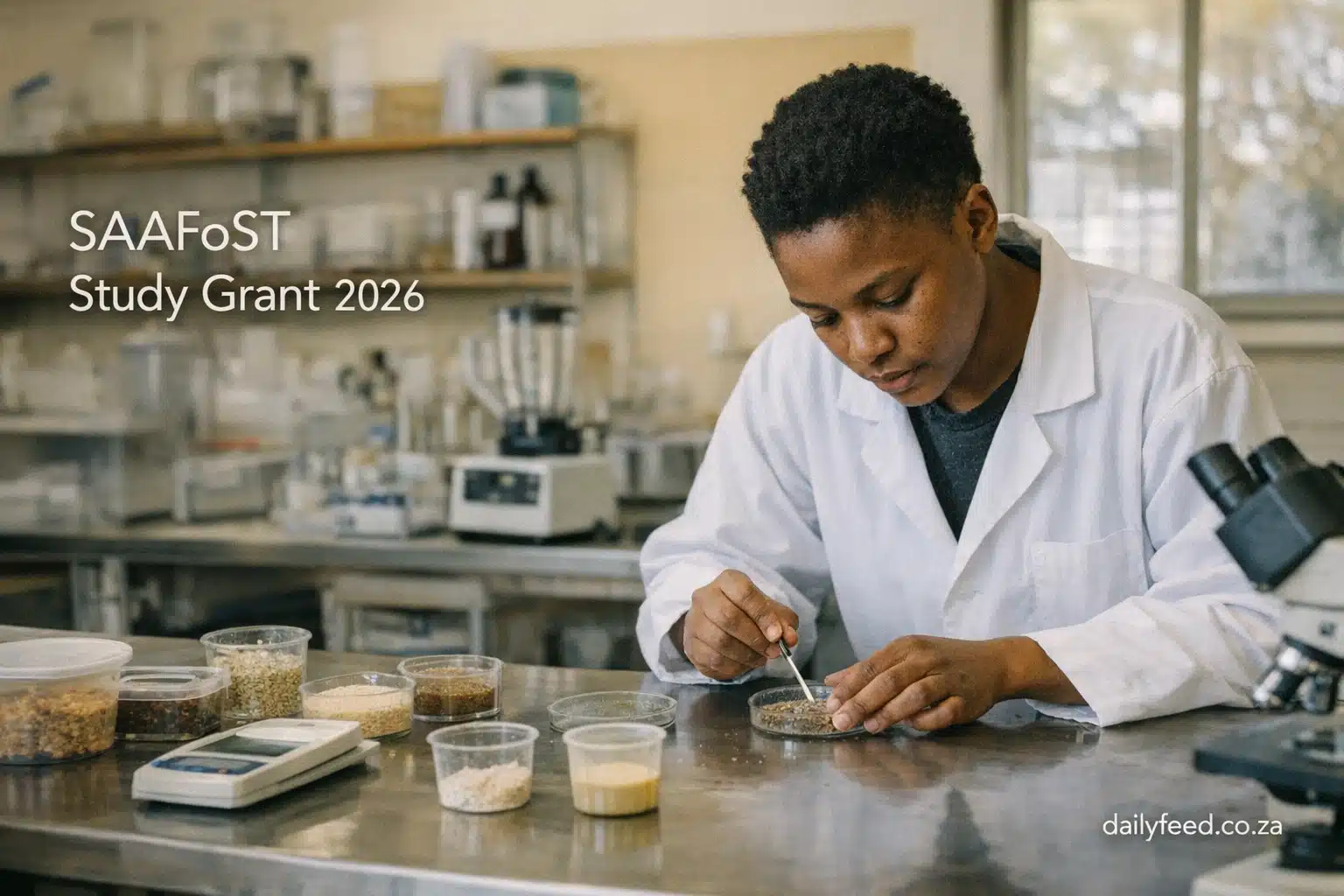
A steady, merit-based grant for honours and BTech students who are already building a future in food science
If you’re studying Food Science or Food Technology in South Africa and already doing well academically, funding can feel frustratingly out of reach — especially at postgraduate level. Many grants are competitive, poorly explained, or only open to a narrow group of students.
The SAAFoST Aubrey Parsons Study Grant for 2026 is different. It’s modest, focused, and designed specifically for students who are already part of the food science academic community — and applications close 27 February 2026, which means now is the time to understand whether it applies to you.
This guide breaks down what the grant is, who it’s really for, and how the nomination process actually works in practice.
What the SAAFoST Aubrey Parsons Study Grant Is (and What It Isn’t)
The South African Association for Food Science and Technology (SAAFoST) is a long-standing professional body representing food scientists, technologists, and researchers across Southern Africa. Through the SAAFoST Foundation, the organisation supports academic development via targeted bursaries and study grants.
The Aubrey Parsons Study Grant is one of those initiatives.
It offers a once-off award of R20,000 to a single postgraduate student per institution, paid directly to the university or university of technology to assist with tuition fees.
What’s important to understand upfront is that this is not a full bursary and not a needs-blind award. It’s intended to recognise strong academic performance, combined with commitment to the field and involvement in SAAFoST.
That focus makes it especially relevant for students who may not qualify for large national funding schemes but still need meaningful financial support.
USEFUL LINKS
Fields of Study and Institutions Covered
The grant is only open to students registered in specific departments at selected South African institutions. This keeps the selection process focused and ensures that nominees are directly aligned with the food science profession.
Eligible study paths include:
Food Science (BSc Honours) at:
- University of Stellenbosch
- University of Pretoria
- University of Venda
- University of the Free State
Food Technology (BTech) at:
- Cape Peninsula University of Technology (CPUT)
- Durban University of Technology (DUT)
- Tshwane University of Technology (TUT)
- University of Johannesburg (UJ)
If you’re studying outside these departments or institutions, this particular grant unfortunately won’t apply — even if your field is closely related.
Who Is Actually Eligible (and Why Many Students Miss Out)
On paper, the eligibility requirements are straightforward. In practice, they trip up a lot of otherwise strong students.
To be considered, you must:
- Be a registered SAAFoST member for at least 12 months before applying
- Be studying full-time at one of the approved institutions
- Be registered for BSc (Hons) or BTech studies only
- Have a minimum overall academic average of 70%
- Show consistent academic performance across previous years
The SAAFoST membership requirement is the most commonly overlooked condition. If you joined recently — even if everything else is perfect — you won’t qualify for 2026.
This requirement exists to reward long-term engagement with the profession, not last-minute applications.
How the Application Process Really Works
Unlike most bursaries, students cannot apply directly for the SAAFoST Aubrey Parsons Study Grant.
Instead, the process works like this:
- Department Heads nominate candidates they believe are deserving
- Each institution may nominate only one student
- The nomination is based on academic merit and financial need
- The SAAFoST Foundation reviews all nominations and makes the final decision
If you’re interested, your first step is not filling out forms — it’s speaking to your Head of Department early and expressing interest clearly and professionally.
Once nominated, the department submits the official nomination form (PDF or DOCX), along with supporting documents, to SAAFoST.
Required documents include:
- Proof of SAAFoST membership
- Proof of full-time registration
- Full academic record
Incomplete submissions are not considered.
FIND MORE INFORMATION: Bursaries – SAAFoST
What the Grant Covers and How It’s Paid
The grant is valued at R20,000 per student, regardless of the length of the qualification. It is not renewable and cannot be split.
Payment is made directly to the institution, not to the student, and is typically allocated toward tuition fees.
While the amount won’t cover all postgraduate costs, it can make a real difference — especially when combined with other funding or personal resources.
Important Dates and Contact Details
- Closing date: 27 February 2026
- Submission method: Email (by the institution only)
- Email address: irene@saafost.org.za
- Email subject: SAAFoST Aubrey Parsons Study Grant Application
Contact details:
SAAFoST Membership Development Officer
📞 071 870 2633
📧 irene@saafost.org.za
If the closing date has passed, SAAFoST asks that students do not contact them and instead look for other open opportunities.
ALSO APPLY FOR: BBD Bursary South Africa 2026: A Real Path into Software Development
ALSO APPLY FOR: Tongaat Hulett Graduate Internships 2026: A Practical Step for Graduates Ready to Work
Frequently Asked Questions
Can I apply directly as a student?
No. Only approved tertiary institutions may submit applications.
Is this a full bursary?
No. It’s a once-off study grant of R20,000.
Do I need to be a SAAFoST member?
Yes — for at least 12 months before applying.
How many students are selected each year?
One student per participating institution.
Can I use the grant for living expenses?
No. Payment is made directly to the institution for fees.
Final Thoughts
The SAAFoST Aubrey Parsons Study Grant South Africa 2026 isn’t flashy, and it won’t fund an entire degree — but that’s also its strength. It’s targeted, transparent, and designed for students who are already committed to food science as a profession.
If you meet the requirements and act early, it’s one of the more realistic postgraduate funding opportunities available in this space.
About The Author
