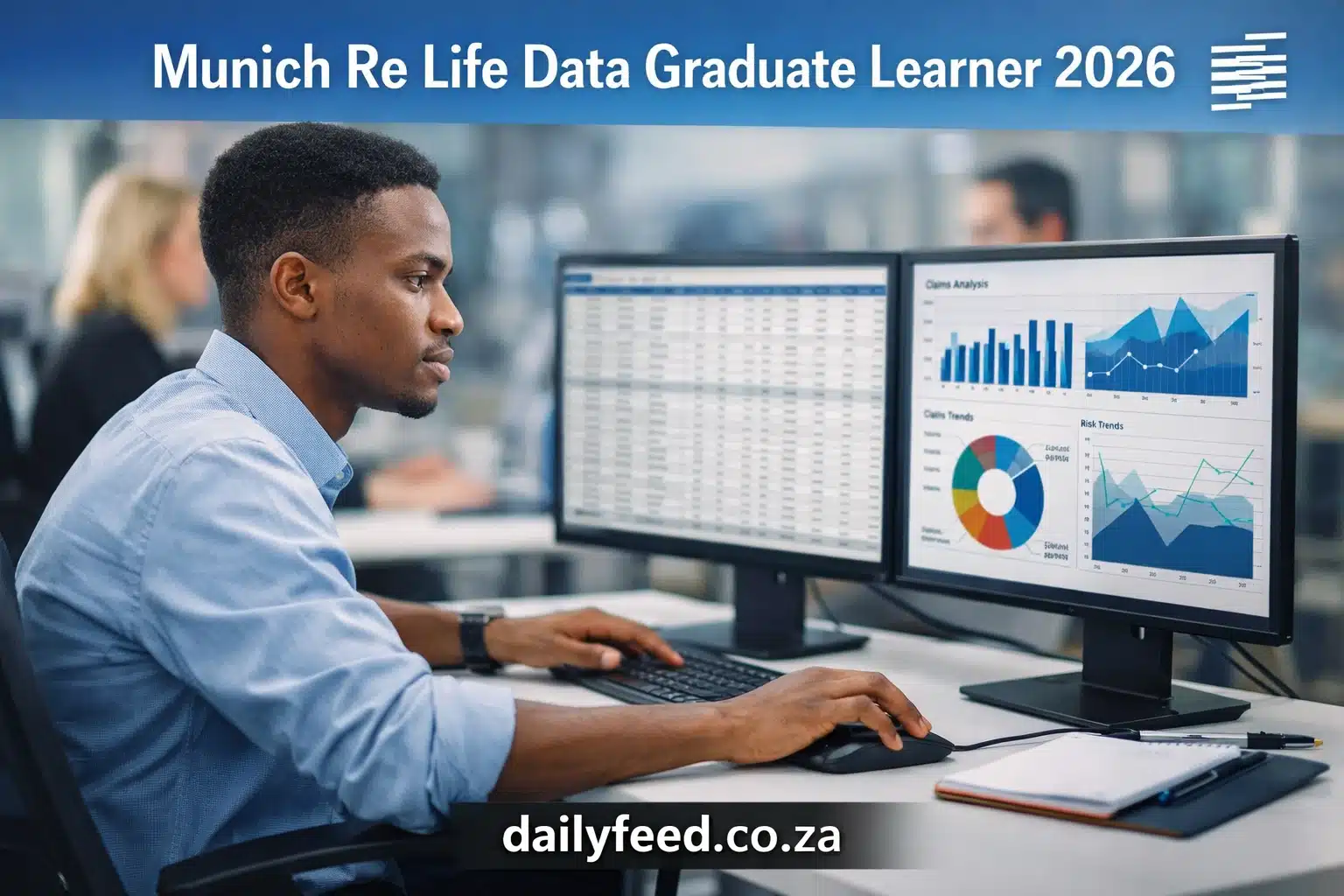
If you’re finishing a BSc in Statistics and wondering where “data skills” actually meet real business decisions, this programme is for you.
The Munich Re Life Data Graduate Learner 2026 arrives at a time when insurers are under pressure to use cleaner, smarter data. That makes this opportunity unusually relevant.
For many graduates, reinsurance feels distant, complex, technical, almost invisible. Yet it’s one of the few spaces where statistical thinking directly shapes pricing, risk, and long-term financial stability.
Why this learnership stands out right now
Graduate programmes are everywhere, but few sit at the intersection of insurance, data transformation, and risk analytics.
This learnership is positioned inside the Munich Reinsurance Africa Branch Team, part of Munich Re, one of the world’s most established reinsurers. That context matters.
Reinsurance is where insurers themselves get insured. Decisions here rely heavily on structured data, treaty terms, and actuarial logic. It’s not theoretical work.
At a time when companies talk endlessly about AI and analytics, this programme focuses on something more fundamental: understanding and preparing insurance data so it can actually be trusted.
ALSO Apply for Work Integrated Non Technical Learner
What you’ll realistically be doing
The description mentions training, projects, and daily tasks — standard language. But the exposure details reveal the real substance.
Graduates are introduced to Life Data Management, a niche many students never encounter at university.
In practice, that often includes:
- Reviewing datasets submitted by insurers
- Checking whether fields match treaty requirements
- Identifying missing or inconsistent data
- Converting raw client files into analysis-ready formats
This is not glamorous work, but it’s critical. Poor data quality can distort pricing models and risk projections.
You may also work with treaties — the agreements defining what risks are covered and under which conditions.
That could involve documenting:
- Standard treaty information
- Product-specific data requirements
- Special treaty conditions
For a statistics graduate, this is where numbers meet legal and commercial reality.
ALSO APPLY FOR Cape Union Mart International YES Programme 2026
The skills profile they’re quietly emphasising
The academic requirement is clear: a Bachelor of Science in Statistics with strong results.
But the less obvious filters sit elsewhere.
Good coding skills suggest comfort with tools like R, Python, SQL, or similar. Not expert level — but functional enough to manipulate datasets.
Working knowledge of Excel and MS tools signals something practical: much of insurance data still lives in spreadsheets, not sleek dashboards.
The role also highlights:
- Ability to work under pressure
- Multitasking
- Passion for data
Those aren’t clichés here. Reinsurance cycles, reporting deadlines, and client deliverables can compress timelines quickly.
Graduates expecting slow academic pacing may find the adjustment sharp.
ALSO APPLY FOR THE Grain Handling Learnership 2026
The learnership layer most graduates overlook
Munich Re indicates the programme includes an INSETA Learnership: FETC – Short-Term Insurance Qualification.
This is more significant than it sounds.
Beyond technical exposure, learners gain a recognised insurance qualification. That can open doors across underwriting, analytics, operations, and risk roles.
For graduates unsure whether they want to remain purely “data-side,” this qualification adds career flexibility.
The contract runs for 12 months, with a possible extension.
Important reality check: extensions are never guaranteed. Performance, business needs, and budget constraints all play a role.
Culture, diversity, and the SA graduate context
The programme notes preference may be given to EE candidates.
In South Africa’s employment landscape, this is standard practice aligned with transformation policies. Applicants should understand this without misreading it as exclusionary or symbolic.
Munich Re’s emphasis on diverse perspectives reflects a broader shift in global firms. Risk analysis benefits from varied viewpoints, economic, social, and geographic.
Whether that translates into daily team experience depends on the specific environment graduates enter.
Benefits The Learnership Offers
The listing mentions competitive salary, incentives, wellbeing, and development.
While attractive, graduates should approach benefits with grounded expectations.
Learnership compensation is typically structured differently from permanent roles. It supports early career development rather than long-term earnings.
The real value often sits in:
- Exposure to specialised insurance data work
- Structured training
- Industry qualification
- Brand recognition on your CV
In fields like analytics and actuarial support, that experience can outweigh short-term pay differences.
NOTE: Closing date is not disclosed on the official Company website
Apply for the Munich Re Life Data Graduate Learner 2026

FAQs About the Munich Re Life Data Graduate Learner 2026
Who should apply for this programme?
Graduates with a BSc in Statistics, strong academics, and comfort with coding and Excel.
Is this an actuarial role?
Not directly. It’s data-focused but sits close to actuarial, underwriting, and risk functions.
Do I need advanced programming skills?
You need working coding ability. Data manipulation and transformation skills are key.
What happens after the 12 months?
Possible outcomes include extension, internal opportunities, or leveraging the experience elsewhere. Nothing is guaranteed.
Will this help outside reinsurance?
Yes. Data quality, transformation, and insurance domain knowledge are transferable.
Is prior insurance experience required?
No. The programme includes technical and soft-skills training.
Final thoughts for cautious graduates
This learnership won’t suit everyone.
If you dislike detailed data checking, documentation, and structured processes, the work may feel repetitive.
But for graduates curious about how statistical thinking supports real financial risk decisions, this is rare exposure.
Reinsurance is a quiet industry with deep technical demand. Entry points are limited, especially for fresh graduates.
For the right candidate, the Munich Re Life Data Graduate Learner 2026 is less about a 12-month contract — and more about stepping into a specialized career lane few graduates even see.
About The Author
