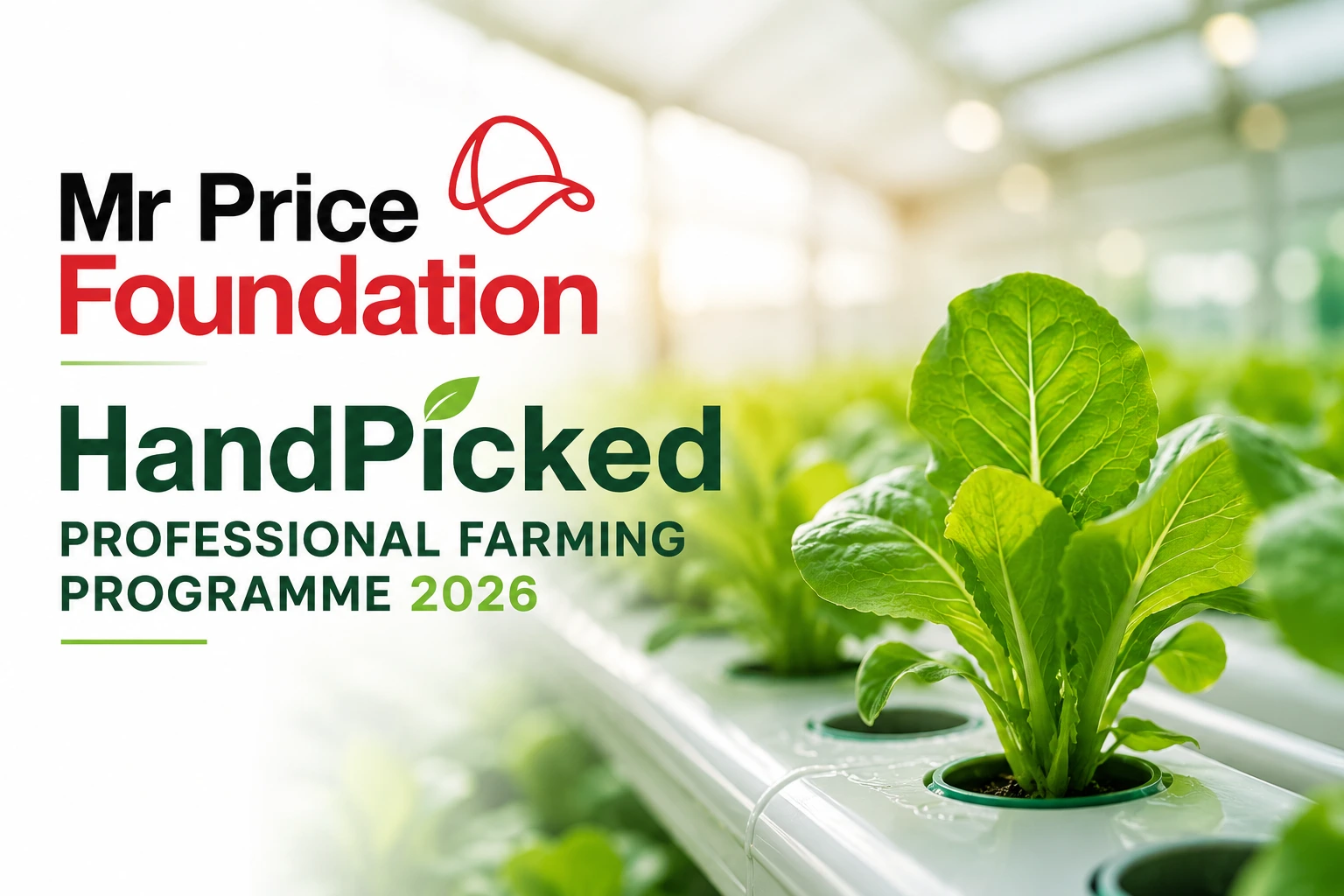
The Mr Price Foundation HandPicked Professional Farming Programme 2026 offers unemployed South African youth agricultural training, hydroponics exposure, NQF Level 5 credits, and a R4 000 monthly stipend.
For many young South Africans, agriculture still brings to mind traditional farms, open fields, and physically demanding work passed down through generations. But on the outskirts of Hammarsdale in KwaZulu-Natal, a different picture of farming is beginning to emerge — one built around hydroponic systems, climate-controlled environments, and technology-driven food production.
Inside modern growing tunnels, vegetables are cultivated without soil. Water usage is carefully measured. Temperature and humidity are monitored with precision. Young trainees work alongside mentors learning not only how to grow crops, but how to understand the future of sustainable food systems.
The Mr Price Foundation HandPicked Professional Farming Programme 2026 is designed for this new era of agriculture. At a time when unemployment among young people remains one of South Africa’s biggest challenges, programmes focused on practical skills and future industries are becoming increasingly important.
Rather than offering short-term theory alone, this initiative combines hands-on farming experience, online learning, mentorship, and agri-tech exposure over a full 12-month period. For unemployed youth with agricultural qualifications, it represents more than training — it offers entry into a changing industry where innovation and sustainability are becoming central to economic growth.
Quick Facts About the Programme
- Programme Name: Mr Price Foundation HandPicked Professional Farming Programme 2026
- Duration: 12 Months
- Locations: Hammarsdale, KwaZulu-Natal and Kenilworth, Cape Town
- Monthly Stipend: R4 000
- Application Deadline: 25 May 2026
- Qualification Level: NQF Level 5 Credits
- Certification: Certificate of Completion from the University of Venda (UniVen)
Why the Mr Price Foundation HandPicked Professional Farming Programme Matters
South Africa’s agriculture sector is under pressure from several directions at once. Climate change continues affecting rainfall patterns. Urban expansion is reducing available farming land. Water shortages remain a serious concern in multiple provinces. At the same time, food demand is growing as cities expand and populations increase.
This is where modern farming methods are becoming critical.
The Mr Price Foundation HandPicked Professional Farming Programme focuses heavily on sustainable horticulture and controlled environmental agriculture — systems designed to produce food more efficiently using less space and fewer natural resources.
Hydroponics, one of the programme’s key focus areas, allows crops to grow in nutrient-rich water rather than soil. These systems can operate in urban environments, warehouses, greenhouses, and controlled farming structures where conditions are carefully managed.
For young South Africans entering the agricultural sector today, understanding these systems may become just as valuable as traditional farming knowledge.
In many ways, agriculture is evolving into a technology-driven industry requiring both practical and technical skills.
Farming Is No Longer Only Rural
One of the biggest shifts happening globally is the movement of food production closer to urban areas. Controlled Environmental Agriculture (CEA) is helping cities produce fresh vegetables in spaces previously considered unsuitable for farming.
This matters in South Africa, where urbanisation continues increasing rapidly.
Cape Town, Johannesburg, Durban, and Pretoria are all seeing rising interest in urban farming initiatives, vertical agriculture projects, and sustainability-focused food production businesses. Young people trained in climate-smart farming methods may eventually find opportunities not only on commercial farms, but also within agri-tech startups, food supply chains, greenhouse operations, and community-based farming cooperatives.
The programme’s inclusion of hybrid-hydroponics incubators reflects this growing industry direction.
Instead of preparing participants solely for conventional farming jobs, the training introduces concepts that align with future food production trends.
Inside the Training Experience
The structure of the programme appears designed to balance theory with real workplace exposure.
Participants will complete structured online coursework while also gaining practical experience in modern horticulture systems. The inclusion of NQF Level 5 credits means the learning carries formal educational value beyond the immediate training period.
The programme covers modules such as:
- Introduction to horticulture of the future
- Soil-less vegetable farming systems
- Climate-smart agriculture
- Controlled Environmental Agriculture
- Sustainable crop production
- Plant nutrition and care
- Future farming methods
What makes this particularly relevant is that many agricultural programmes still focus heavily on traditional methods without adequately addressing changing environmental realities.
This initiative appears to recognise that future farmers will need adaptability alongside technical expertise.
A Growing Industry Few Young People Fully Understand
Agriculture is often overlooked by younger job seekers because it is still associated with outdated stereotypes. Yet globally, the sector is becoming increasingly sophisticated.
Large-scale farming operations now use data systems, precision irrigation, environmental monitoring, automated nutrient delivery, and advanced greenhouse technologies.
In countries facing water scarcity, hydroponics and controlled agriculture are becoming especially valuable because they use significantly less water than conventional farming.
South Africa’s long-term food security may depend partly on these innovations.
For unemployed graduates with agricultural qualifications, programmes like this can provide exposure to practical systems that many universities or colleges may not fully cover in real-world environments.
That combination of theory and workplace experience is often where employability improves most.
Expert Insight: Why Climate-Smart Agriculture Could Shape Future Employment
Climate-smart agriculture is no longer simply an environmental discussion. It is increasingly becoming an economic and employment issue.
As extreme weather conditions continue affecting farming output globally, agricultural employers are looking for workers who understand resilience-based farming systems. Skills linked to water efficiency, controlled growing environments, sustainable production, and agri-tech adaptation may become highly valuable over the next decade.
South Africa’s agricultural future will likely require professionals who can combine environmental awareness with practical production knowledge. Programmes introducing young people to these systems now may help build a workforce better prepared for future food production challenges.
The Value Beyond the Monthly Stipend
The R4 000 monthly stipend will understandably attract many applicants, especially in a difficult economic environment. For unemployed youth, financial support during training can make participation more realistic by helping cover transport, food, and basic living costs.
But the long-term value of the programme may extend far beyond the stipend itself.
Participants who successfully complete the programme receive a Certificate of Completion from the University of Venda, adding credibility to their training profile.
More importantly, they gain practical workplace exposure, mentorship opportunities, and industry connections that could influence future employment prospects.
In South Africa’s competitive job market, practical experience often separates candidates who secure opportunities from those who struggle to enter industries.
The networking component may also prove important. Agriculture remains relationship-driven in many areas, and exposure to professionals, mentors, and agricultural stakeholders can open future pathways that formal qualifications alone sometimes cannot.
Who Can Apply for the Programme?
The programme targets unemployed South African youth with agricultural qualifications.
Applicants must:
- Be between 18 and 33 years old
- Be unemployed
- Have a valid South African ID
- Hold a tertiary qualification in agriculture
- Be based in Hammarsdale and surrounding areas or Cape Town
- Be able to travel to the assigned placement site
The programme also appears to prioritise qualities beyond academic achievement alone.
Motivation, discipline, willingness to learn, teamwork, and resilience are repeatedly emphasised. That reflects the reality of modern workplace training environments where adaptability often matters as much as technical knowledge.
The Bigger Picture Behind Programmes Like This
Youth unemployment remains one of South Africa’s most urgent economic problems. At the same time, industries such as agriculture face growing pressure to modernise and innovate.
Skills programmes positioned between education and employment are becoming increasingly important because they attempt to bridge the gap many graduates face after completing studies.
Too often, young people leave tertiary institutions with qualifications but limited practical experience.
The Mr Price Foundation HandPicked Professional Farming Programme 2026 attempts to address that challenge directly by combining structured training with hands-on exposure.
It also highlights a broader trend: agriculture is no longer simply about food production. It increasingly overlaps with technology, sustainability, environmental science, logistics, and urban development.
That evolution may reshape how younger generations view careers within the sector.
see also: Discovery Long Term Insurance Learnerships 2026: Complete Educational GuideSEO Title
Where To Apply
Applications for the Mr Price Foundation HandPicked Professional Farming Programme 2026 are currently open.
Applicants can apply through the official programme application platform provided in the advert:
APPLY FOR THE MR PRICE FOUNDATION HANDPICKED PROFESSIONAL FARMING PROGRAMME 2026 HERE
Candidates are encouraged to apply before the closing date of 25 May 2026.
Preparing a Strong Application
Competition for funded skills programmes is often high, especially those offering both training and stipends.
Applicants can improve their readiness by preparing:
- An updated CV
- Certified copy of ID
- Agricultural qualification documents
- Proof of residence
- A motivational statement explaining career goals
- Reliable contact information
It may also help applicants to familiarise themselves with basic hydroponics concepts and sustainability challenges within agriculture before interviews or assessments.
Showing genuine interest in future-focused farming systems could strengthen an application.
FAQ About the Mr Price Foundation HandPicked Professional Farming Programme 2026
What stipend does the programme offer?
Successful participants will receive a monthly stipend of R4 000 during the 12-month programme.
Does the programme provide a recognised qualification?
Participants who successfully complete the programme will receive a Certificate of Completion from the University of Venda and gain NQF Level 5 credits through the coursework component.
Who is eligible to apply?
The programme is open to unemployed South Africans aged 18 to 33 who have a tertiary qualification in agriculture and are based in Hammarsdale surrounding areas or Cape Town.
Conclusion
South Africa’s agricultural sector is entering a period of major transformation. Water scarcity, climate pressure, urbanisation, and food security concerns are forcing the industry to innovate faster than ever before.
For young people, this creates both uncertainty and opportunity.
The Mr Price Foundation HandPicked Professional Farming Programme 2026 reflects how agricultural careers are evolving beyond traditional farming into technology-driven, sustainability-focused industries that may define future food production.
While the programme lasts only 12 months, the skills, exposure, and industry understanding participants gain could influence careers for years to come.
In a country searching for sustainable employment pathways for youth, initiatives that combine practical training, modern technology, and real workplace experience may ultimately become some of the most valuable opportunities available.
About The Author
