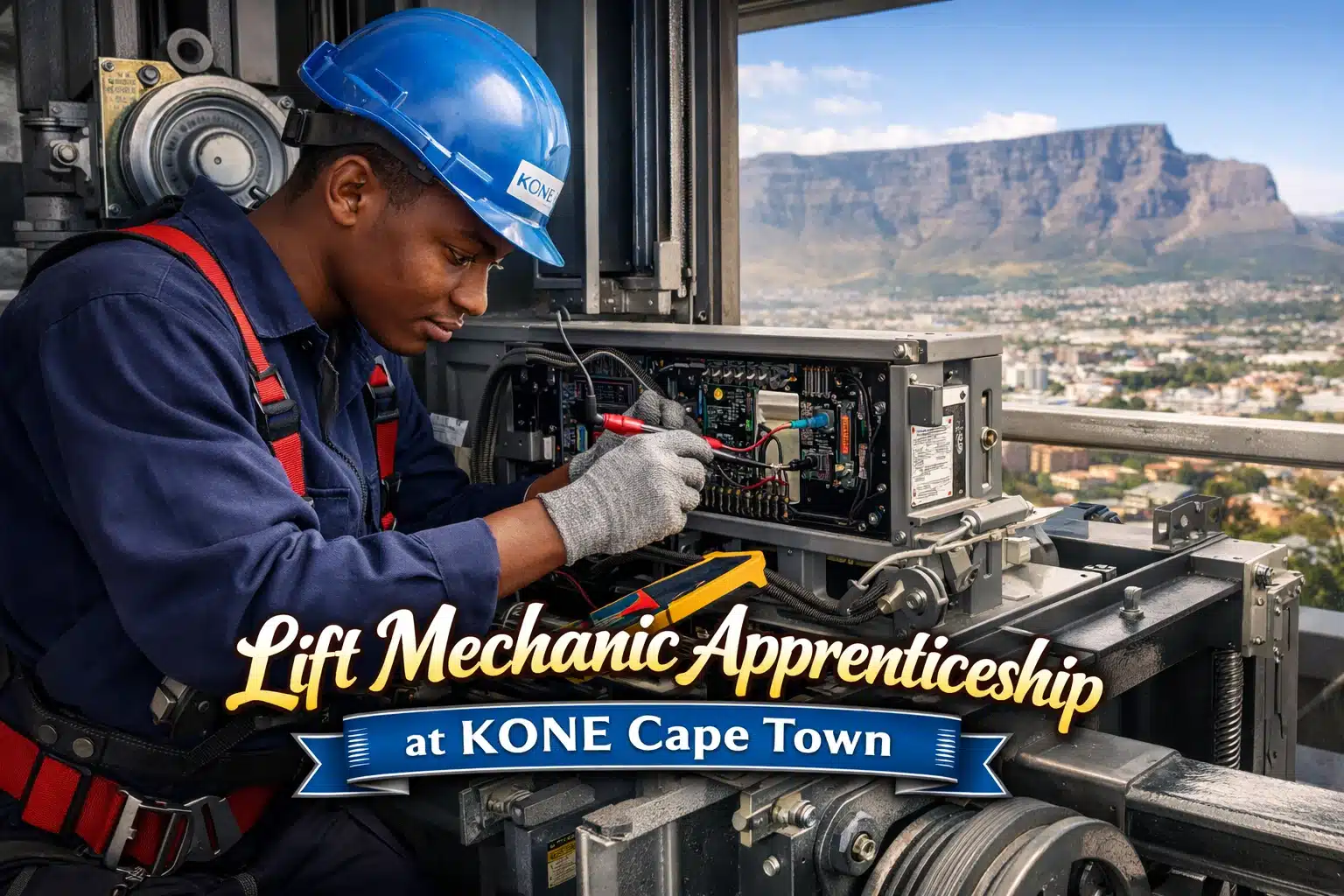
Lift Mechanic Apprenticeship Cape Town: KONE offers young South Africans a structured entry into the elevator and escalator trade.
Skilled trades are quietly becoming one of the most reliable career paths in South Africa — and elevator mechanics are right at the centre of that shift.
For young people in Cape Town with Maths, Science, or technical training, KONE’s Lift Mechanic Apprenticeship offers something rare: a structured entry into a global industry that isn’t overcrowded or fading away.
With cities growing upward, not outward, the demand for elevator and escalator technicians isn’t a future promise — it’s already here.
ALSO APPLY FOR Shoprite Money Market YES Programme 2026-Apply Now! Turn Your Qualification into Earning Potential
Why Elevator and Escalator Skills Matter Right Now
Urban life depends on vertical movement more than most people realise. Office towers, hospitals, malls, residential blocks — none function without reliable lifts and escalators.
KONE, which moves over one billion people every day worldwide, operates in more than 60 countries. That scale matters because it reflects stability, standardised training, and long-term demand. Elevators aren’t seasonal work, and they’re not easily automated away.
For apprentices, this means learning a trade that combines electrical, mechanical, and safety-critical skills — a combination that keeps technicians employable across decades, not just years.
In South Africa, where many entry-level jobs offer limited progression, technical apprenticeships stand out because they lead to recognised trade experience, not just short-term contracts.
Who This Apprenticeship Is Really For-Lift Mechanic Apprenticeship
This Lift Mechanic Apprenticeship in Cape Town is not aimed at everyone — and that’s a good thing.
It’s suited to:
- Young people 35 years or younger
- Candidates with Matric (Grade 12) including Maths & Science, or N2/N3 mechanical or electrical qualifications
- Individuals who are physically fit, comfortable with heights, and hands-on work
- People who prefer practical problem-solving over desk-based routines
An Electrical Trade Test is listed as advantageous, not required. That suggests KONE values potential and trainability, not only finished qualifications.
The role also demands something often overlooked in technical careers: customer interaction. Lift technicians work in occupied buildings, meaning communication, professionalism, and teamwork matter just as much as technical accuracy.
What the Work Actually Involves
Elevator and escalator work is physically demanding and mentally precise.
On a typical day, apprentices may:
- Assist with installing or maintaining lift and escalator systems
- Climb stairs, ladders, and scaffolding at job sites
- Use tools and diagnostic equipment
- Lift components weighing up to 15 kg
- Follow strict safety and quality procedures
The physical requirements — including vision, balance, and full medical fitness — are clearly stated for a reason. These systems carry people, not packages. Mistakes have real consequences.
At the same time, apprentices gain exposure to modern urban infrastructure, advanced control systems, and internationally recognised standards. This is not informal labour — it’s regulated, audited, and safety-driven work.
Inside KONE’s Work Culture: What to Expect
KONE positions itself as a company focused on collaboration, ethics, and sustainability, which is increasingly important in global engineering firms.
Rather than selling the role as glamorous, the company emphasises:
- Team-based problem-solving
- Shared responsibility for safety and quality
- Recognition for good performance
- Long-term development rather than quick wins
For apprentices, this usually translates into structured learning, mentorship, and exposure to experienced technicians — not being left alone to “figure it out.”
That said, like any demanding technical environment, the pressure is real. Deadlines, customer expectations, and safety standards don’t disappear because someone is learning. This apprenticeship suits people who handle responsibility early and learn best by doing.
How to Apply and What to Prepare-Lift Mechanic Apprenticeship
Applications are directed through KONE’s official careers platform. Candidates should prepare:
- Certified copies of qualifications
- A clear CV highlighting technical subjects or hands-on experience
- Proof of computer literacy (basic Microsoft Office skills are expected)
Applicants should also be realistic. This is not an office job, and it’s not fast money. The value lies in skill accumulation, not immediate comfort.
You can read more and apply via KONE’s careers page:
👉 Lift Mechanic Apprenticeship Online
For broader context on artisan development in South Africa, the Department of Higher Education and Training provides useful guidance:
👉 Broader context on artisan development
Frequently Asked Questions–
Is this apprenticeship paid?
KONE apprenticeships typically offer structured training with compensation, though exact terms are confirmed during the recruitment process.
Do I need prior lift or escalator experience?
No. The programme is designed to train suitable candidates from related mechanical or electrical backgrounds.
Is the apprenticeship only based in Cape Town?
Yes, this specific opportunity is for Cape Town. KONE may offer other programmes in different regions at different times.
What happens after completing the apprenticeship?
Successful apprentices are usually positioned for technician roles, depending on performance, business needs, and certification progress.
Is this career future-proof?
Elevator and escalator maintenance remains essential as cities grow vertically. While technology evolves, skilled technicians remain critical.
About The Author
