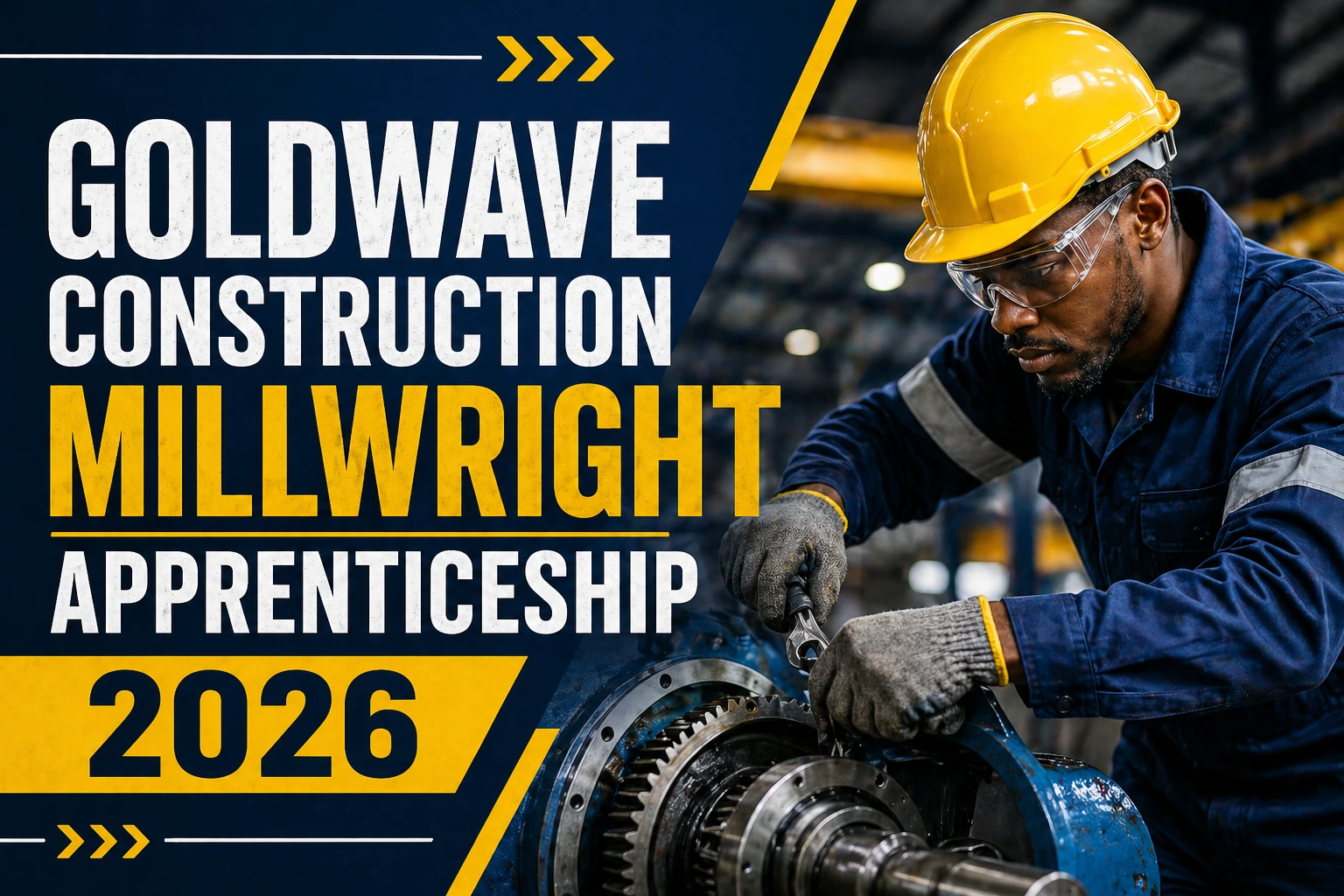
Apply for the Goldwave Construction Millwright Apprenticeship 2026 in Gauteng. Learn requirements, benefits, and how to apply before 27 April 2026.
By 7 a.m., the construction site is already alive with movement somewhere in Gauteng. Steel structures rise slowly, cranes shift into position, and technicians move between machines that power the entire operation. In the middle of it all, a young apprentice stands beside a senior millwright, watching closely as a motor is dismantled and rebuilt.
There’s no lecture here. No textbook. Just real machinery, real responsibility, and real learning.
This is the environment the Goldwave Construction Millwright Apprenticeship 2026 is designed to introduce young South Africans to—a space where technical knowledge is tested daily and skills are built through hands-on experience.
What You Should Know First
The Goldwave Construction Millwright Apprenticeship 2026 is a structured training opportunity for unemployed youth with a background in mechanical or electrical engineering. Offered by Goldwave Construction, the programme is based in Gauteng and focuses on developing millwrights—artisans trained in both mechanical and electrical systems.
This dual-trade approach makes millwrights some of the most versatile and in-demand professionals in South Africa’s infrastructure and industrial sectors.
Understanding the Role of a Millwright in Today’s Economy
The term “millwright” might sound outdated, but the role is anything but.
Modern millwrights are responsible for installing, maintaining, and repairing complex machinery across industries—from construction and manufacturing to energy and logistics.
In a country like South Africa, where infrastructure development remains a priority, these skills are essential.
The Goldwave Construction Millwright Apprenticeship 2026 aligns directly with this demand. By training apprentices in both electrical circuitry and mechanical assembly, the programme prepares them for real-world challenges on construction sites and in industrial environments.
Inside the Goldwave Construction Millwright Apprenticeship 2026
The apprenticeship is built around practical exposure. Instead of spending most of the time in classrooms, learners work alongside experienced technicians, gaining hands-on experience with heavy machinery and complex systems.
Training typically includes:
- Installation and maintenance of machinery
- Fault-finding and repairs
- Electrical system diagnostics
- Mechanical assembly and adjustments
- Adherence to safety standards
This approach ensures that by the time apprentices complete the programme, they are not just qualified—they are experienced.
Why This Apprenticeship Matters in 2026
South Africa continues to face a shortage of skilled artisans. While many young people hold qualifications, fewer have the practical experience required by employers.
This gap is especially visible in technical trades.
The Goldwave Construction Millwright Apprenticeship 2026 addresses this issue by combining theory with real-world application. It offers a pathway to becoming a qualified artisan, potentially leading to a Red Seal certification—a nationally recognized standard for skilled trades.
In regions like Johannesburg and surrounding industrial hubs, the demand for millwrights remains steady. Infrastructure projects, manufacturing plants, and energy facilities all rely on these skills.
Quick Facts: Goldwave Construction Millwright Apprenticeship 2026
- Closing Date: 27 April 2026
- Location: Gauteng, South Africa
- Trade: Millwright (Mechanical & Electrical)
- Minimum Requirement: Technical Matric or N2–N6
- Stipend: Not specified
What Makes a Strong Candidate
The requirements for the Goldwave Construction Millwright Apprenticeship 2026 are clear, but competition means applicants need to go further.
To qualify, you need:
- Technical Matric OR N2–N6 in Mechanical/Electrical Engineering
- Fluency in English
- A strong interest in both mechanical and electrical systems
Additional advantages include:
- Basic welding skills
- A valid driver’s licence
But beyond qualifications, employers look for mindset. Construction environments demand discipline, attention to detail, and a commitment to safety.
Expert Insight: Why Dual-Trade Skills Are a Game Changer
The most valuable aspect of the Goldwave Construction Millwright Apprenticeship 2026 is its dual-trade nature.
Millwrights are trained in both mechanical and electrical systems. This combination creates professionals who can diagnose and fix a wider range of problems compared to single-trade artisans.
From an industry perspective, this reduces downtime and increases efficiency—making millwrights highly valuable.
For the individual, it opens more career opportunities.
A qualified millwright can work in:
- Construction
- Manufacturing
- Mining
- Energy production
In a job market where specialization often limits flexibility, dual-trade skills offer a significant advantage.
Application Strategy: Standing Out in a Competitive Field
Applying for the Goldwave Construction Millwright Apprenticeship 2026 requires more than submitting documents.
Here are a few ways to strengthen your application:
- Clearly list your technical subjects (e.g., Engineering Science, Industrial Electronics)
- Highlight any practical skills like welding or workshop experience
- Emphasize your commitment to safety in your cover letter
Employers want candidates who are ready to work in high-risk environments responsibly.
see also: AFGRI Apprenticeship 2026: How to Apply and Build Great Career as a Tractor or Earthmoving Mechanic
Where to Apply
Applications for the Goldwave Construction Millwright Apprenticeship 2026 must be submitted via email.
Email Address: careers@goldwavegroup.co.za
Subject Line: Apprenticeship Application: Millwright 2026 – [Your Name]
Required Documents:
- Updated CV
- Certified copy of ID
- Certified copies of Matric and N-certificates
Ensure all documents are clear and properly formatted before sending.
Frequently Asked Questions
1. Do I need both mechanical and electrical qualifications?
No, but you should have a background in either field and a willingness to learn both.
2. Is this apprenticeship paid?
The stipend is not specified, but most apprenticeships offer some form of financial support.
3. What happens after completing the apprenticeship?
You can work toward a Red Seal certification and pursue roles as a qualified millwright in various industries.
A Practical Path Into South Africa’s Technical Future
The Goldwave Construction Millwright Apprenticeship 2026 is not just another training programme. It reflects a broader shift in how careers are built in South Africa—moving away from purely academic pathways toward practical, skills-based development.
For young people with technical interests, it offers something tangible: the chance to learn by doing, to work with real systems, and to build a career that is both stable and in demand.
On a construction site in Gauteng, as machines come to life and systems are restored to working order, the role of a millwright becomes clear.
It’s not just about fixing equipment.
It’s about keeping entire industries running.
About The Author
