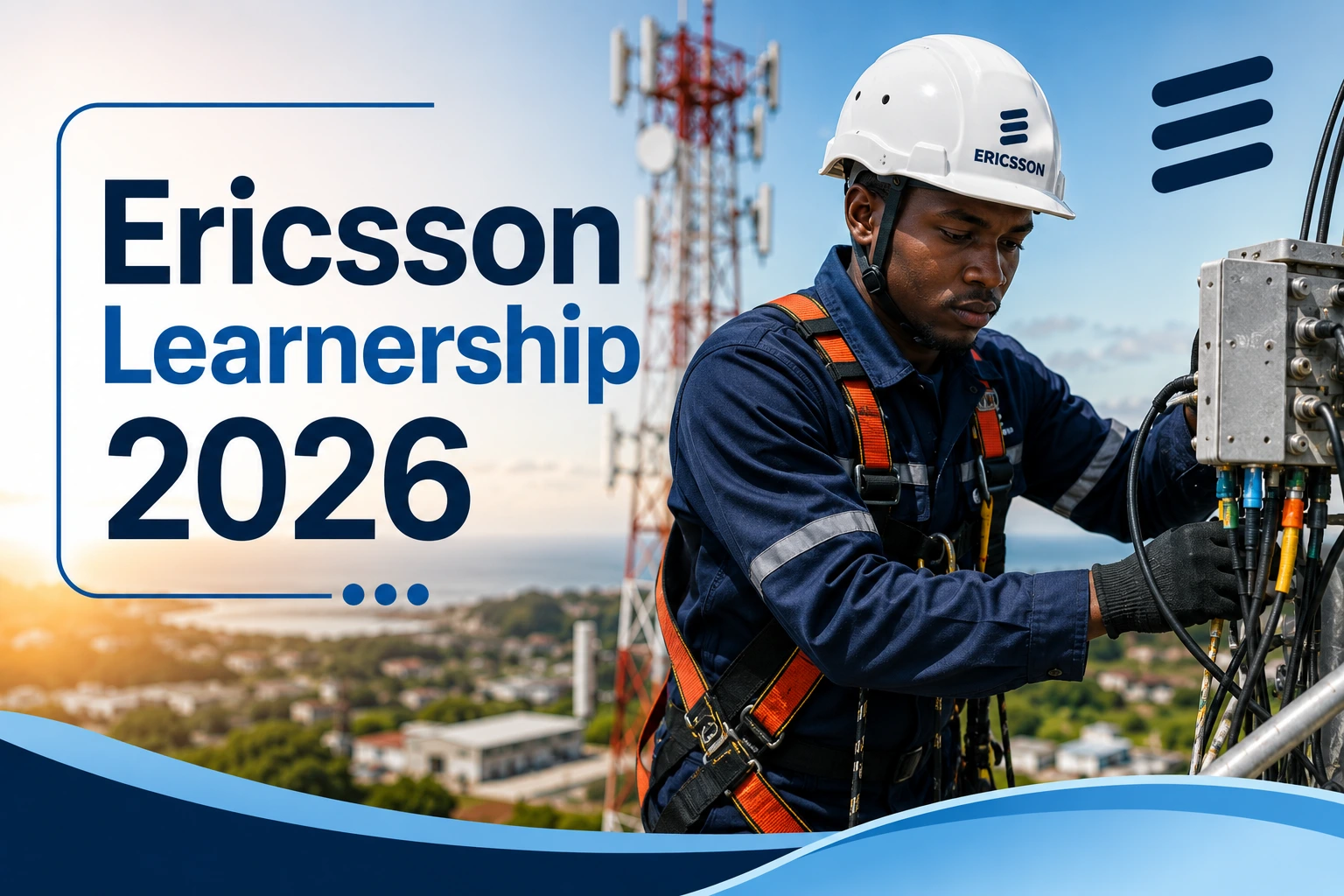
Apply for the Ericsson Learnership 2026 in East London and gain hands-on telecommunications network operations experience with monthly stipend support.
Just after sunrise in East London, a technical field team arrives at a telecommunications tower on the outskirts of the city. Safety harnesses are checked twice. Fibre cables are unpacked carefully. One technician studies a network fault report while another prepares equipment for installation several metres above the ground.
For many South Africans, reliable mobile signals and stable internet connections feel routine. Yet behind every phone call, banking app notification and online classroom session is a complex infrastructure network maintained by trained technical teams working in demanding environments.
That reality explains why the Ericsson Learnership 2026 is attracting attention from young people interested in practical ICT careers rather than traditional office-based roles.
The Ericsson Telecommunication Network Operations Learnership Programme offers qualifying candidates a structured 12-month opportunity to gain exposure to fibre systems, tower operations, network maintenance and field-based telecommunications work. At a time when South Africa’s digital economy continues expanding, programmes like this are becoming increasingly relevant for technically minded youth seeking long-term career direction.
Quick Facts About the Ericsson Learnership 2026
| Details | Information |
|---|---|
| Programme | Ericsson Telecommunication Network Operations Learnership Programme 2026 |
| Company | Ericsson |
| Duration | 12 Months |
| SAQA ID | 59057 |
| NQF Level | 4 |
| Start Date | 1 June 2026 |
| End Date | 31 May 2027 |
| Primary Location | East London |
| Head Office | Woodmead |
| Reference Number | Req ID: 784797 |
| Monthly Stipend | Yes |
| Travel Required | Yes, within Eastern Cape after 4–6 months |
| Closing Date | Not specified |
Why the Ericsson Learnership 2026 Matters Right Now
South Africa’s telecommunications sector has changed dramatically over the past decade. Fibre rollouts have accelerated, mobile data usage has surged, and businesses increasingly depend on stable digital infrastructure to operate efficiently.
At the same time, the country faces a major youth unemployment challenge, particularly among school leavers and graduates struggling to secure practical work experience.
The Ericsson Learnership 2026 sits at the intersection of those two realities.
Instead of focusing only on theoretical classroom learning, the programme exposes learners to real operational environments where network systems are installed, repaired and maintained. That practical element matters because employers in technical industries increasingly value hands-on capability alongside academic qualifications.
For many young South Africans, telecommunications offers something increasingly rare in the modern economy: a sector where practical technical skills remain essential.
Behind every expanding 5G network, fibre installation project and communication tower upgrade are technicians, support teams and network operations specialists performing physically demanding work that keeps the country connected.
Not Just Another Office-Based ICT Programme
One of the most important details about the programme is what it is not.
The learnership is not designed primarily for candidates expecting desk-bound administrative work or purely software-focused IT training. Instead, it focuses heavily on field operations and technical infrastructure support.
Learners may be required to:
- Work outdoors in changing weather conditions
- Travel across the Eastern Cape
- Support fibre and cable installations
- Assist with telecommunications hardware maintenance
- Work at heights under strict safety procedures
- Participate in emergency network repair situations
That distinction is important because many young applicants enter ICT-related programmes expecting computer lab environments rather than physical field operations.
The telecommunications industry still relies heavily on technicians who can work directly with infrastructure systems in real-world environments. Towers, antennas, fibre lines and network hardware all require ongoing installation and maintenance.
For candidates who enjoy practical technical work, that can make the experience far more engaging than conventional classroom-based learning alone.
The Telecommunications Industry Is Quietly Expanding
Across South Africa, digital infrastructure has become increasingly tied to economic activity.
Remote work, digital banking, online education platforms, streaming services and mobile commerce all depend on stable telecommunications networks. In provinces like the Eastern Cape, expanding network coverage remains especially important for improving connectivity in underserved areas.
This creates growing demand for technically trained workers capable of supporting infrastructure development and network reliability.
The Ericsson Learnership 2026 reflects how large telecommunications companies are investing in skills pipelines to support future network growth.
Programmes like this also expose learners to several areas of technical operations, including:
- Fibre optic systems
- Tower maintenance
- Microwave communication hardware
- Cable testing
- Network support
- Safety procedures
- Equipment installation
That broad exposure can help learners better understand where they may eventually specialise within the telecommunications field.
Inside the Daily Reality of Telecommunications Field Work
Telecommunications field work is often misunderstood by people outside the industry.
While modern technology may appear sleek and automated from the consumer side, maintaining network infrastructure remains physically demanding and operationally complex.
A network outage in one area can require technicians to travel long distances, diagnose faults quickly and restore systems under pressure. Fibre damage, weather disruptions and equipment failures can all impact communication services relied upon by thousands of users.
The learnership exposes candidates to these operational realities early.
According to the programme details, learners may assist with:
- Tower climbing support
- Fibre optic installation
- Antenna installation assistance
- Equipment testing
- Network maintenance
- Structural component support
- Emergency repair responses
- Health and safety compliance
This type of field exposure is particularly valuable because it develops both technical competence and workplace discipline simultaneously.
Expert Insight: Why Practical Technical Skills Are Becoming More Valuable Again
For several years, many young South Africans focused heavily on office-based career paths linked to administration, finance or general business studies. But sectors tied to infrastructure, engineering support and telecommunications are quietly regaining importance.
One reason is that infrastructure cannot be outsourced entirely to automation.
Networks still require technicians to physically install hardware, repair systems, inspect towers and manage on-site operations. As South Africa continues investing in digital infrastructure expansion, technical field workers remain central to keeping those systems functional.
Programmes like the Ericsson Learnership 2026 therefore offer something beyond short-term work experience: exposure to an industry where practical technical capability still carries strong long-term value.
Who Is Most Likely to Benefit From This Opportunity?
The programme may suit candidates who are naturally curious about how communication systems work behind the scenes.
Applicants with backgrounds in:
- ICT
- Networking
- Telecommunications
- Digital electronics
- Low-voltage systems
- Technical TVET studies
may find the transition easier because they already understand some technical concepts.
However, the programme also appears designed for candidates with strong learning potential rather than extensive prior experience.
Qualities likely to matter include:
- Reliability
- Teamwork
- Safety awareness
- Problem-solving ability
- Physical readiness
- Willingness to work outdoors
- Communication skills
In technical environments, employers often value attitude and discipline as highly as qualifications, especially for entry-level development programmes.
East London’s Role in the Programme
The learnership’s primary operational base is East London, a city that continues to play an important role in the Eastern Cape’s industrial and infrastructure landscape.
Although often overshadowed by Johannesburg or Cape Town in discussions about technology careers, East London remains strategically important for regional telecommunications infrastructure and service operations.
Candidates based in the Eastern Cape may therefore benefit from proximity to the operational environment where much of the field training is expected to occur.
The programme’s travel requirements also suggest learners will gain exposure to telecommunications infrastructure across different parts of the province rather than remaining confined to one office location.
What Applicants Should Prepare Before Applying
One overlooked reality about competitive learnership applications is that many candidates submit incomplete or generic CVs.
For technical programmes like this, applicants can strengthen their profiles by clearly highlighting:
- Networking knowledge
- Technical subjects studied
- ICT-related projects
- Computer literacy
- Team activities
- Volunteer work
- Hands-on practical experience
- Safety awareness
Even small experiences — such as assisting with computer repairs, networking setups or technical school projects — may help demonstrate genuine interest in the field.
Applicants should also ensure all required documents are properly certified and clearly scanned before submission.
Where to Apply
Applications for the Ericsson Learnership 2026 must be submitted through the official
Applicants should reference:
Req ID: 784797
when searching for the programme online.
APPLY HERE: Ericsson Learnership 2026
Because no official closing date has been specified, early applications may improve visibility before the opportunity receives higher application volumes.
SEE ALSO: OSS Hastings Learnership 2026 in Centurion Offers R9 000 Monthly Stipend
Frequently Asked Questions
Is the Ericsson Learnership 2026 office-based?
No. The programme includes significant field-based exposure involving telecommunications sites, infrastructure work and travel within the Eastern Cape.
Do applicants need previous telecommunications experience?
No formal industry experience is listed as mandatory, although ICT or networking-related qualifications may be advantageous.
Will learners receive financial support?
Yes. The programme includes a monthly stipend for successful candidates.
The Bigger Picture Behind Opportunities Like This
South Africa’s digital future depends on more than software developers and corporate technology executives. It also depends on technicians, infrastructure specialists and field teams capable of building and maintaining the physical systems that support communication networks nationwide.
The Ericsson Learnership 2026 reflects a broader shift toward practical technical training linked directly to industry operations. For young South Africans seeking a route into telecommunications, the programme offers exposure to real network environments rather than simulated classroom exercises alone.
For candidates willing to work outdoors, learn under pressure and engage with technical infrastructure firsthand, this 12-month opportunity could become the beginning of a much larger career journey within one of the country’s most essential industries.
About The Author
