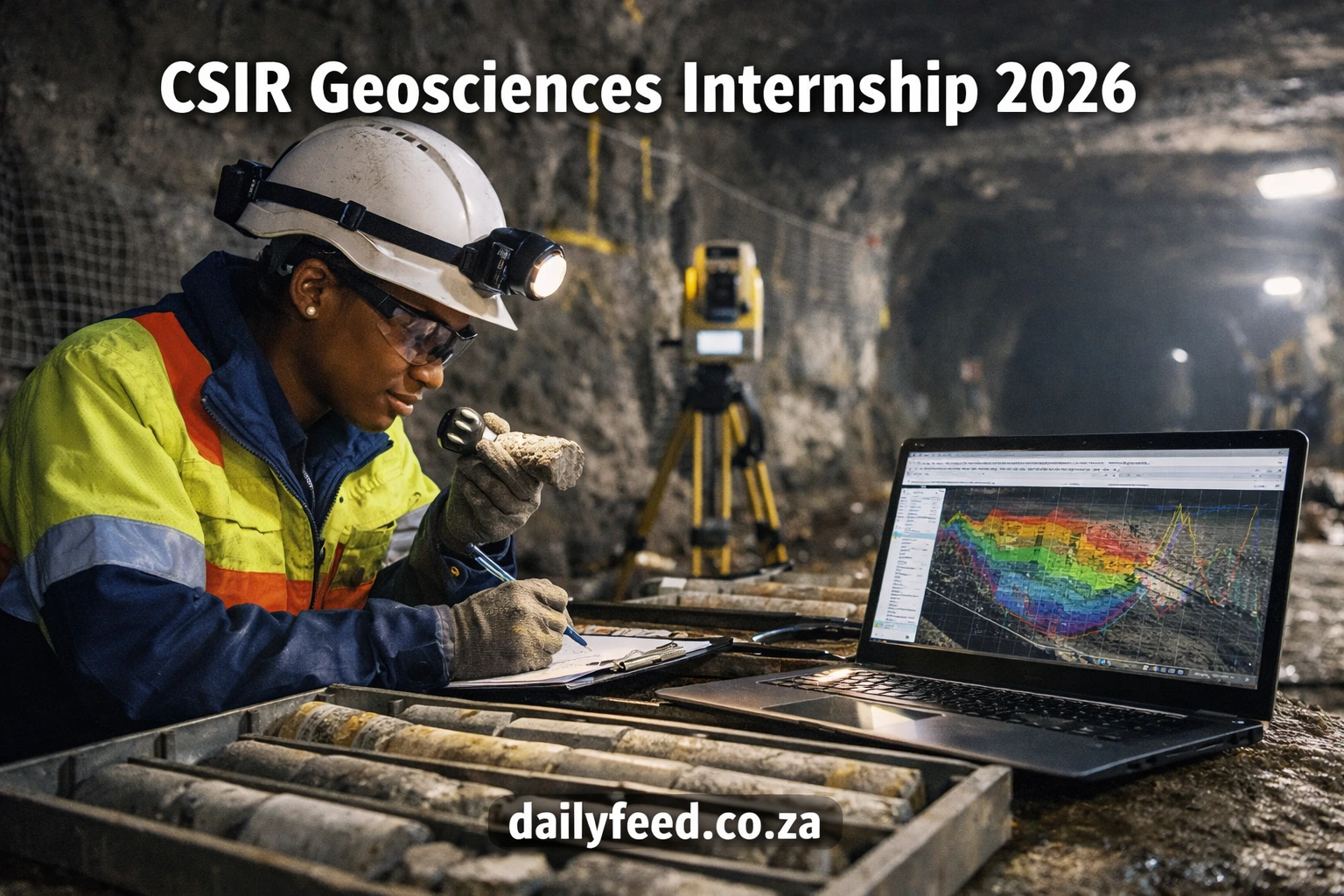
Graduates in geology and geophysics don’t often see internships tied directly to national research programmes.
If you’ve been waiting for something more substantial than a generic graduate role, the CSIR Geosciences Internship 2026 may feel different and timely.
South Africa’s mining sector is under pressure to modernise, improve safety, and extend the life of deep-level operations. This internship sits right at that intersection.
Why this internship stands out right now
The Council for Scientific and Industrial Research (CSIR) isn’t just another employer. It’s one of the country’s central science and technology institutions, tasked with developing solutions that feed into industrial growth and state capability.
The internship is hosted within the Mandela Mining Precinct a collaborative initiative focused on revitalizing mining through research, innovation, and applied technologies.
That context matters.
Rather than shadowing routine operational work, interns are placed in an environment where research outcomes influence real mining challenges: underground safety, orebody understanding, rock mechanics, and exploration technologies.
For someone early in their career, exposure like this is hard to replicate elsewhere.
ALSO APPLY FOR: Umzimkhulu Municipality Firefighter Learnership 2026
What the work may actually look like
On paper, the responsibilities sound academic and structured:
- Literature reviews
- Supporting underground trials
- Stakeholder engagement
- Reporting on results
- Administrative support
In practice, this often translates into a blend of desk-based research and field-linked activity.
One week could involve analysing previous studies on geophysical imaging or rock behaviour. Another might mean preparing documentation or assisting researchers before a mine-site trial.
Underground trials, in particular, are not routine office exercises. They can involve:
- Early starts
- Strict safety protocols
- Adapting to unpredictable site conditions
- Close collaboration with engineers and technicians
For candidates with limited mining exposure, this can be both challenging and eye-opening.
It’s not unusual for young geoscience graduates to discover that applied research demands flexibility, patience, and comfort with uncertainty, especially when technologies are being tested in live environments.
ALSO APPLY FOR City of Cape Town Student Opportunities 2026
The 18-month contract: longer than typical internships
Most internships run 6–12 months. This one spans 18 months, which signals something important:
You’re not just observing; you’re expected to contribute over time.
Longer placements typically allow interns to:
- Follow research cycles from design to reporting
- Build stronger relationships with project leads
- Develop practical competence rather than surface-level familiarity
That said, length also means commitment.
An 18-month research internship requires sustained curiosity and discipline. The novelty fades; the learning deepens.
Who is realistically suited for this role
The minimum requirement is a BSc Honours in Geology or Geophysics.
Beyond qualifications, the profile suggests the CSIR is looking for someone who is:
- Comfortable with data and numbers
- Detail-oriented
- Digitally competent (Microsoft tools are essential)
- Professionally reliable (clear criminal record required)
Advantages, not strict requirements, include:
- Mineral Resource Management background
- Prior mining exposure
- Valid driver’s licence
A driver’s licence may seem like a minor detail, but it often becomes relevant when site visits or travel between facilities are involved.
Similarly, “experience in mining” doesn’t necessarily mean years underground. Even vacation work, academic field trips, or project-based exposure can help candidates understand the environment.
What you gain (beyond remuneration)
Yes, the internship offers market-related pay and learning opportunities. But early-career value usually lies elsewhere:
1. Applied research experience
Many graduates understand theory but lack exposure to how research integrates with industry constraints.
2. Cross-disciplinary interaction
Geoscience rarely operates in isolation. Expect engagement with engineers, data scientists, safety specialists, and programme managers.
3. Professional credibility
Having CSIR experience on a CV signals familiarity with structured research, reporting standards, and stakeholder environments.
Of course, outcomes vary.
Not every internship guarantees a permanent role, and research programmes can shift direction. The CSIR itself notes it may withdraw the advert or not appoint if a suitable candidate isn’t identified.
That transparency is worth noting.
Key dates and practical details
- Position: Geosciences Intern
- Contract: 18 months
- Location: Johannesburg
- Closing date: 27 February 2026
Enquiries go to Recruitmentinfo@csir.co.za
(Applications should not be sent to this mailbox.)
International qualifications must be evaluated by SAQA, a step that can take time, so eligible candidates should not leave this until the last minute.
Apply for the CSIR Geosciences Internship 2026
FAQs: CSIR Geosciences Internship 2026
Is this internship only for recent graduates?
Not explicitly. However, internships typically target early-career candidates. Those long out of university may face stronger competition from newer graduates.
Do I need underground mining experience?
No. It’s listed as an advantage, not a requirement.
Is a driver’s licence mandatory?
No, but it may strengthen your application depending on project needs.
Will everyone receive feedback?
No. Feedback is provided only to shortlisted candidates.
Can international graduates apply?
Yes, provided qualifications are SAQA-evaluated.
A final, grounded perspective
The CSIR Geosciences Internship 2026 is not a glamorous shortcut into mining or research leadership.
It’s more likely to be:
- Demanding
- Structured
- Occasionally unpredictable
- Deeply educational for the right candidate
For graduates genuinely interested in geoscience, mining innovation, or applied research, it represents a relatively rare entry point into nationally significant work.
For those seeking quick career acceleration without patience for research processes, it may feel slower than expected.
As with most meaningful opportunities, fit matters more than excitement.
About The Author
