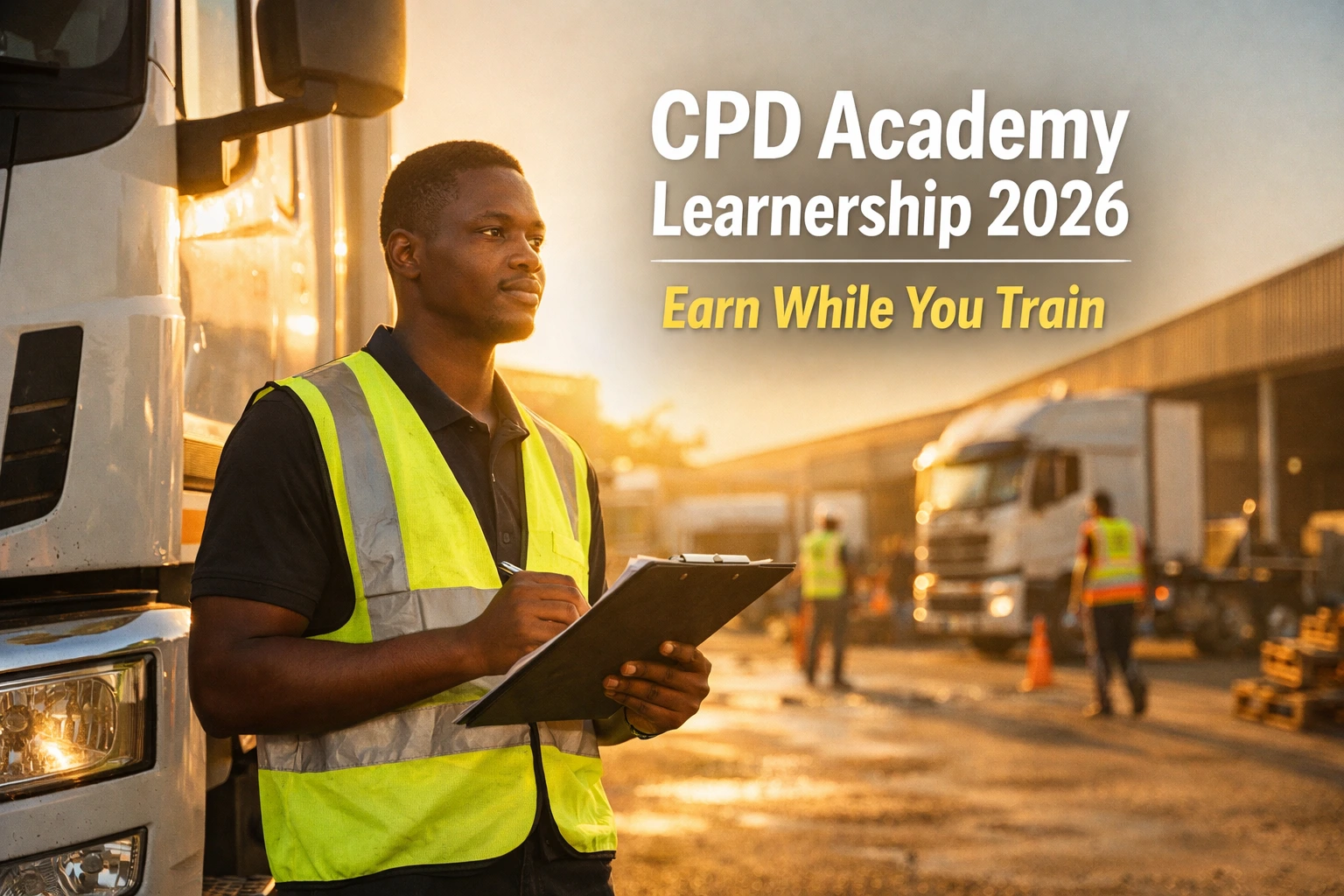
Explore how the CPD Academy Learnership 2026 offers unemployed South Africans real logistics training, a monthly stipend, and nationally recognised qualifications.
At sunrise in Nigel, Gauteng, a small group of hopeful applicants gathers outside a training campus. Some clutch neatly arranged document folders. Others rehearse answers quietly under their breath. A few arrived before 6am, determined not to miss the chance.
For many, this is not just another application day. It is a shot at stability — a way to move from uncertainty into structured opportunity. Programmes like the CPD Academy Learnership 2026 are becoming increasingly significant in South Africa’s evolving labour landscape, where experience has become the currency of employability.
The reality is simple but difficult: thousands of capable young people struggle to enter the workforce because they lack workplace exposure. Learnerships that combine real training with financial support are stepping in to fill that gap.
Understanding the CPD Academy Learnership 2026 in Today’s Job Market
The CPD Academy Learnership is designed as a structured 12-month training pathway that blends classroom learning with practical workplace experience. Participants work toward an occupational qualification registered on the National Qualifications Framework (NQF), while gaining exposure to sectors where demand for skilled workers continues to grow.
Logistics, transport operations, business administration, and fleet management are not always seen as glamorous career choices. Yet these industries form the backbone of South Africa’s economy. Every delivery truck on the N3, every warehouse operation near industrial zones, and every administrative system managing supply chains depends on skilled professionals.
By positioning learners directly within these environments, the programme creates an authentic learning experience. Participants are not simply absorbing theory — they are learning how real organisations operate under pressure, deadlines, and customer expectations.
This approach reflects a broader shift in workforce development. Employers increasingly prefer candidates who understand workplace culture, can manage tasks independently, and adapt to fast-changing operational demands.
Why Logistics Learnerships Are Becoming More Important
South Africa’s logistics sector has undergone noticeable transformation over the past decade. Growth in e-commerce, regional trade, and infrastructure investment has created new roles that did not exist in the past.
However, skills shortages remain a persistent challenge. Companies need employees who can coordinate deliveries, manage inventory systems, handle documentation, and ensure compliance with safety regulations.
The CPD Academy Learnership responds directly to these industry needs. Training is aligned with recognised authorities such as the Transport Education Training Authority and the Quality Council for Trades and Occupations, ensuring qualifications remain relevant nationwide.
For learners, this alignment offers reassurance. It means the skills they develop are transferable across provinces and employers, improving long-term career mobility.
A Day Inside CPD Academy Learnership 2026 Programme
Imagine stepping into a logistics training facility for the first time. The environment is structured but energetic. Whiteboards display delivery schedules. Computers track fleet movement. Trainers move between learners, explaining how administrative systems link to real transport operations.
Participants may rotate through several focus areas during the programme, including:
- Logistics and transport coordination
- Supply chain and warehouse support
- Business administration tasks
- Technical or fleet operations assistance
This variety helps learners identify where their strengths lie. Some discover a passion for operational planning. Others thrive in client communication roles or technical environments.
What matters most is exposure. By the end of the programme, learners gain a clearer understanding of workplace expectations — from time management to professional communication.
Financial Support That Makes Training Possible
One of the defining features of the CPD Academy Learnership is the financial support provided to participants.
Unlike unpaid internships that place pressure on already vulnerable households, this programme offers a monthly stipend to help learners cover essential living expenses. Reports from recent cohorts suggest allowances ranging between R4,200 and R5,100 per month.
While not equivalent to full employment salaries, this support can make a significant difference. It enables participants to focus on training without the constant stress of survival.
Fully funded training further strengthens the programme’s accessibility. Partnerships with industry stakeholders and training authorities ensure that successful applicants do not pay tuition fees.
This model reflects an important principle in skills development: opportunity should not be limited by financial background.
Expert Insight: Experience as the New Qualification
Labour analysts increasingly point to a shift in hiring priorities across South Africa. Formal education remains important, but practical experience is often what determines employability.
Learnerships like this create measurable advantages. Participants graduate not only with certificates, but with workplace references, operational familiarity, and industry networks.
For logistics companies facing operational risks, hiring someone who already understands systems and compliance requirements reduces onboarding time and training costs.
At a macroeconomic level, expanding workplace learning opportunities can help stabilise youth employment trends and strengthen sector productivity. 📦
Who Should Consider Applying
The CPD Academy Learnership is particularly suitable for individuals aiming to build careers in logistics, administration, or transport operations.
Eligibility requirements typically include:
- South African citizenship and a valid ID
- Unemployed status and availability for full-time training
- Minimum education level of Grade 10 or Matric
- Driver programme applicants may require a Code 14 licence and PrDP
Age guidelines vary depending on the training stream. Administrative pathways often target candidates aged 18 to 35, while driver-focused programmes may prioritise applicants between 25 and 35.
Applicants are encouraged to prepare certified documents, updated CVs, and proof of residence to streamline the application process.
These criteria are not arbitrary. They help ensure learners can fully commit to the programme and benefit from its structured learning environment.
Regional Impact: Why Gauteng Matters
Gauteng remains a central logistics hub in South Africa. Industrial corridors around Johannesburg, Nigel, and surrounding municipalities host transport companies, warehouses, and distribution centres that support national supply chains.
Learnership campuses located in these areas provide learners with proximity to real operational environments. This geographic advantage increases exposure to industry networks and potential employment pathways after completion.
For communities facing high unemployment, successful learnership placements can create ripple effects. Financial stability at household level often translates into improved access to education, healthcare, and local economic activity.
In this way, skills programmes contribute not only to individual advancement but also to broader community resilience.
How the Application Process Works
Applicants can typically choose between multiple application methods depending on convenience and availability.
Online applications allow candidates to submit documents through official platforms. Walk-in interviews offer immediate engagement opportunities, particularly at training campuses where recruitment teams assess readiness and motivation.
Email submissions provide an alternative for those unable to travel.
Regardless of method, preparation plays a decisive role. Arriving early, presenting organised documents, and demonstrating clear career interest can influence outcomes significantly.
First impressions matter in structured workplace training environments. They signal professionalism and commitment — qualities valued by both trainers and future employers.
APPLY HERE: CPD Academy Learnership 2026
Email Application: Send your documents to: info@cpda.co.za
ALSO APPLY FOR: DHL YES 4 Youth Learnerships 2026 – Boksburg Opportunities for Youth
Frequently Asked Questions
1. Does the CPD Academy Learnership guarantee a job after completion?
There is no automatic job placement guarantee, but learners gain recognised qualifications and practical experience that improve employment prospects significantly.
2. Can someone apply without Matric?
Yes. Some programme streams accept applicants with Grade 10, although requirements may vary depending on the training focus.
3. Is the stipend enough to live on?
The monthly allowance is intended to support basic expenses during training. Many learners view it as a stepping stone toward full employment income.
Looking Ahead: Skills, Confidence and Opportunity
In a country where the journey from education to employment can feel uncertain, initiatives like the CPD Academy Learnership 2026 offer something tangible — direction.
They remind young people that careers are not always built through sudden breakthroughs. More often, they grow through structured exposure, consistent effort, and the willingness to learn from real-world challenges.
For the logistics sector,CPD Academy Learnership 2026 programmes help build a workforce capable of sustaining economic growth and adapting to technological change. For learners, they represent proof that opportunity can be created, not just awaited.
As the morning crowd outside the Nigel campus slowly disperses after interviews, some applicants leave hopeful, others reflective. Yet all carry the same understanding: taking the first step matters.
Because in today’s evolving job market, experience does not simply open doors — it keeps them open. 🚛📈
About The Author
