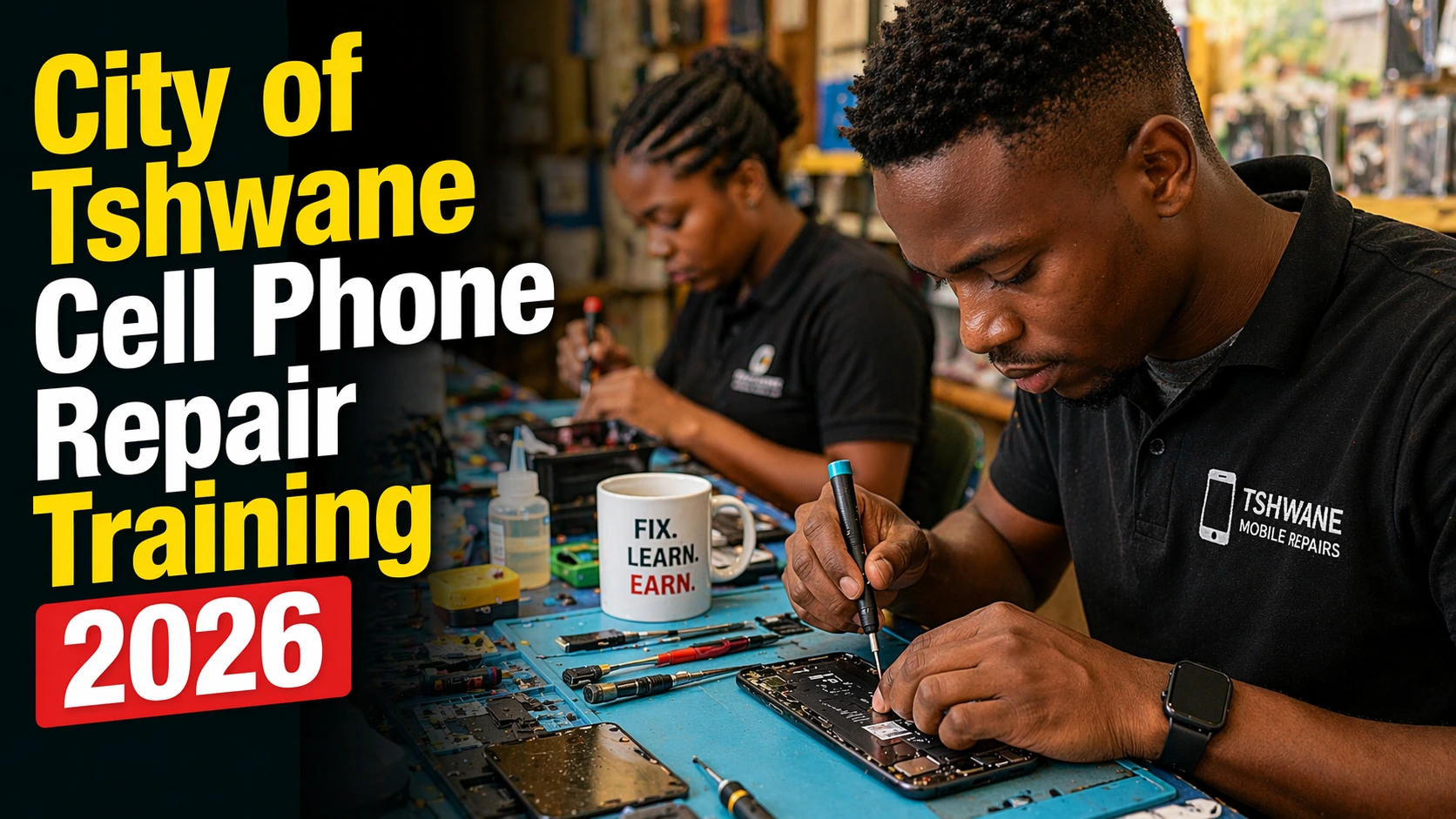
The City of Tshwane Cell Phone Repair Training 2026 offers experienced technicians a 3-month certification in Pretoria West. Learn how to apply before 20 April 2026.
On a busy street corner in Pretoria West, a small table sits under a faded umbrella. Wires, screens, and tiny screwdrivers are spread across the surface. Behind it, Kabelo leans over a cracked smartphone, carefully prying it open. He has fixed hundreds of devices like this — from water-damaged phones to shattered screens — all without formal training.
Customers trust him. His hands are steady. His knowledge is real.
But when it comes to growing his work into something bigger — a registered business, a proper stall, or access to funding — Kabelo hits a wall. His skills are there, but his status remains informal.
That is exactly where the City of Tshwane Cell Phone Repair Training 2026 steps in.
This initiative is not about teaching beginners how to fix phones. It is about recognising people like Kabelo — skilled, experienced, but overlooked — and giving them a pathway into formal participation in South Africa’s growing digital repair economy.
What Makes the City of Tshwane Cell Phone Repair Training 2026 Different?
Unlike many training programmes that start from the basics, the City of Tshwane Cell Phone Repair Training 2026 is built for those who are already in the field.
This is a three-month certification programme developed in partnership with the South African Mobile Device Distributors and Repairers Association (SAMDDRA). It focuses on formalising existing skills rather than introducing new ones from scratch.
Participants are not just trained — they are recognised.
By the end of the programme, successful candidates are listed on the City of Tshwane Traders Database. This single step can change how a technician operates within the local economy.
It means moving from being “just a guy who fixes phones” to being acknowledged as a legitimate service provider within the municipality.
Why Formalisation Matters More Than Ever
South Africa’s informal economy has always been a space of resilience and creativity. From street vendors to small repair businesses, millions of people earn a living outside formal employment structures.
But the challenge has always been the same: growth.
Without formal recognition, it becomes difficult to access:
- Municipal trading spaces
- Government support programmes
- Small business funding opportunities
- Partnerships with larger organisations
The City of Tshwane Cell Phone Repair Training 2026 directly addresses this gap.
By linking informal technicians to an official database, it creates a bridge between grassroots skills and structured economic participation.
And in a city like Pretoria, where digital device usage continues to grow rapidly, that bridge is becoming increasingly important.
Inside the Programme: What Participants Will Actually Learn
The three-month duration may seem short, but the focus is sharp and practical. This is not about theory-heavy learning — it is about refining and standardising real-world skills.
Participants will cover:
- Advanced hardware repair — including professional screen replacements and battery handling
- Software troubleshooting — unlocking, flashing, and maintaining devices
- Safety and compliance — especially when dealing with lithium-ion batteries and electronic waste
- Business development — understanding municipal regulations and trader compliance
For someone who has been working informally, this training can feel like switching from instinct to precision.
It’s the difference between guessing and knowing.
Who Should Apply for the City of Tshwane Cell Phone Repair Training 2026?
This programme is not open to everyone — and that is intentional.
It targets individuals who already have at least 12 months of experience in phone repair or related trading. That experience can be informal, home-based, or street-based.
Applicants must also:
- Be residents of Pretoria West or nearby areas
- Provide proof of residence
- Show willingness to be registered on the City’s traders database
- Demonstrate basic literacy and numeracy skills
Interestingly, Matric is not required.
This makes the City of Tshwane Cell Phone Repair Training 2026 one of the few opportunities that prioritises practical experience over formal education.
It recognises that skills are not always learned in classrooms.
Quick Facts: City of Tshwane Cell Phone Repair Training 2026
- Closing Date: 20 April 2026 (Midnight)
- Location: Pretoria West
- Duration: 3 Months
- Stipend: None (self-funded participation)
The Reality of a No-Stipend Programme
One of the most important aspects of the City of Tshwane Cell Phone Repair Training 2026 is that it does not offer a stipend.
At first glance, this may discourage some applicants.
But it also reflects the programme’s purpose.
This is not a financial relief initiative. It is a business development pathway.
Participants are expected to already be earning — even if modestly — through their repair work. The programme then builds on that foundation, helping them move toward sustainability and growth.
In other words, it is an investment.
For many, the long-term benefits — credibility, recognition, and access — outweigh the short-term lack of income support.
Expert Insight: Why Certification Changes the Game for Informal Technicians
The real power of the City of Tshwane Cell Phone Repair Training 2026 lies in something that is often overlooked — credibility.
In the repair industry, trust is everything.
Customers are handing over expensive devices containing personal data. One mistake can damage not only the phone but also the technician’s reputation.
Certification introduces:
- Standardisation — consistent methods and best practices
- Accountability — adherence to recognised guidelines
- Professional identity — being seen as a qualified technician
This shift can lead to higher customer confidence, better pricing opportunities, and repeat business.
Over time, it can transform a small informal setup into a stable, recognised enterprise.
SEE ALSO: I&J Yes4Youth Learnership 2026: How AVI Limited Is Opening Doors for Youth in Cape Town
How to Apply for the City of Tshwane Cell Phone Repair Training 2026
Where to Apply
Applicants should ensure they complete the form before the deadline: 20 April 2026 at midnight.
Required Documents
To strengthen your application, prepare the following:
- A clear copy of your ID
- Proof of residence (Pretoria West or nearby)
- An affidavit confirming at least 12 months of experience (if no Matric)
- Optional: Photos of your workspace or repair setup
APPLY HERE: Official City of Tshwane Repair Form
Providing evidence of your current work can significantly improve your chances.
It shows commitment and proves that you are already active in the field.
A Local Opportunity with Broader Implications
While the programme is based in Pretoria West, its impact goes beyond a single area.
South Africa’s digital economy is expanding rapidly. Smartphones are no longer luxury items — they are essential tools for communication, banking, education, and work.
As a result, the demand for repair services continues to grow.
But without proper regulation and support, the informal repair sector can struggle to keep up with technological advancements.
Initiatives like the City of Tshwane Cell Phone Repair Training 2026 represent a shift toward integration — bringing informal workers into a more structured ecosystem.
It’s not just about fixing phones.
It’s about building a sustainable, inclusive digital economy.
FAQ: City of Tshwane Cell Phone Repair Training 2026
1. Is this programme suitable for beginners?
No. Applicants must have at least 12 months of experience in phone repair or related work.
2. Will participants receive a stipend?
No, the programme is self-funded and does not offer a stipend.
3. What happens after completing the training?
Successful participants are listed on the City of Tshwane Traders Database, which can help them access trading opportunities and business support.
Conclusion: From Street Skill to Recognised Trade
Back at his table, Kabelo finishes repairing the cracked phone and hands it back to his customer. Another job done. Another small payment earned.
But now, there is a possibility of something more.
The City of Tshwane Cell Phone Repair Training 2026 is not just about learning new techniques. It is about recognition — about taking skills that already exist and placing them within a system that supports growth.
For many informal technicians, the journey to success is not about starting over. It is about being seen, validated, and given the tools to move forward.
And sometimes, all it takes is three months to change the direction of a career.
About The Author
