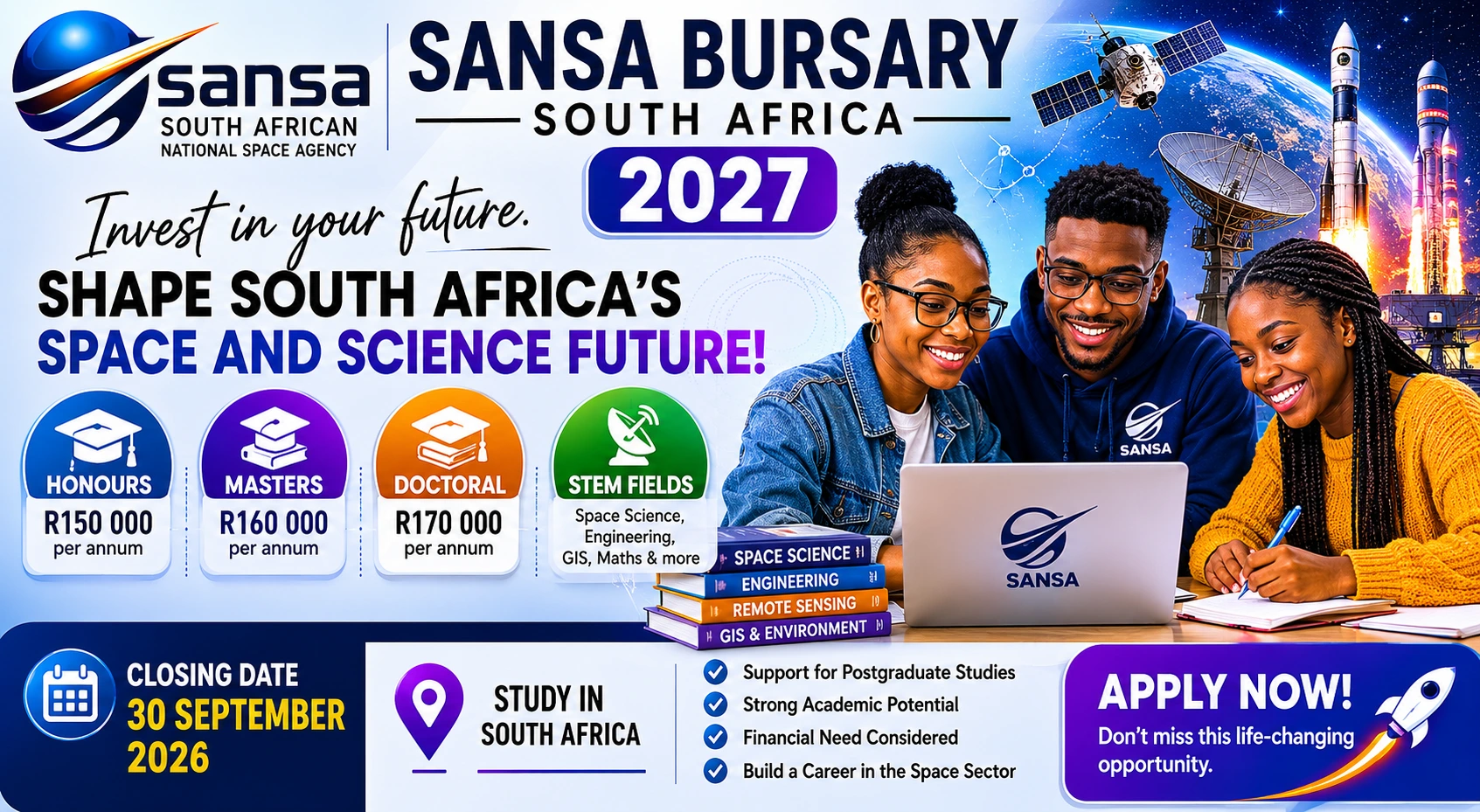
The SANSA Bursary South Africa 2027 programme offers an exciting opportunity for postgraduate students who want to pursue advanced studies in Science, Technology, Engineering, and Mathematics (STEM). Offered by the South African National Space Agency (SANSA), this bursary supports students who are passionate about research, innovation, technology, environmental science, engineering, and space-related fields.
As South Africa continues to invest in scientific advancement and technological innovation, the demand for highly skilled professionals in STEM disciplines continues to grow. However, postgraduate studies can be expensive, making financial support essential for many students. The SANSA Bursary Programme helps address this challenge by providing substantial funding to deserving students while contributing to the development of critical skills needed for South Africa’s future space and technology sectors.
For students interested in pursuing Honours, Master’s, or Doctoral studies, the SANSA Bursary South Africa 2027 could provide the financial support and academic opportunities needed to achieve their goals.
What You Should Know First
The SANSA Bursary South Africa 2027 is a postgraduate funding programme designed for students pursuing STEM-related qualifications.
Important details include:
- Application Closing Date: 30 September 2026
- Study Level: Honours, Master’s, and Doctoral studies
- Location: South Africa
- Honours Funding: R150 000 per annum
- Master’s Funding: R160 000 per annum
- Doctoral Funding: R170 000 per annum
- Focus on STEM disciplines
- Applicants must be 32 years old or younger
- Minimum academic average of 65% required
The programme supports students who demonstrate strong academic potential, financial need, and an interest in contributing to South Africa’s science and space sectors.
Understanding SANSA and Its Role in South Africa
The South African National Space Agency plays a vital role in advancing the country’s capabilities in space science, technology, and research.
SANSA is responsible for:
- Promoting the peaceful use of outer space
- Supporting scientific research
- Developing space technologies
- Advancing Earth observation capabilities
- Supporting innovation and engineering development
- Building South Africa’s space sector
The organisation contributes to national development by supporting research that addresses environmental challenges, technological advancement, infrastructure planning, agriculture, climate monitoring, and scientific discovery.
Through its bursary programme, SANSA invests directly in the development of future scientists, engineers, researchers, and innovators.
Why Postgraduate STEM Education Matters
Many students wonder why organisations place such emphasis on postgraduate STEM education.
The answer lies in the growing importance of science and technology in modern society.
Postgraduate research contributes to:
- Scientific discoveries
- Technological innovation
- Economic growth
- Environmental sustainability
- National competitiveness
- Problem-solving capabilities
Advanced qualifications help graduates develop specialised knowledge that can contribute to important industries such as aerospace, telecommunications, environmental management, artificial intelligence, engineering, and data science.
The SANSA Bursary Programme aims to strengthen South Africa’s capacity in these strategic fields.
Fields of Study Covered by the SANSA Bursary South Africa 2027
One of the strengths of the programme is the wide range of supported disciplines.
The bursary supports postgraduate studies in numerous STEM-related fields.
Space Science and Engineering
These fields are directly linked to SANSA’s core mission.
Examples include:
- Space Science
- Mechanical Engineering
- Electrical Engineering
- Electronic Engineering
- Mechatronics Engineering
- Computer Engineering
These disciplines support the development of advanced technologies used in the space industry and other high-tech sectors.
Computer and Information Sciences
Technology continues to transform industries across the globe.
Supported fields include:
- Computer Science
- Information Technology
- Information Systems
Graduates in these disciplines play important roles in software development, cybersecurity, artificial intelligence, data analytics, and digital innovation.
Environmental and Earth Sciences
Environmental monitoring is one of the key applications of space technology.
Supported disciplines include:
- Environmental Science
- Environmental Management
- Environmental Geology
- Environmental and Water Science
- Geography and Environmental Management
- Ecology and Resource Management
Researchers in these areas help address environmental challenges and support sustainable development.
GIS and Remote Sensing
Geographic Information Systems and remote sensing technologies are increasingly important across multiple industries.
Supported fields include:
- GIS and Remote Sensing
- Applied Remote Sensing
- Applied Remote Sensing and GIS
- Geoinformatics
- Geographical Information Systems
Example
Satellite imagery can be used to monitor drought conditions, track urban development, manage natural resources, and support disaster response efforts.
Students working in these fields contribute directly to solving real-world problems.
Mathematics and Physical Sciences
Mathematics and physics form the foundation of many scientific and technological advancements.
Supported disciplines include:
- Applied Mathematics
- Mathematics
- Physics
- Statistical Ecology
These fields provide critical analytical skills that support research and innovation.
Understanding the Value of the SANSA Bursary
The bursary offers substantial financial support that can help students focus on their studies and research.
Funding varies according to the level of study.
Honours Funding
Students pursuing Honours studies may receive:
R150 000 per annum
This funding can assist with tuition, research-related expenses, accommodation, learning materials, and other academic costs.
Master’s Funding
Students enrolled in Master’s programmes may receive:
R160 000 per annum
Master’s studies often involve significant research components, making financial support particularly valuable.
Doctoral Funding
Doctoral candidates may receive:
R170 000 per annum
Doctoral research frequently requires extensive investigation, specialised equipment, fieldwork, and academic resources.
The increased funding helps support these advanced research requirements.
Who Should Consider Applying?
The SANSA Bursary Programme is ideal for students who are passionate about science, technology, engineering, and research.
Suitable applicants often possess:
- Strong academic performance
- Curiosity and problem-solving abilities
- Interest in research
- Commitment to STEM fields
- Interest in space science and technology
- Long-term career ambitions within scientific industries
Students who enjoy innovation and contributing to technological advancement may find the programme particularly attractive.
Eligibility Requirements for SANSA Bursary South Africa 2027
Meeting the eligibility criteria is essential before applying.
Age Requirement
Applicants must be:
32 years old or younger
This requirement aligns with SANSA’s goal of supporting emerging researchers and professionals.
Academic Qualification Requirement
Applicants must be:
- Studying towards a postgraduate qualification, or
- Intending to pursue postgraduate STEM studies
Eligible levels include:
- Honours
- Master’s
- Doctoral studies
Academic Performance Requirement
Applicants must have achieved:
A minimum average of 65%
This requirement demonstrates academic capability and readiness for postgraduate research.
Financial Need Requirement
The bursary prioritises students who demonstrate financial need.
Financial assistance helps ensure that talented students are not prevented from pursuing advanced studies because of financial constraints.
Interest in the Space Sector
Applicants should show an interest in working within South Africa’s space science, technology, and innovation sectors.
This aligns with SANSA’s objective of developing future professionals who can contribute to national scientific advancement.
Required Supporting Documents
Many bursary applications are unsuccessful because applicants fail to submit all required documents.
Applicants should carefully prepare the following.
Certified Identity Document
Applicants must provide:
- Certified South African ID
- Certification completed within the last three months
- PDF format
Academic Record
Students must submit:
- Complete university academic record
- Results from first year onward
- Latest available results
This helps SANSA assess academic performance.
Financial Documentation
Applicants must provide:
- University fee statement, or
- NSFAS funding confirmation
This assists in assessing financial need.
Additional Documents for Master’s and Doctoral Applicants
Master’s and doctoral candidates must provide:
- SANSA testimonial
- Draft research proposal
- Supervisor endorsement
Master’s Proposal
Maximum length:
Two pages
Doctoral Proposal
Maximum length:
Four pages
These proposals help SANSA evaluate the quality and relevance of the applicant’s planned research.
How to Submit a Strong Application
A strong application requires more than meeting minimum requirements.
Step 1: Prepare Documents Early
Gather all supporting documents well before the deadline.
Step 2: Review Academic Records
Ensure all transcripts are complete and accurate.
Step 3: Develop a Strong Research Proposal
Master’s and doctoral applicants should clearly explain:
- Research objectives
- Expected outcomes
- Importance of the study
Step 4: Demonstrate Genuine Interest
Show how your studies align with scientific development and the space sector.
Step 5: Submit Before the Deadline
Avoid last-minute submissions that may result in errors or missing documents.
How to apply
Click here to apply for SANSA Bursary South Africa 2027.
Applicants must complete the online application form and upload all required supporting documents. Missing documents may lead to the application being disqualified.
Career Opportunities After Receiving the SANSA Bursary
The skills developed through postgraduate STEM education can lead to diverse career opportunities.
Graduates may pursue careers in:
- Research institutions
- Government agencies
- Engineering firms
- Technology companies
- Environmental organisations
- Universities
- Space science organisations
- GIS and remote sensing industries
Many fields supported by SANSA are expected to experience continued growth as technology becomes increasingly important across sectors.
See also: Discovery Long Term Insurance Learnerships 2026: Complete Educational GuideSEO Title
See also: Exxaro Graduate Internships 2026: Everything South African Graduates Should Know
Common Misunderstandings About SANSA Bursary South Africa 2027
“Only Space Scientists Can Apply”
This is incorrect.
The bursary supports a wide range of STEM disciplines beyond space science.
“Only Engineering Students Qualify”
Students in mathematics, environmental sciences, GIS, information technology, and other STEM fields are also eligible.
“You Need Perfect Marks”
Applicants need a minimum average of 65%, not perfect academic results.
“Research Proposals Must Be Extremely Technical”
Strong proposals should be clear, focused, and well-structured rather than unnecessarily complicated.
Key Takeaways
- The SANSA Bursary South Africa 2027 supports postgraduate STEM studies.
- Funding is available for Honours, Master’s, and Doctoral students.
- Honours students may receive R150 000 annually.
- Master’s students may receive R160 000 annually.
- Doctoral students may receive R170 000 annually.
- Applicants must be 32 years old or younger.
- A minimum average of 65% is required.
- Financial need and academic potential are important considerations.
- Applications close on 30 September 2026.
- Complete supporting documents are essential for a successful application.
Frequently Asked Questions
1. Can undergraduate students apply for the SANSA Bursary South Africa 2027?
No. The programme is specifically designed for Honours, Master’s, and Doctoral studies.
2. What is the minimum academic average required?
Applicants must have achieved a minimum overall average of 65% in their most recent year of study.
3. Does the bursary only support space science students?
No. SANSA supports a wide range of STEM disciplines, including engineering, mathematics, GIS, computer science, environmental science, and related fields.
4. When is the application closing date?
Applications close on 30 September 2026.
Final Thoughts
The SANSA Bursary South Africa 2027 represents an outstanding opportunity for talented postgraduate students who want to advance their studies in STEM disciplines. Through substantial financial support, SANSA helps develop the next generation of scientists, engineers, researchers, and innovators who will contribute to South Africa’s scientific and technological future. Students who meet the eligibility requirements are encouraged to apply early and ensure all supporting documents are submitted correctly before the closing date.
About The Author
