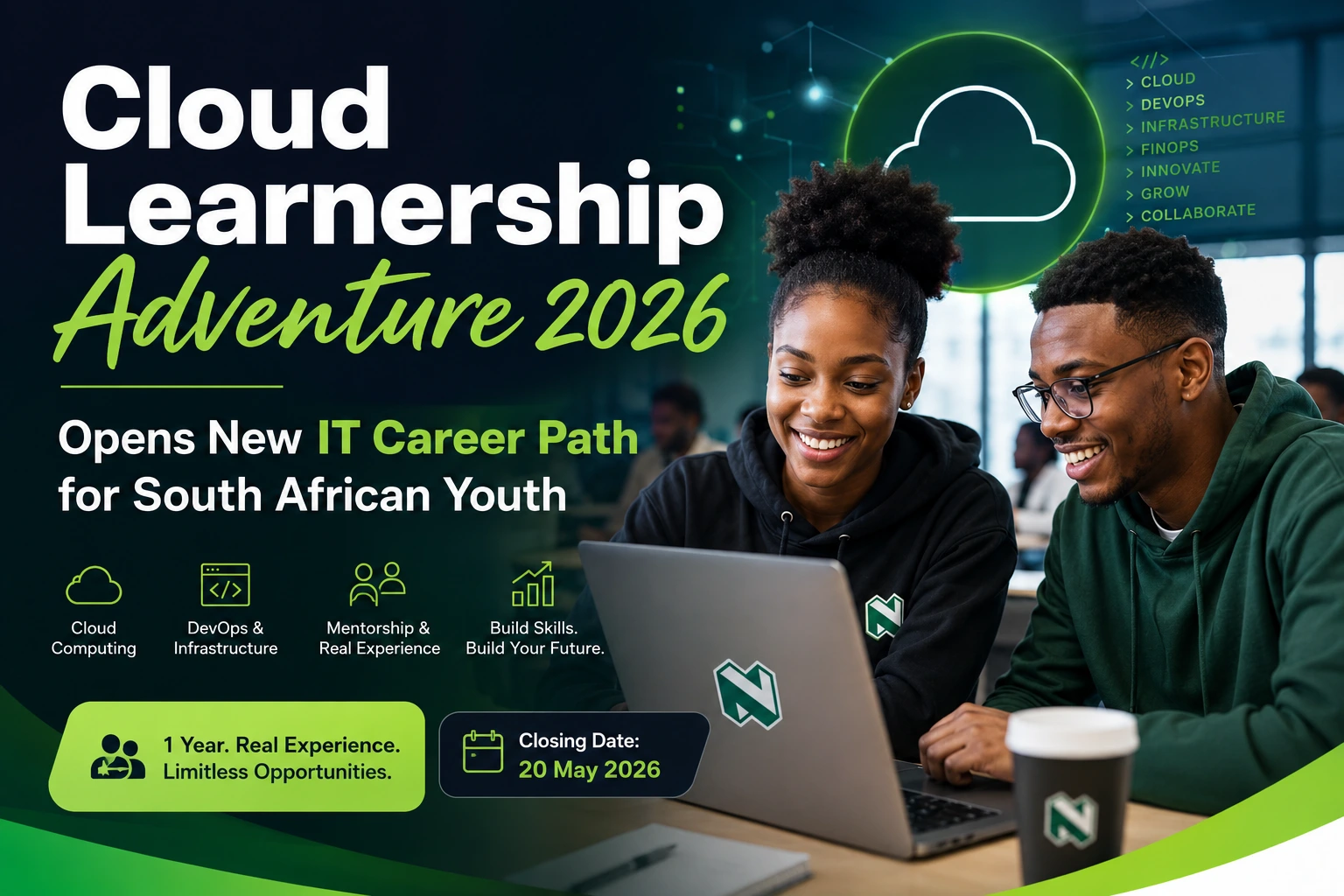
The Cloud Learnership Adventure 2026 offers South African IT graduates practical cloud computing experience, mentorship, and career development opportunities in a growing digital industry.
On a chilly Tuesday morning in Johannesburg, a recent IT graduate sat inside a crowded taxi scrolling through job listings on a cracked smartphone screen. Like thousands of young South Africans entering the technology field each year, he had qualifications, curiosity, and ambition — but very little workplace experience. Most positions demanded practical exposure to systems, cloud platforms, or development environments he had only encountered in theory.
That gap between education and employability has become one of the biggest challenges facing South Africa’s digital economy. Businesses are rapidly shifting to cloud infrastructure, automation, and hybrid technology systems, yet many entry-level candidates struggle to gain the experience employers expect.
The Cloud Learnership Adventure arrives at a moment when those challenges are becoming impossible to ignore. Designed as a one-year contract opportunity within the information technology space, the programme focuses on practical cloud computing exposure while helping young professionals build workplace confidence and technical capability.
For many aspiring developers, system administrators, and cloud specialists, this kind of programme is no longer just an optional stepping stone. It is increasingly becoming the bridge between classroom learning and meaningful employment in a competitive industry.
Quick Facts
- Closing Date: 20 May 2026
- Job Family: Information Technology
- Career Stream: IT Application Development
- Duration: 1 Year Contract
- Experience Required: 0–1 year
- Qualification Requirement: Matric plus IT certification, diploma, or degree
Why the Cloud Learnership Adventure Matters in 2026
South Africa’s technology sector has changed dramatically over the past few years. Banks, retailers, insurance companies, logistics firms, and even government departments are investing heavily in cloud-based systems to improve scalability, reduce infrastructure costs, and strengthen digital services.
This transformation has created demand for people with practical cloud-related skills. Companies now require junior professionals who understand cloud environments, DevOps workflows, automation tools, and digital infrastructure management.
The problem is that many graduates leave tertiary institutions with theoretical knowledge but limited exposure to real operational systems.
The Cloud Learnership Adventure attempts to address that gap directly by combining mentorship, technical learning, soft-skills development, and real workplace exposure.
Unlike older learnership models that focused mainly on administration or observational training, modern IT learnerships increasingly place participants inside active digital environments where they contribute to projects, collaborate with teams, and learn industry tools in real time.
That distinction matters because employers today often prioritize adaptability and practical problem-solving over memorised technical concepts alone.
Inside the Cloud Learnership Adventure Programme
The programme focuses on several key areas shaping the future of technology careers:
- Cloud computing
- Hybrid cloud environments
- Infrastructure systems
- DevOps principles
- FinOps concepts
- Cloud architecture fundamentals
These are not niche specialisations anymore. They are becoming foundational skills across the broader IT industry.
In simple terms, businesses are no longer asking whether they should adopt cloud technologies. They are asking how quickly they can scale them.
That means companies need people who can support cloud migration, monitor infrastructure, improve deployment efficiency, and help manage digital ecosystems.
Participants in the Cloud Learnership Adventure are expected to gain exposure not only to technical systems but also to workplace culture, communication, and professional accountability.
The programme also highlights something increasingly valued across the global technology industry: continuous learning.
Technology changes rapidly. Programming frameworks evolve. Security standards shift. Infrastructure models become more automated every year. The most successful IT professionals are often not those who know everything immediately, but those who adapt quickly and remain curious.
That is why the behavioural competencies mentioned in the programme — communication, organisation, continuous improvement, and eagerness to learn — are just as important as technical ability.
South Africa’s Growing Demand for Cloud Skills
Across Gauteng, the Western Cape, and other major economic regions, businesses are competing for cloud-skilled talent.
Financial institutions especially have accelerated their investment in digital transformation. Mobile banking, digital payment systems, AI-powered customer services, and cloud-hosted applications now form part of everyday business operations.
Consumers may only see the polished mobile app interface on their phones, but behind those platforms are large cloud ecosystems requiring developers, support teams, infrastructure specialists, and operational staff.
The Cloud Learnership Adventure speaks directly to this environment by introducing participants to the systems powering modern digital services.
For young South Africans struggling to enter the technology sector, that exposure can become extremely valuable.
Employers increasingly want candidates who understand how cloud systems work in real organisational settings rather than purely academic contexts.
A Different Kind of Entry-Level IT Opportunity
One of the more interesting aspects of the programme is its emphasis on both technical and personal development.
Many graduates underestimate how important professional behaviour becomes in technology careers. Companies often look for individuals who can communicate effectively, work in teams, manage deadlines, and adapt under pressure.
The learnership’s focus on resilience, innovation, and collaboration reflects how technology workplaces actually operate today.
Modern IT environments are rarely isolated coding spaces where individuals work entirely alone. Teams collaborate across departments, respond to incidents, improve systems continuously, and solve operational challenges together.
Participants are encouraged to:
- Take ownership of tasks
- Contribute ideas
- Improve workflows
- Build professional confidence
- Engage in company initiatives
These workplace habits can significantly influence long-term employability.
The Bigger Story Behind Learnerships and Youth Employment
South Africa’s youth unemployment crisis remains one of the country’s biggest economic and social challenges.
For many young people, obtaining qualifications is only the first hurdle. The next challenge is finding an employer willing to provide initial experience.
That is why technology learnerships have become increasingly important.
They help employers identify emerging talent while giving participants structured opportunities to develop workplace experience.
The Cloud Learnership Adventure reflects a broader shift in how organisations approach skills development. Rather than waiting for fully experienced candidates, many companies are beginning to invest earlier in talent pipelines.
This approach benefits both sides:
- Young professionals gain exposure and employability
- Organisations help address future digital skills shortages
In sectors like cloud computing, where demand continues to rise globally, building local talent capacity is becoming strategically important for South Africa’s economic competitiveness.
Expert Insight: Why Cloud Computing Skills Are Becoming Essential
Technology analysts increasingly describe cloud computing as the “electricity” of modern digital business — an invisible infrastructure powering nearly everything behind the scenes.
From streaming services and banking apps to healthcare platforms and logistics systems, cloud environments now support massive amounts of data, transactions, and communication.
For young professionals entering IT careers, cloud literacy is becoming less of a specialised advantage and more of a baseline expectation.
The deeper implication is that future technology jobs may increasingly revolve around integrating systems, automating workflows, improving scalability, and securing distributed digital environments.
That makes entry-level exposure to cloud operations particularly valuable in 2026 and beyond.
What Candidates Need to Qualify
The programme is open to individuals with:
- Matric plus an IT-related certification
- Diploma or degree in IT or related fields like engineering
- 0–1 year work experience
Candidates are also expected to demonstrate foundational coding or programming ability alongside strong problem-solving potential.
Importantly, the opportunity appears designed for individuals at the beginning of their careers rather than experienced professionals.
That makes it especially relevant for recent graduates, entry-level developers, aspiring cloud engineers, and young IT enthusiasts seeking practical industry exposure.
The Human Side of Technology Careers
One overlooked reality about technology careers is that many successful professionals started with uncertainty.
Very few junior candidates fully understand cloud architecture, DevOps pipelines, or enterprise infrastructure at the start of their careers.
What often separates successful candidates is willingness to learn consistently.
The programme’s emphasis on curiosity, adaptability, and resilience reflects this reality.
In South Africa’s fast-changing digital economy, technical knowledge alone is rarely enough. Employers increasingly value professionals who remain flexible and open to growth.
That mindset may ultimately matter more than perfect technical expertise at entry level.
Where to Apply
Applications for the Cloud Learnership Adventure close on 20 May 2026.
Interested candidates should apply through the official careers platform associated with the programme before the closing date.
Applicants are advised to prepare:
- An updated CV
- Certified qualifications
- Supporting IT certifications if available
- Clear contact details
APPLY HERE: Cloud Learnership Adventure 2026 Opens New IT Career Path for South African Youth
Because technology learnerships attract high levels of competition, candidates should ensure their applications are professional, accurate, and submitted early.
SEE ALSO: Discovery Long Term Insurance Learnerships 2026: Complete Educational GuideSEO Title
FAQ About the Cloud Learnership Adventure
Who can apply for the Cloud Learnership Adventure?
Candidates with Matric plus an IT-related qualification such as a certification, diploma, or degree can apply, especially those with little or no work experience.
Is the programme suitable for beginners in IT?
Yes. The opportunity targets individuals with 0–1 year experience and focuses on developing practical workplace skills.
What skills will participants learn?
Participants may gain exposure to cloud computing, infrastructure systems, DevOps, cloud architecture, teamwork, communication, and professional development.
Final Thoughts
The Cloud Learnership Adventure arrives during a critical moment for South Africa’s digital future.
As businesses accelerate cloud adoption and technology-driven services expand, the need for adaptable young IT professionals continues to grow. Yet many talented graduates remain locked out of opportunities because they lack workplace exposure.
Programmes like this matter because they address that disconnect directly.
They do more than provide temporary employment. They help participants enter the professional technology ecosystem, understand modern digital operations, and develop the confidence required to compete in an increasingly cloud-driven economy.
For ambitious young South Africans looking to begin a career in technology, the value of real-world exposure can be difficult to overstate.
And in 2026, cloud skills may become one of the most important career foundations a new IT professional can build.
About The Author
