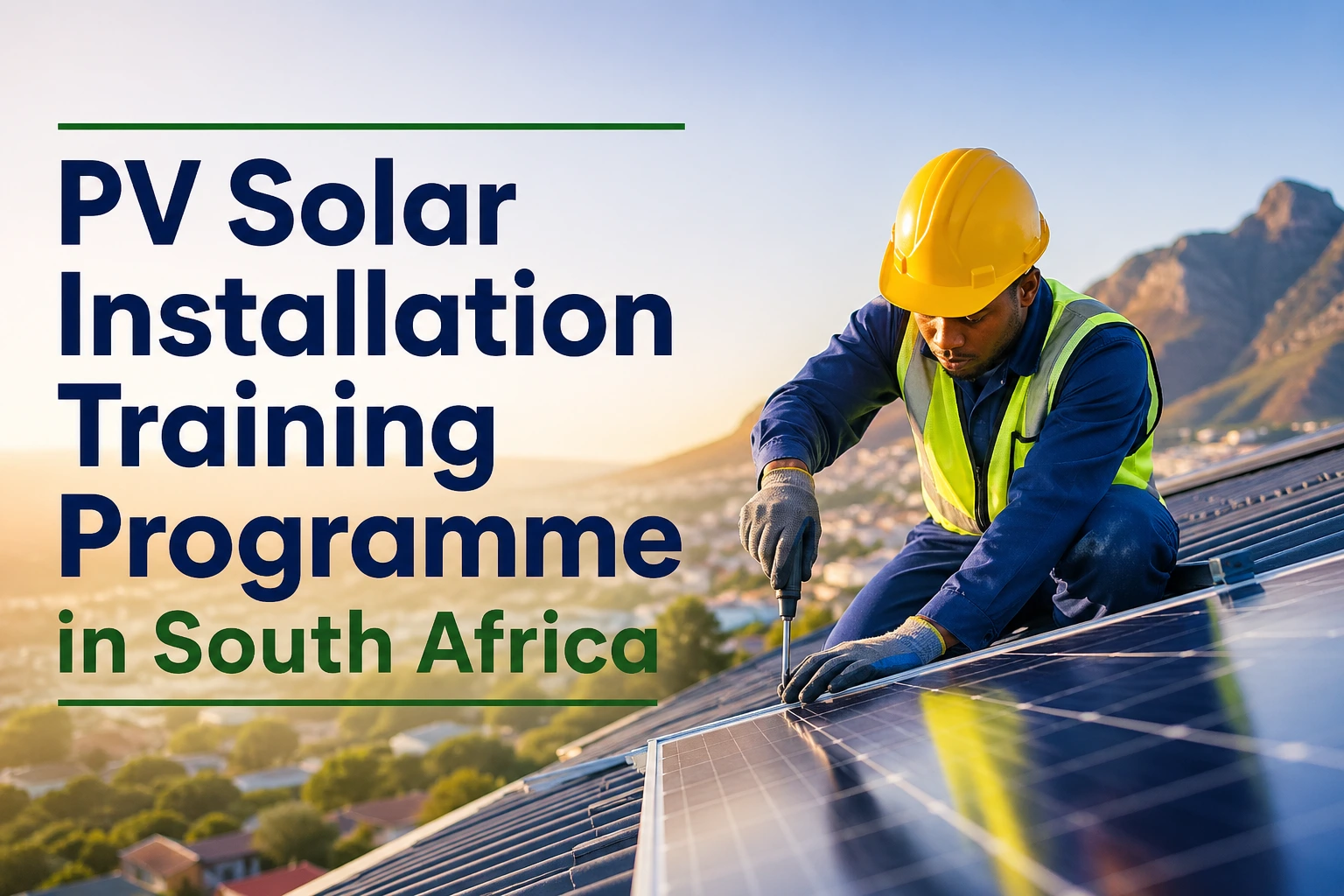
Explore the PV Solar Installation Training Programme by Sekhukhune Development Agency (SDA). Learn about requirements, benefits, and how it connects South Africans to renewable energy careers.
The first thing you notice is the silence.
No humming generator. No flickering lights. Just a steady glow from the ceiling as a small business owner in Groblersdal points proudly to the rooftop above. “We installed it ourselves,” he says, referring to the solar panels that now power his shop through daily load-shedding. What used to be downtime has turned into uninterrupted business hours—and behind that transformation is a skillset South Africa urgently needs.
This is exactly where the PV Solar Installation Training Programme comes in.
As the country grapples with an evolving energy crisis and a rapid push toward renewables, technical training initiatives like the one offered by the Sekhukhune Development Agency (SDA) are quietly reshaping the workforce. They are not just about skills—they’re about survival, opportunity, and long-term economic relevance.
A Turning Point for South Africa’s Energy Workforce
South Africa’s relationship with electricity has changed dramatically over the past decade. Load-shedding is no longer a temporary inconvenience; it’s a structural reality. Businesses, households, and municipalities are increasingly turning to solar solutions—not out of preference, but necessity.
This shift has created a demand surge for skilled solar installers.
Yet, demand alone doesn’t create opportunity. Training does.
The PV Solar Installation Training Programme offered through SDA is part of a broader effort to bridge this gap. It focuses on equipping individuals who already have an electrical engineering background with specialised, industry-recognised solar installation skills.
What makes this programme stand out is its alignment with real-world needs. It doesn’t just teach theory—it prepares participants for the exact environments they will enter after completion, from residential rooftops to municipal infrastructure projects.
What Makes the PV Solar Installation Training Programme Different?
At first glance, it may seem like another technical training course. But dig deeper, and its structure reveals a deliberate attempt to match industry expectations.
Participants don’t just sit in classrooms. They work with actual equipment, follow installation sequences, and learn safety compliance in real-time scenarios. This practical exposure is critical in a field where mistakes can be costly—or dangerous.
The programme also leads to a PV Green Card certification, a credential that has become increasingly valuable in South Africa’s solar sector. Employers often prioritise candidates with this certification because it signals readiness. It tells them the candidate understands installation standards, safety procedures, and compliance requirements.
There’s also a unique element that sets this initiative apart: exposure to scientific research.
Participants are introduced to advanced photovoltaic concepts through a study experience at the Council for Scientific and Industrial Research. This is not common in short-term training programmes and adds a layer of depth that goes beyond installation basics.
Inside the Training: Skills That Translate into Jobs
The curriculum of the PV Solar Installation Training Programme is designed with one clear goal—employability.
Participants gain hands-on experience in:
- Solar panel mounting and structural setup
- Basic photovoltaic system wiring
- Safety and compliance procedures
- Installation sequencing and workflow
- Troubleshooting and maintenance basics
- System inspection readiness
These are not abstract concepts. They are the daily tasks of a solar installer.
By the end of the PV Solar Installation Training Programme, participants are not just familiar with these tasks—they’ve practiced them in controlled, supervised environments. This significantly reduces the learning curve once they enter the workforce.
Employers notice the difference.
In a sector where time and precision matter, hiring someone who already understands installation workflows can save weeks of onboarding. That’s why programmes like this are gaining attention—not just from job seekers, but from companies looking to scale quickly.
Quick Facts About the Programme
- Closing Date: 15 May 2025 at 16:30
- Location: Sekhukhune Skills Centre, Limpopo
- Duration: Short-term intensive training (exact duration varies)
- Positions Available: 40
- Stipend: Not specified
Who Should Apply—and Why It Matters
This PV Solar Installation Training Programme is not open to everyone. It specifically targets individuals with a background in electrical engineering.
Minimum requirements include:
- N3–N6 Electrical Engineering qualification, or
- Diploma or Degree in Electrical Engineering
A Trade Test in Electrical Engineering is considered an advantage.
This focus is intentional. Solar installation is not an entry-level skill—it builds on existing technical knowledge. By targeting candidates who already have this foundation, the programme ensures a higher success rate and better job readiness.
But beyond eligibility, there’s a bigger question: why does this matter?
Because South Africa is not just facing an energy crisis—it’s undergoing an energy transition.
And transitions create winners and losers.
Those who adapt, reskill, and align with emerging industries position themselves for long-term relevance. Those who don’t risk being left behind in a shrinking job market.
Expert Insight: The Hidden Value of Solar Certification
From an industry perspective, certifications like the PV Green Card are becoming more than just a bonus—they are a filter.
Recruiters increasingly use them to separate candidates who understand compliance from those who don’t. In regulated environments, especially where insurance and municipal approvals are involved, certified installers reduce risk.
There’s also a broader implication.
As solar installations scale across South Africa, standardisation becomes critical. Certifications help ensure that installations are safe, efficient, and compliant with national guidelines. This protects not just businesses, but the entire energy ecosystem.
In that sense, the PV Solar Installation Training Programme is not just training individuals—it’s contributing to the stability of the sector itself.
Real-World Impact: From Training to Opportunity
It’s easy to think of training programmes as temporary interventions. But their real impact is long-term.
Graduates of the PV Solar Installation Training Programme can move into:
- Solar installation companies
- Renewable energy contractors
- Municipal infrastructure projects
- Small business solar support roles
- Entry-level entrepreneurship in solar services
In many cases, these roles offer more stability than traditional entry-level jobs.
There’s also an entrepreneurial angle.
With the right tools and network, a trained installer can start offering services independently—installing backup systems, maintaining solar setups, or partnering with suppliers. In a country where small businesses are a key economic driver, this matters.
Where to Apply
Applications for the PV Solar Installation Training Programme can be submitted through the following methods:
- Online: Apply via Google Form (official application link provided by SDA)
- In Person: Submit your CV and certified documents at Bareki Mall, Groblersdal
- Contact: SDA Communications – 076 360 2091
APPLY HERE: PV Solar Installation Training Programme
Make sure all required documents are prepared, including certified copies of your ID and qualifications.
Frequently Asked Questions
1. Is the PV Solar Installation Training Programme free?
The programme does not clearly state fees, but similar initiatives are often subsidised. Applicants should confirm during the application process.
2. Do I need prior solar experience to apply?
No, but you must have an electrical engineering qualification. The programme builds on that foundation.
3. What happens after completing the programme?
Participants receive a PV Green Card certification, which can improve job prospects in the renewable energy sector.
The Bigger Picture: Skills That Power the Future
South Africa’s energy story is still being written.
From large-scale renewable projects to small rooftop installations, the country is steadily moving toward a more decentralised energy system. This shift is not just about technology—it’s about people.
The electricians who retrain as solar installers.
The graduates who pivot into renewable energy.
The communities that build resilience through local skills.
The PV Solar Installation Training Programme sits at the intersection of all these changes.
It’s not a silver bullet. It won’t solve unemployment overnight. But it represents something more realistic—and more powerful: a pathway.
A pathway for technically skilled individuals to align themselves with one of the fastest-growing sectors in the country. A pathway that turns knowledge into practical ability. And, ultimately, a pathway that connects South Africa’s energy challenges with human potential.
In a time of uncertainty, that kind of alignment is not just useful—it’s necessary.
About The Author
