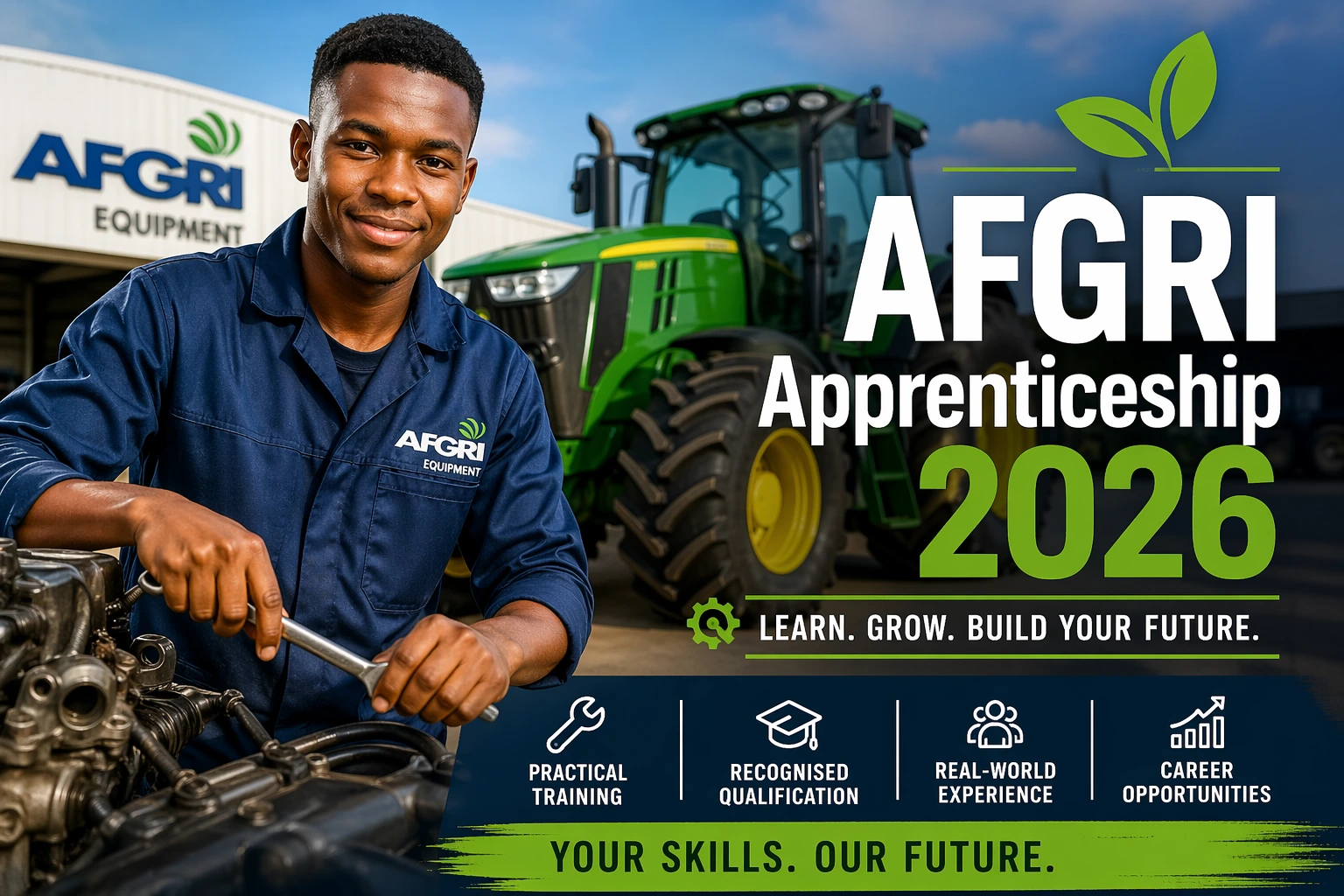
Discover the AFGRI Apprenticeship 2026 in South Africa. Learn about requirements, benefits, training structure, and how to apply for this 3-year technical opportunity.
The early morning sun hasn’t fully risen over a farm outside Bethal, but the day has already begun. A young apprentice wipes grease from his hands after helping repair a tractor that will soon head back into the fields. It’s not glamorous work, but it’s steady, skilled, and deeply needed. In a country where youth unemployment remains one of the biggest challenges, opportunities like the AFGRI Apprenticeship 2026 are quietly shaping a different kind of future—one built on technical expertise and real-world experience.
For many young South Africans, especially those outside major metros, traditional career paths don’t always feel accessible. University isn’t always an option. But industries still need skilled hands—and that’s where apprenticeships step in.
What You Should Know First
The AFGRI Apprenticeship 2026 is a structured 3-year training programme designed to develop qualified Tractor Mechanics and Earthmoving Mechanics. It combines practical, hands-on work with formal technical training, offering a direct route into the agricultural and mechanical sectors.
Unlike short-term learnerships, this apprenticeship is a long-term commitment with real career potential—particularly in industries that keep South Africa’s economy moving.
A Network That Reaches Beyond the Workshop
One of the defining aspects of AFGRI Equipment is its reach. Since becoming a John Deere agency in 1962, the company has expanded across a wide network of branches—from Polokwane to George, and even internationally into Botswana, Kenya, and Australia.
This matters more than it might seem at first glance.
Apprentices aren’t just trained in isolation. They become part of a system that supports agriculture, construction, and forestry industries—sectors that are critical to South Africa’s infrastructure and food security. Whether servicing tractors in rural areas or maintaining heavy machinery in industrial zones, apprentices gain exposure to real operational environments.
And that exposure translates into employability.
Inside the AFGRI Apprenticeship 2026
The structure of the programme reflects a balance between theory and practice, but also accountability.
The first six months act as a probation period. It’s a mutual test—both the apprentice and AFGRI assess whether the fit is right. After that, successful candidates enter into a formal contract and begin the full training programme.
Training includes:
- Practical workshop experience
- Distance learning through technical colleges
- Product-specific training from specialists
- Occasional Saturday classes
- Internal training sessions led by AFGRI experts
What stands out is the integration of industry bodies like AgriSETA and MerSETA. These organizations ensure that the training aligns with national standards, giving apprentices recognized qualifications that carry weight in the job market.
But there’s also a clear expectation: if you fail a phase, you’ll need to repeat it at your own cost. It’s a system that rewards commitment and discipline.
Why Technical Apprenticeships Are Gaining Ground
In recent years, there’s been a noticeable shift in how young South Africans approach careers. While degrees still matter, there’s growing awareness that technical skills can offer faster, more stable entry into the workforce.
The AFGRI Apprenticeship 2026 reflects this shift.
Agriculture and heavy machinery sectors aren’t shrinking—they’re evolving. Modern tractors and earthmoving equipment are increasingly sophisticated, requiring technicians who understand both mechanics and technology. This creates a steady demand for skilled professionals who can maintain and repair these systems.
In regions like Middelburg or Pietermaritzburg, where agriculture and logistics play a key role, these skills are particularly valuable.
Expert Insight: The Real Value Behind the Apprenticeship
From a workforce development perspective, programmes like the AFGRI Apprenticeship 2026 do more than train individuals—they strengthen entire industries.
South Africa faces a persistent skills gap in technical trades. While many young people are unemployed, industries struggle to find qualified technicians. Apprenticeships bridge that gap by aligning training directly with industry needs.
The inclusion of a work-back period—where apprentices are expected to remain with the company after qualifying—also ensures that skills are retained within the local economy, rather than lost to migration or job-hopping.
In the long term, this model supports sustainability: businesses get skilled workers, and individuals gain stable, long-term careers.
What It Takes to Get In
The entry requirements are straightforward, but not necessarily easy.
Applicants need:
- A valid driver’s license
- Grade 12 with Mathematics or Technical Mathematics (not Mathematical Literacy)
- Strong communication and administrative skills
- Basic computer literacy
Subjects like Engineering Graphics & Design or Diesel Trade Theory are advantageous, but not mandatory.
More importantly, AFGRI looks for behavioral qualities—attention to detail, teamwork, and motivation. In a workshop environment, these traits often matter just as much as technical knowledge.
Quick Facts: AFGRI Apprenticeship 2026
- Closing Date: 30 September 2026
- Location: Across South Africa (multiple branches)
- Duration: 3 years (up to 4 years maximum)
- Positions Available: 40
- Reference Number: AO-2345
- Stipend: Market-related
Where to Apply
To apply for the AFGRI Apprenticeship 2026, candidates need to complete the official application and screening process through AFGRI’s recruitment platform.
APPLY HERE: AFGRI Apprenticeship 2026
Be prepared to spend at least 30 minutes on the assessment questions, as they are part of the evaluation process. Shortlisted candidates will be invited for interviews and further assessments.
The Commitment Few Talk About
While the opportunity is attractive, it comes with a level of commitment that shouldn’t be overlooked.
The apprenticeship is bound by a contract, and if a candidate withdraws early—or leaves before completing the required work-back period—they may be required to repay training costs.
This isn’t unusual in technical training programmes, but it does mean applicants should think carefully before applying. It’s not just a short-term opportunity—it’s a multi-year investment.
SEE ALSO: Siza Water Plumber Learnerships 2026: Requirements, Application Guide & Career Opportunities
Frequently Asked Questions
1. Can I apply without Technical subjects in matric?
Yes, but having subjects like Physical Science or Engineering Graphics can improve your chances.
2. Is the AFGRI Apprenticeship 2026 paid?
Yes, apprentices receive a market-related stipend during the programme.
3. What happens after completing the apprenticeship?
Successful apprentices can qualify as Tractor or Earthmoving Mechanics, opening doors to employment within AFGRI or across the broader industry.
A Different Kind of Career Path
Not every career begins in an office. Some start in workshops, in fields, or on construction sites—places where skills are learned through doing, not just studying.
The AFGRI Apprenticeship 2026 represents one of those paths.
For young South Africans willing to commit to the process, it offers more than just training. It offers direction. In a country where uncertainty often defines the job market, that kind of clarity is rare—and valuable.
And as the apprentice in Bethal finishes tightening the final bolt and watches the tractor roll back into the field, it becomes clear: this isn’t just about fixing machines. It’s about building something that lasts.
About The Author
