Necsa Generic Management Learnership 2026 (NQF Level 5) in Pretoria. Learn requirements, benefits, skills gained, and application steps.
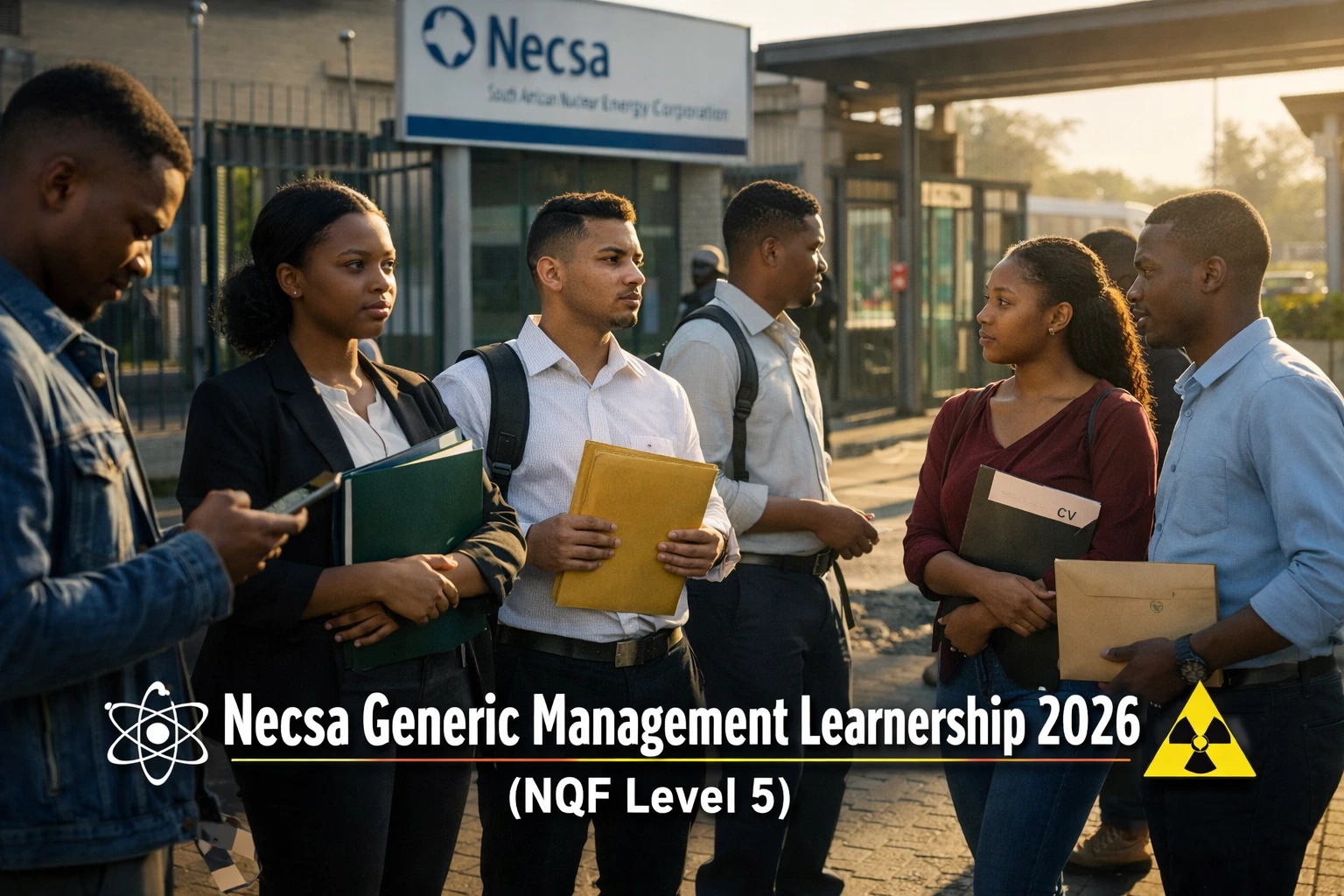
The sun rises slowly over the quiet security gates at Pelindaba, just outside Pretoria. A small group of young South Africans wait patiently, clutching document files and carefully printed CVs. Some travelled overnight from Limpopo, others from townships across Gauteng. Their conversations drift between nerves and hope — this could be the day their lives begin to change.
Inside this high-security research environment operated by the South African Nuclear Energy Corporation, leadership development is not just theory. It is a daily reality. And in 2026, the organisation is once again opening its doors through the Necsa Generic Management Learnership 2026, a programme that has quietly become one of the most meaningful entry pathways for matriculants seeking real workplace exposure.
Located at the Pelindaba site, this 12-month learnership offers something rare: the chance to move directly into an NQF Level 5 qualification, bypassing lower entry-level training routes. For thousands of unemployed youth navigating a competitive job market, this represents more than training — it represents momentum.
Understanding the Necsa Generic Management Learnership 2026
At its core, the Necsa Generic Management Learnership 2026 is designed to develop foundational leadership and operational skills within a structured scientific and industrial environment. While the qualification itself focuses on management competencies rather than nuclear engineering, the workplace context adds significant credibility.
Participants are exposed to real organisational processes: planning meetings, performance monitoring discussions, customer-focused service strategies, and cross-department collaboration. This is not simulated classroom learning alone. Instead, the programme integrates theory with practical workplace tasks that mirror real junior supervisory responsibilities.
In South Africa’s current labour landscape — where employers increasingly prioritise demonstrated workplace readiness — programmes like this are gaining relevance. Youth unemployment remains persistently high, and many graduates struggle with the gap between academic achievement and professional experience. Necsa’s learnership model attempts to address precisely this gap.
Quick Intake Facts for 2026
- Organisation: Necsa SOC Ltd
- Programme: Generic Management Learnership (Reference NE-861)
- Location: Pretoria (Pelindaba site)
- Duration: 12 months
- Qualification Level: NQF Level 5 (Higher Certificate equivalent)
- Closing Date: 30 March 2026
- Stipend: Market-related learnership allowance
While stipends vary based on SETA guidelines, the real value often lies in skills acquisition and future employability rather than immediate financial gain.
Why the Necsa Learnership Matters in Today’s Job Market
South Africa’s workplace environment is evolving rapidly. Automation, digital transformation, and organisational restructuring mean that transferable skills — communication, adaptability, leadership — are becoming as important as technical expertise.
The Necsa Generic Management Learnership 2026 reflects this shift. Its “generic” label may sound broad, but that breadth is intentional. Participants gain exposure to competencies that apply across industries, including banking, retail, logistics, mining, and government administration.
For matriculants who may not have access to university funding or who prefer experiential learning, this creates an alternative route into the professional world. It also helps address the psychological barrier many young job seekers face: the perception that meaningful career progression is only possible through traditional academic pathways.
Furthermore, Necsa Generic Management Learnership 2026 (NQF Level 5) programme’s location in Gauteng — the economic heart of South Africa — places learners within proximity of diverse employment opportunities after completion.
What Participants Will Learn During the Programme
Unlike passive training initiatives, the Necsa learnership emphasises structured skill development across multiple domains. Participants are expected to engage actively with assignments, workplace projects, and mentorship activities.
Key learning areas include:
- Strategic Leadership: Understanding operational plans and implementing structured change initiatives.
- Performance Monitoring: Measuring productivity, service delivery outcomes, and customer satisfaction.
- Team Coordination: Leveraging team strengths to improve efficiency.
- Relationship Management: Communicating effectively across departments and organisational levels.
- Workplace Readiness: Practical coaching on CV development, interview preparation, and professional conduct.
These modules align with broader national skills development priorities, particularly the emphasis on managerial capacity building at entry levels.
Eligibility Requirements for the Necsa Generic Management Learnership 2026
To maintain programme quality and compliance with national youth development frameworks, Necsa has outlined specific criteria for applicants.
Applicants must:
- Be unemployed South African citizens
- Be between 18 and 35 years old
- Hold a completed Grade 12 (Matric) certificate
- Have a clean criminal record (security clearance is required)
- Not have previously participated in another learnership or internship
These conditions aim to ensure equitable access while prioritising first-time workplace exposure for young people.
The “Management Shortcut”: Why NQF Level 5 Changes Career Trajectories
Expert Insight
In South Africa’s qualification framework, each NQF level signals a distinct capability threshold. Completing an NQF Level 5 programme like the Necsa Generic Management Learnership effectively moves a candidate into the higher education qualification category, even without attending a traditional tertiary institution.
This shift has practical implications.
Employers often use qualification levels as quick screening tools during recruitment. While matric (NQF Level 4) demonstrates foundational knowledge, Level 5 suggests applied learning and workplace competency. This can make candidates eligible for entry-level supervisory roles or administrative leadership positions. Necsa Generic Management Learnership 2026 (NQF Level 5).
Equally important is the reputational impact. Having a recognised state-owned scientific organisation on one’s CV signals discipline, security awareness, and adaptability — qualities valued across sectors.
In this sense, the learnership functions as both a training opportunity and a career positioning strategy.
How to Apply for the Necsa Generic Management Learnership 2026
Necsa uses a digital recruitment system, reflecting broader public-sector shifts toward streamlined application processes.
Applicants should follow these steps:
- Visit the official recruitment portal.
- Search for reference NE-861 (Generic Management Learnership).
- Register and complete the online profile.
- Upload certified copies of ID and Matric certificate in PDF format.
- Submit the application before 30 March 2026.
Hand-delivered applications are typically not accepted due to security protocols at the Pelindaba facility.
Attention to detail matters. Incorrect contact information or incomplete document uploads can result in automatic disqualification.
Beyond Training: Exposure to a Unique Work Environment
Working within the broader ecosystem of the South African Nuclear Energy Corporation introduces learners to a highly regulated operational environment.
Even though participants are not directly involved in nuclear science activities, they observe structured safety procedures, disciplined workflow systems, and strict accountability measures. This exposure can shape professional habits that remain valuable throughout their careers.
It also highlights a broader societal dimension: South Africa’s scientific and technological infrastructure relies not only on engineers and researchers, but also on capable managers who ensure projects run efficiently.
For learners from under-resourced communities, stepping into such a space can be transformative — expanding both career horizons and personal confidence.
Regional Impact: Why Programmes Like This Matter for Pretoria and Gauteng
Gauteng continues to attract internal migration due to its economic opportunities, yet this influx also intensifies job competition. Skills programmes anchored in the region therefore play a dual role: supporting individual development while contributing to local workforce sustainability.
The Necsa learnership contributes to this ecosystem by equipping young people with competencies that can be deployed across industries within the province. Over time, such initiatives help build managerial capacity in small businesses, municipalities, and corporate sectors alike.
In a broader national context, they support government strategies aimed at reducing youth unemployment through structured workplace learning.
Where To Apply
APPLY HERE: Necsa Generic Management Learnership 2026
ALSO APPLY FOR: Munich Re Life Claims Graduate Learnership 2026: A Real Stable Path Into Insurance Careers
FAQ: Necsa Generic Management Learnership 2026
Necsa Generic Management Learnership 2026
No. Like most learnerships, it focuses on training and experience. However, the qualification and exposure can significantly improve future job prospects.
Can applicants with post-matric qualifications apply?
Generally, the programme prioritises candidates without prior learnership or internship experience, but having additional qualifications does not automatically disqualify an applicant.
Is relocation required for learners outside Gauteng?
Yes, learners may need to arrange accommodation near the Pelindaba site if selected.
Looking Ahead: The Bigger Picture for South African Youth
The story that begins at the Pelindaba gates each year is about more than a single programme. It reflects a generation searching for structured opportunities in a complex labour market.
The Necsa Generic Management Learnership 2026 illustrates how targeted workplace learning can bridge the gap between education and employment. By offering an NQF Level 5 pathway within a respected national institution, the programme demonstrates that career progression is not always linear — sometimes it emerges from strategic exposure and skill development.
For policymakers, such initiatives underscore the importance of sustained investment in youth training. For employers, they highlight the value of cultivating adaptable entry-level managers. And for applicants themselves, they represent a chance to redefine what is possible after matric. Necsa Generic Management Learnership 2026.
As the application deadline approaches, hundreds of young South Africans will once again weigh their options, update their CVs, and take a step toward uncertain but promising futures. In that quiet moment of decision lies the real significance of programmes like this — the possibility of movement, growth, and long-term impact. Necsa Generic Management Learnership 2026.
About The Author
