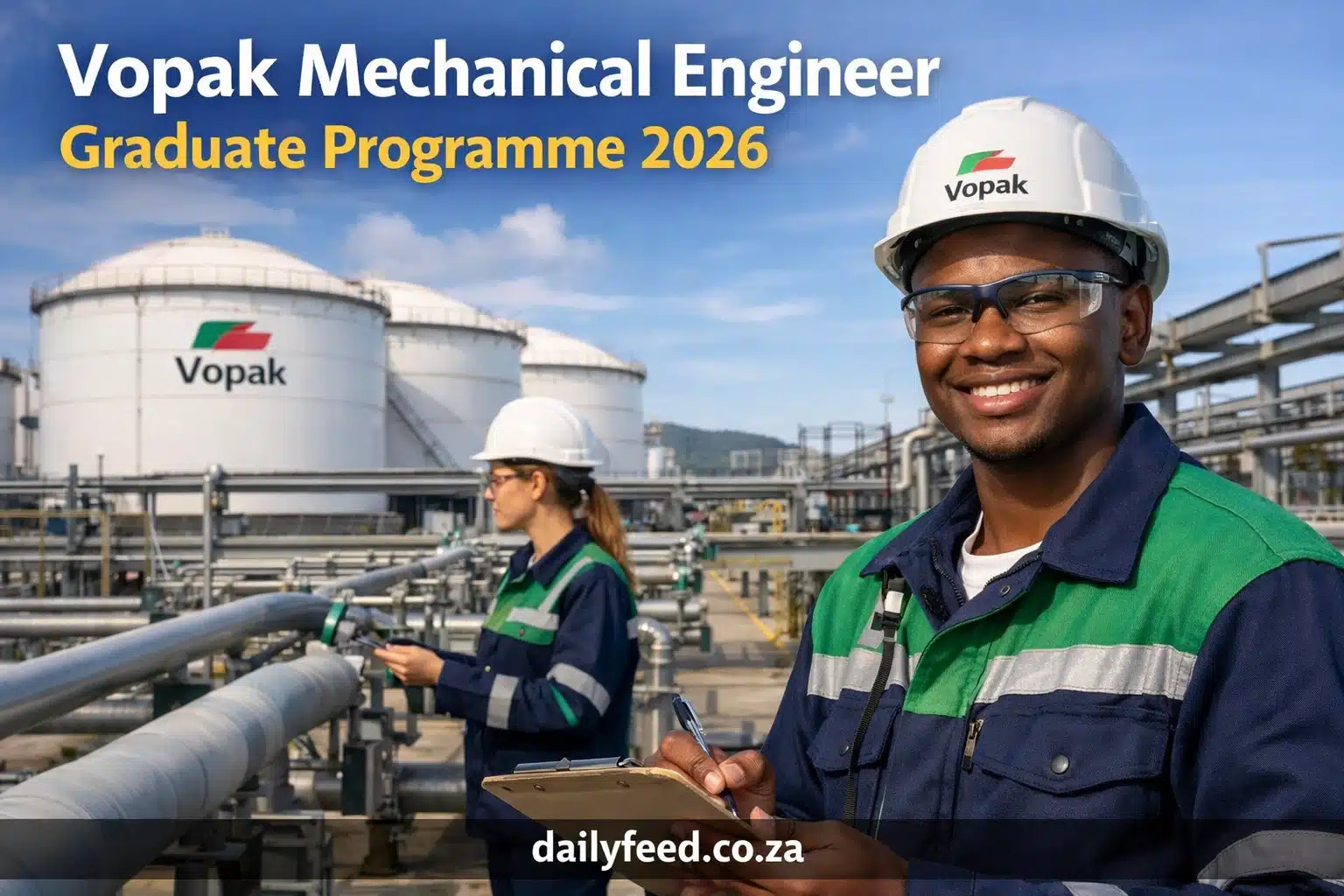
Graduating as a mechanical engineer can feel like standing at a crossroads.
If you’re finishing your BTech, BEng, or BSc Eng and still need workplace exposure, this opportunity may matter more than you think.
The Vopak Mechanical Engineer Graduate Programme 2026 arrives at a time when industries are under pressure to modernise, decarbonise, and operate more safely. For young engineers, structured training is no longer just “nice to have” — it’s becoming essential.
Why this programme feels timely
Across South Africa and globally, companies handling energy and chemicals are navigating two competing demands: reliability and transition. Facilities must run without failure, yet they must also adapt to cleaner fuels, new regulations, and stricter safety standards.
A graduate programme placed inside a maintenance and technical environment offers a front-row seat to these realities.
Instead of learning from textbooks alone, graduates see how pumps fail, how corrosion is managed, how shutdowns are planned, and how safety systems influence every engineering decision.
That context is difficult to simulate in a classroom.
ALSO APPLY FOR: FAIS Ombud HR Graduate Internships 2026 Bring Real Hope for Unemployed Graduates in Pretoria
What the 12-month experience typically involves
The programme is structured as a 12-month fixed-term contract, combining on-the-job learning with personal and career development.
Graduates are exposed to Vopak South Africa’s Maintenance & Technical portfolio, supporting the Maintenance Department in daily operations and projects tied directly to departmental targets.
In practical terms, that often means:
- Assisting with preventive and corrective maintenance activities
- Observing inspections, troubleshooting, and root cause analyses
- Supporting documentation, reporting, and compliance processes
- Participating in technical improvement or reliability projects
- Learning how safety protocols shape engineering work
This kind of rotation helps graduates understand that engineering is not only about design, it’s about uptime, risk reduction, communication, and decision-making under constraints.
The skills that quietly matter most
The technical requirements are clear: a completed qualification in Mechanical or Electro-mechanical Engineering and a strong academic record (75%+ average).
But graduate success usually depends on less obvious qualities.
Attention to detail becomes critical when dealing with equipment integrity and safety procedures. Small oversights can carry large consequences in storage and terminal environments.
Communication skills also stand out. Maintenance engineers spend significant time explaining issues, presenting findings, and coordinating with operations, contractors, and safety teams.
The ability to apply theory separates strong graduates from struggling ones. Knowing thermodynamics or mechanics is valuable; knowing how those principles explain vibration, heat buildup, or fatigue in real equipment is transformative.
ALSO APPLY FOR: Canyon Coal Khanye Colliery Internship 2026 is Open! Your Future in Mining Starts Here
What graduates can realistically expect
It’s important to approach programmes like this with balanced expectations.
You’re unlikely to be handed major design authority in month one. Early stages often involve observation, assisting senior engineers, and learning procedures.
Some graduates find this slower pace frustrating. Others recognise it as essential groundwork.
There may be exposure to:
- Equipment inspections and condition monitoring
- Maintenance planning systems
- Reliability and asset management concepts
- Safety and risk management processes
- Cross-functional teamwork
The learning curve can feel steep, especially for those transitioning from academic environments into highly regulated operational settings.
The support structures worth noting
The programme mentions several forms of support:
- A competitive stipend with allowances
- A wellness agenda focused on work/life balance
- A diverse and inclusive work environment
- Cross-functional projects for broader business exposure
- Assistance with a Portfolio of Evidence (PoE) if required
For graduates still completing work-integrated learning requirements, PoE support can be particularly valuable. Many students struggle to secure placements that align with academic criteria.
A reality check: who this suits best
This programme is especially relevant for graduates who:
- Require work-integrated learning experience to obtain their qualification
- Have strong academic discipline
- Are curious about maintenance, reliability, or operations
- Are comfortable learning through observation and gradual responsibility
- Value structured development over immediate autonomy
It may be less suitable for someone expecting rapid progression into purely design-focused roles.
Neither path is “better”, they simply serve different career trajectories.
Long-term career value
Maintenance and technical exposure builds a foundation many engineers underestimate.
Understanding failure modes, asset lifecycles, safety systems, and operational constraints often produces engineers who design more practical, resilient solutions later in their careers.
Even graduates who move into consulting, design, or project management frequently draw on early maintenance experience.
It changes how you think about engineering decisions.
Apply for the Vopak Mechanical Engineer Graduate Programme 2026
FAQs: Vopak Mechanical Engineer Graduate Programme 2026
Do I need work-integrated learning (WIL) requirements?
Yes. The programme specifies that WIL experience is a prerequisite for those needing it to complete their qualification.
Is a 75% average strict?
It’s stated as a requirement. However, selection decisions can also consider overall profile, communication ability, and potential.
Will I get permanent employment afterwards?
There is no guarantee. Graduate programmes are typically fixed-term, though strong performance may open future opportunities.
Is this more maintenance than design?
Yes. The focus is exposure to the Maintenance & Technical portfolio rather than pure design engineering.
What if I lack industry experience?
That’s exactly what graduate programmes aim to address. Openness to learning and adaptability are key.
Final thoughts
For many engineering graduates, the hardest step is the first one, gaining meaningful industry exposure.
The Vopak Mechanical Engineer Graduate Programme 2026 represents more than a temporary contract. For the right candidate, it’s a structured entry point into real operational engineering, where safety, reliability, and technical judgement intersect daily.
Approached with patience and curiosity, a year like this can quietly shape the rest of an engineering career.
About The Author
