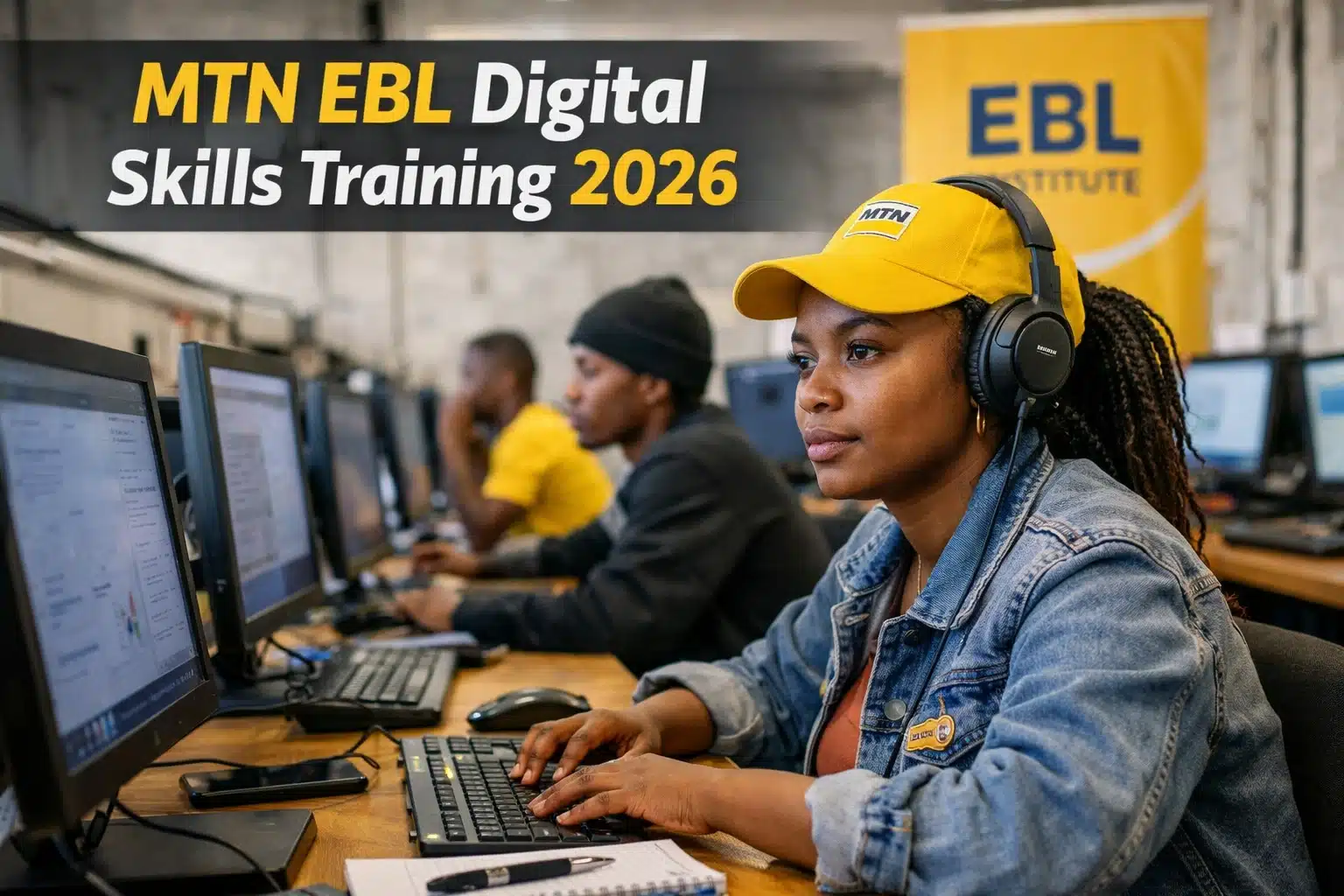
MTN EBL Digital Skills Training 2026 offers fully funded ICT training for unemployed South African youth aged 18–35.
South Africa’s youth unemployment crisis is not new. But for many young people aged 18 to 35, 2026 could bring a meaningful shift.
The MTN EBL Digital Skills Training 2026 programme is opening doors to fully funded ICT training at a time when digital skills are no longer optional. If you have Matric and want to enter the tech space but lack funding, this opportunity matters now more than ever.
A Practical Response to Youth Unemployment
Youth unemployment in South Africa remains one of the highest globally. According to Statistics South Africa, young people continue to face significant barriers to entering the workforce — particularly in specialised industries like ICT.
That’s where the partnership between MTN Foundation and EBL Institute of Business and Technology comes in.
Their Digital Skills for Digital Jobs Training Programme is designed to bridge the gap between education and employment. Instead of offering general short courses, it provides an accredited qualification aligned with real industry needs.
The programme is accredited by MICT SETA at NQF Level 5 under SAQA ID 48872, meaning it holds formal recognition in South Africa’s qualifications framework.
That detail matters. Accreditation increases employability and creates pathways for further studies.
What the Programme Actually Offers
This is not just another online workshop. The MTN EBL Digital Skills Training 2026 programme runs for 4 to 6 months and combines technical instruction with workplace readiness.
Key facts:
- Fully funded (no tuition fees)
- Target age: 18–35 years
- Minimum requirement: Matric (Grade 12)
- Provinces covered: Free State, Northern Cape, Western Cape, Eastern Cape, and KwaZulu-Natal
- Start period: Around May 2026
Participants choose from specialised streams, including:
- Software Development
- Cybersecurity
- Data Analytics
- Digital Marketing
- Robotics Process Automation (RPA)
These aren’t random selections. They reflect areas where companies are actively hiring. Cybersecurity and data analytics, for example, are growing fields as businesses digitise operations.
It’s also important to note that the programme doesn’t promise instant employment. What it offers instead is structured preparation — technical knowledge, applied projects, and soft skills training.
That’s a more realistic and responsible approach.
More Than Coding: Workplace Readiness Matters
One of the most overlooked gaps among graduates is professional readiness.
The programme includes:
- Communication training
- Problem-solving techniques
- Interview preparation
- Career guidance
In real workplaces, technical skills alone are rarely enough. Employers look for people who can collaborate, adapt, and communicate clearly.
By blending digital skills with professional development, the initiative acknowledges that employability is broader than coding ability.
It also gives participants exposure to professional networks and masterclasses — something many unemployed youth struggle to access.
Who Should Seriously Consider Applying
This programme is ideal for:
- Young adults aged 18–35
- Individuals with a Matric certificate
- Residents in the listed provinces
- Youth interested in ICT but lacking financial resources
If you already have advanced IT qualifications, this may not be the right fit. But for matriculants who never had the chance to pursue tertiary ICT studies, it can serve as a foundation.
Applicants should prepare:
- Certified ID copy (not older than 6 months)
- Certified Matric certificate
- Proof of residence
Applications are submitted via the official EBL Institute portal:
https://www.eblinstitute.com/applicationform2025
As with many funded programmes, spaces are limited. Early application is strongly advised once the portal opens.
ALSO APPLY FOR: Siyavula Training Learnership 2026 Brings Real Tech Opportunity to Unemployed Youth
ALSO FOR: Horticultural Learnership 2026 in Johannesburg Offers Hope for Outdoor Job Seekers
A Step Into South Africa’s Digital Economy
South Africa’s economy is steadily integrating digital systems across banking, retail, government services, and telecommunications. Companies increasingly require skills in automation, cybersecurity, and analytics.
Organisations such as MTN operate in highly digital environments where technical competence is essential.
Programmes like this aim to ensure that young South Africans are not left behind as industries modernise.
Still, it’s important to stay realistic.
Completing the programme does not guarantee a job. Employment depends on performance, demand, and continued learning. However, an accredited Level 5 qualification significantly improves one’s competitiveness compared to having only Matric.
For many participants, it could also open doors to further undergraduate studies in IT or Computer Science.
Is the MTN EBL Digital Skills Training 2026 really free?
Yes. The programme is fully funded. There are no tuition fees for accepted participants.
What qualification will I receive?
An NQF Level 5 qualification accredited by MICT SETA (SAQA ID 48872).
Do I need prior IT experience?
No formal IT experience is required. A Matric certificate is the minimum requirement.
Which provinces are eligible?
Free State, Northern Cape, Western Cape, Eastern Cape, and KwaZulu-Natal.
When is the closing date?
A specific closing date has not yet been announced. Applications usually open before the May intake. Apply early once the portal is active.
Final Thoughts
The MTN EBL Digital Skills Training 2026 programme stands out because it addresses a real national problem with a structured, accredited solution.
It does not overpromise. It does not market unrealistic outcomes.
Instead, it offers something practical: access to recognised digital training for young people who might otherwise be excluded from the tech economy.
For unemployed matriculants looking for a serious pathway into ICT, this may be one of the more credible options available in 2026.
About The Author
