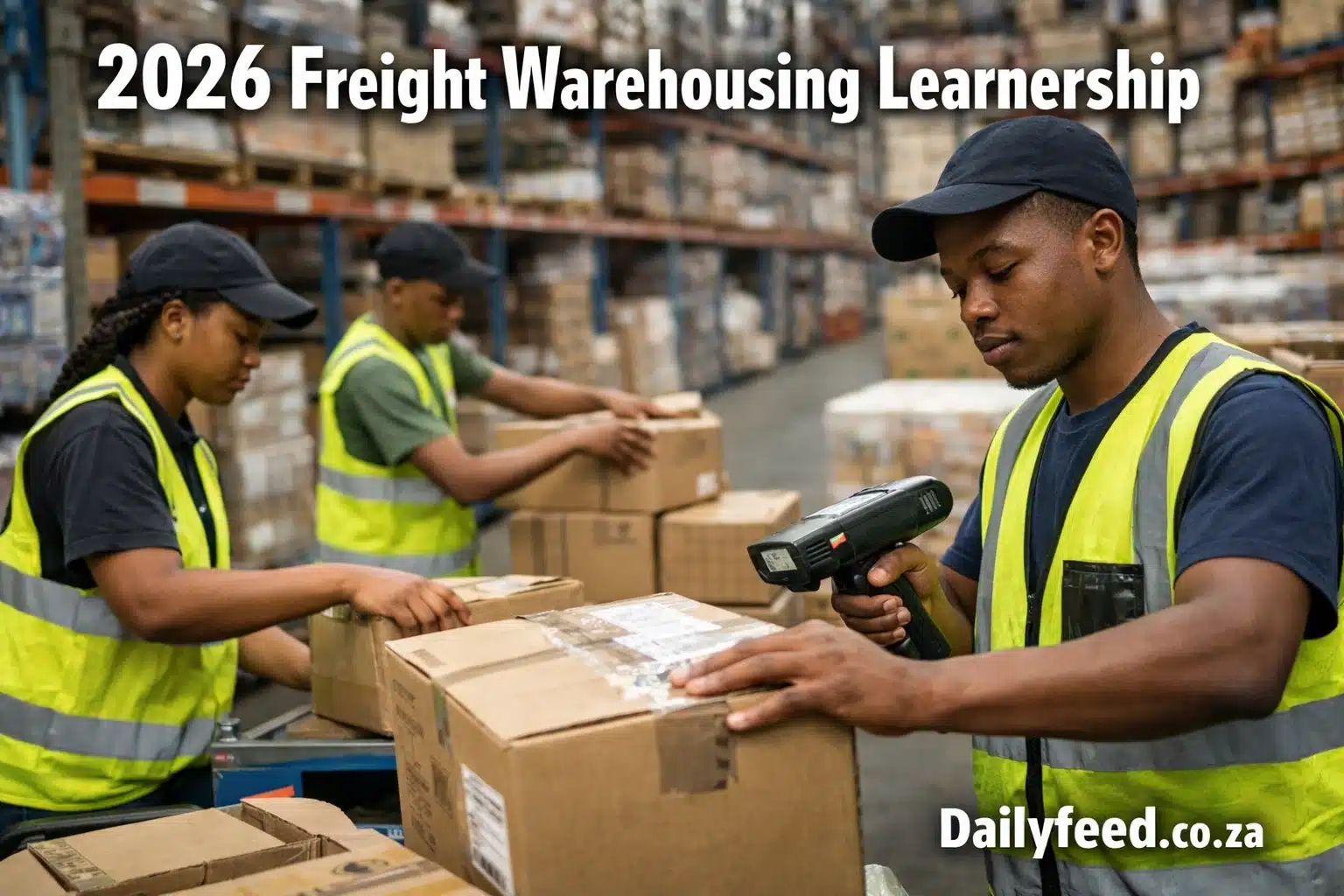
The 2026 Freight Warehousing Learnership offers South African youth paid training, real work experience, and a logistics qualification.
South Africa’s youth unemployment crisis is no longer abstract — it shows up every day in rejected CVs, unanswered emails, and qualifications that don’t translate into work. For young people trying to enter logistics or warehousing, the biggest barrier is often simple: no experience.
The 2026 Freight Warehousing Learnership exists to close that gap. It’s designed for unemployed youth who need practical exposure, a recognised qualification, and income while learning — not promises.
Applications are open now and close in February 2026.
Why This Warehousing Learnership Matters Right Now
Warehousing isn’t glamorous work, but it’s essential. Every online order, supermarket delivery, and factory shipment depends on people who know how to move, store, and track goods correctly.
As e-commerce, retail, and FMCG operations continue expanding, companies are under pressure to hire people who already understand basic warehouse systems. That’s where learnerships matter.
Instead of unpaid training or short courses with no workplace exposure, this programme combines real warehouse work, structured learning, and a monthly stipend of R5100. For many applicants, that stipend alone makes participation possible.
What the 2026 Freight Warehousing Learnership Actually Offers
This is not a classroom-only programme. Learners spend most of their time in active warehouse environments while completing formal assessments aligned with national standards.
Participants receive:
- Daily, hands-on warehouse experience
- Structured learning in logistics, stock control, and safety
- Nationally recognised assessments
- A monthly stipend of R5100
- A clear route into entry-level logistics roles
The qualification is aligned with NQF Level 2 or 3, registered with SAQA, and recognised across retail, logistics, and transport sectors.
While completion does not guarantee permanent employment, many learners finish with practical skills employers actively look for.
Who Can Apply — and Who This Is Best Suited For
The entry requirements are intentionally accessible, but the work itself is not passive.
Minimum requirements
- Grade 11 minimum (Grade 12 is an advantage)
- South African citizen or permanent resident
- 18 years or older by programme start
- Able to read basic English instructions and handle numbers
Personal qualities that matter
Warehousing work is physical and structured. Employers value learners who show:
- Reliability and punctuality
- Willingness to learn on the job
- Comfort with movement-based tasks
- Ability to follow safety procedures
- Teamwork and communication skills
No previous work experience is required — attitude carries more weight than a perfect CV.
The R5100 Monthly Stipend: Why It Changes Things
Many young people drop out of training programmes simply because they cannot afford transport, food, or data costs. This learnership directly addresses that reality.
The R5100 stipend can realistically cover:
- Daily transport to the workplace
- Meals during training
- Mobile data for communication
- Basic savings or household support
While it’s not a salary, it removes the financial barrier that keeps many capable candidates locked out of skills development.
How to Apply Before the February 2026 Deadline
Applications are completed online through the official portal.
Application steps
- Access the official application portal
- Create a personal profile
- Complete the background questionnaire
- Upload required documents
- Submit and await confirmation
- APPLY HERE
Required documents
- Certified copy of South African ID (not older than 3 months)
- Grade 11 or Matric certificate
- Updated CV
- Proof of residence
- Optional reference letters
Incomplete or unclear documents are a common reason for rejection, so preparation matters.
Closing date: 28 February 2026
Applying early reduces the risk of technical issues and late-stage congestion.
What Happens After the Learnership Ends?
Graduates leave with more than a certificate. They leave with workplace credibility.
Skills gained include:
- Stock counting and inventory checks
- Receiving and dispatch processes
- Safety and hazard awareness
- Equipment handling (scanners, pallet jacks)
- Basic warehouse communication systems
Typical progression paths
Many learners start as:
- Picker or Packer
- Stock Controller
- Shift Leader
- Supervisor
- Warehouse Manager
Progress depends on performance and opportunity, but the learnership provides a realistic starting point.
ALSO APPLY FOR: Momentum Sales Learnership 2026 – Opportunities for Young Unemployed South Africans in KZN and Mpumalanga
ALSO FOR: EWSETA Water & Wastewater Treatment Learnership 2026 Offers a Real Path for Unemployed Youth
Final Thoughts: Not a Shortcut — A Starting Point
The 2026 Freight Warehousing Learnership is not a guarantee of instant employment or fast success. What it offers instead is something more practical: a credible way in.
For unemployed youth with at least Grade 11, this programme provides income, experience, and a qualification in a sector that continues to grow quietly but consistently.
If logistics is a field you’re serious about, applying early gives you the best chance.
Frequently Asked Questions (FAQs)
Is this learnership paid?
Yes. Learners receive a monthly stipend of R5100.
Do I need Grade 12 to apply?
No. Grade 11 is the minimum requirement, though Grade 12 is an advantage.
Is employment guaranteed after completion?
No, but the qualification and experience significantly improve employability.
Is previous warehouse experience required?
No. Training is provided from the ground up.
About The Author

hello everyone, my backlink bot is system
it actually answered something i was confused about.
Hello, I found myself reading all the way through, which I really appreciate. I’ll save this for later.
Well, I wasn’t expecting to find something like this today. This filled in some gaps for me, and it felt more genuine.
This filled in some gaps for me. I’ll look into this again.
So, This actually made things clearer for me.
This site was… how do I say it? relevant, This made things a bit easier to understand.
Honestly, I wasn’t planning to spend time on blogs today, and I actually read it fully. this actually helped more than I thought which I don’t see often online. I might explore more here.
Hey, I was able to follow along easily. I might come back and read more later.