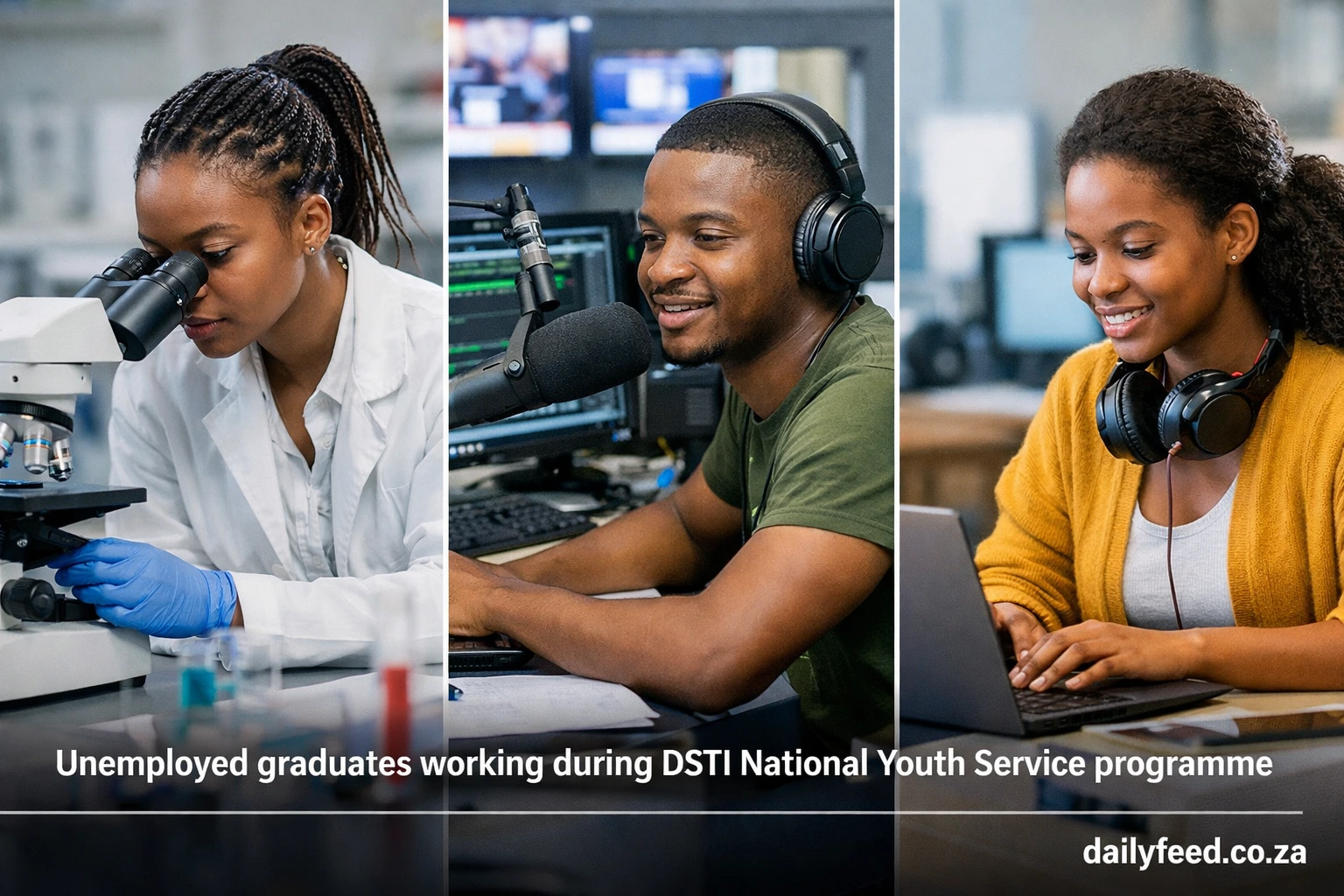
DSTI National Youth Service application 2026 is open for unemployed graduates under 35. Here’s how it works, who qualifies, and how to apply.
For many unemployed graduates, the wait for a first real break feels endless.
The DSTI National Youth Service application window is now open, and it matters because it offers something rare: a paid, structured 12-month placement designed to build real work experience.
If you’re under 35, struggling to enter the job market, and have a tertiary qualification, this programme could be a practical bridge between studying and earning.
What the DSTI National Youth Service Application 2026 Actually Is
The DSTI National Youth Service Application 2026 is part of South Africa’s broader National Youth Service initiative.
It is managed by the South African Agency for Science and Technology Advancement (SAASTA), which operates under the National Research Foundation (NRF). The programme places unemployed graduates in partner institutions for 12 months, while paying a monthly stipend to help cover basic living costs.
Unlike short workshops or once-off internships, this is a full-year placement. Participants work in real institutions, contribute to real projects, and gain experience that can actually be listed on a CV.
Although the main focus is on graduates in science, technology, engineering, and mathematics (STEM), the programme also opens limited slots for graduates in other fields. This year’s call includes areas like Journalism and Media Studies and Communications.
The deeper aim isn’t just employment. It’s about building a culture of community service, volunteerism, and public contribution. In simple terms: helping young people gain skills while also serving the country’s development needs.
Who Should Consider Applying (And Who Shouldn’t)for DSTI National Youth Service Application 2026
This opportunity is meant for a very specific group, and being honest about fit can save you time.
You should seriously consider applying for DSTI National Youth Service Application 2026 if:
- You are an unemployed graduate under the age of 35
- You hold a relevant tertiary qualification (e.g. Science, Technology, Journalism, Media Studies, Communications)
- You are computer literate
- You can work independently and handle some pressure
- You have strong communication and organisational skills
- You are interested in writing, radio, or television work (for media-related placements)
You may want to think twice if:
- You already have stable full-time employment
- You are not available for a 12-month commitment
- You are unwilling to relocate if required by a placement
- You are looking for a permanent job guarantee (this programme improves employability, but it does not promise a job at the end)
A realistic way to see this programme is as a stepping stone, not a final destination. It strengthens your profile, expands your network, and makes your next job search easier—but it doesn’t replace one.
DSTI National Youth Service Application 2026
Monthly Stipend (based on qualification level):
• National Diploma (NQF Level 6): R4,500
• Bachelor’s Degree / BTech (NQF Level 7): R5,000
• Honours (NQF Level 8): R5,500
• Master’s (NQF Level 9): R6,500
• PhD (NQF Level 10): R7,700
How the Application Process Works in Practice
The application process is handled through the SEIMS: NYS initiative portal.
Applications close on Saturday, 31 January 2026, at 23:59, and late submissions are typically not accepted. If you plan to apply, it’s safer to aim for at least a few days before the deadline to avoid technical issues.
You will need to prepare and upload the following documents:
- A detailed Curriculum Vitae (CV)
- A certified copy of your ID
- A motivational letter explaining why you want to join the programme
- A certified copy of your highest qualification
- A certified copy of your Matric certificate
Certification matters. Documents that are not properly certified can lead to automatic disqualification, even if everything else is perfect.
If you have questions or run into problems, the official contact person is:
MacDonald Kapu
Tel: (012) 392 9351
Email: nysprecruitment@saasta.nrf.ac.za
For background reading and official updates, these sources are useful:
This is a credible reference if you want to double-check details or confirm legitimacy for the DSTI National Youth Service Application 2026
Why This Programme Matters Right Now
Graduate unemployment in South Africa remains stubbornly high. Many young people finish their studies only to discover that entry-level jobs now require experience they were never given a chance to gain.
That’s the gap this programme tries to fill.
A 12-month placement won’t solve structural unemployment, and it won’t fix every CV. But for someone who has been sending out applications for a year with no replies, it can be a meaningful reset.
It also matters that this programme pays a stipend. While it won’t make anyone wealthy, it does reduce the financial pressure that forces many graduates to abandon their fields and take unrelated survival jobs.
There are limits, and it’s fair to acknowledge them. Not everyone who applies will be accepted. Some placements may be better resourced than others. And the transition into permanent work after the programme still depends on the wider job market.
Still, compared to doing nothing while waiting for a miracle email from a recruiter, this is a practical, structured option with real upside.
What Makes a Strong Application (Beyond the Paperwork) 2026
Meeting the minimum requirements is only the first step.
A strong application usually includes:
- A clear, honest motivational letter that explains your career goals
- Evidence that you understand what the DSTI-NYS programme is about
- A CV that highlights any volunteering, internships, or community work
- Proof of basic computer skills and communication ability
Avoid generic copy-paste letters. Reviewers can usually tell when someone hasn’t taken time to personalise their motivation.
If your background is not strictly STEM, don’t assume you have no chance. Media, communications, and journalism graduates are sometimes selected when placements need those skills. What matters most is alignment between your profile and the available roles.
ALSO APPLY FOR Westfalia Fruit’s 2026 Graduate Programme Brings Hope for Young Graduates
ALSO APPLY FOR ECD Learnership Vacancies Offer a Hopeful Path for Young South Africans Seeking Work With Purpose 2026
FAQs-DSTI National Youth Service Application 2026
Who can apply for the DSTI National Youth Service programme?
Unemployed graduates under 35 with a relevant tertiary qualification can apply.
When does the application close?
Applications close on Saturday, 31 January 2026, at 23:59.
Is this a permanent job?
No. It is a 12-month placement with a monthly stipend.
Do I need a STEM degree to apply?
STEM graduates are prioritised, but some slots are available for fields like Journalism, Media Studies, and Communications.
What documents are required?
CV, certified ID copy, motivational letter, certified highest qualification, and certified Matric certificate.
Final Thoughts
The DSTI National Youth Service application isn’t a shortcut to instant success. It’s a structured opportunity for graduates who are stuck at the starting line and need a credible first step forward.
If you meet the criteria and can commit to a year of learning and service, this programme is worth serious consideration. Not because it promises everything—but because it offers something real in a job market that too often offers nothing at all.
Click here to Follow the Daily Feed channel on WhatsApp
About The Author
