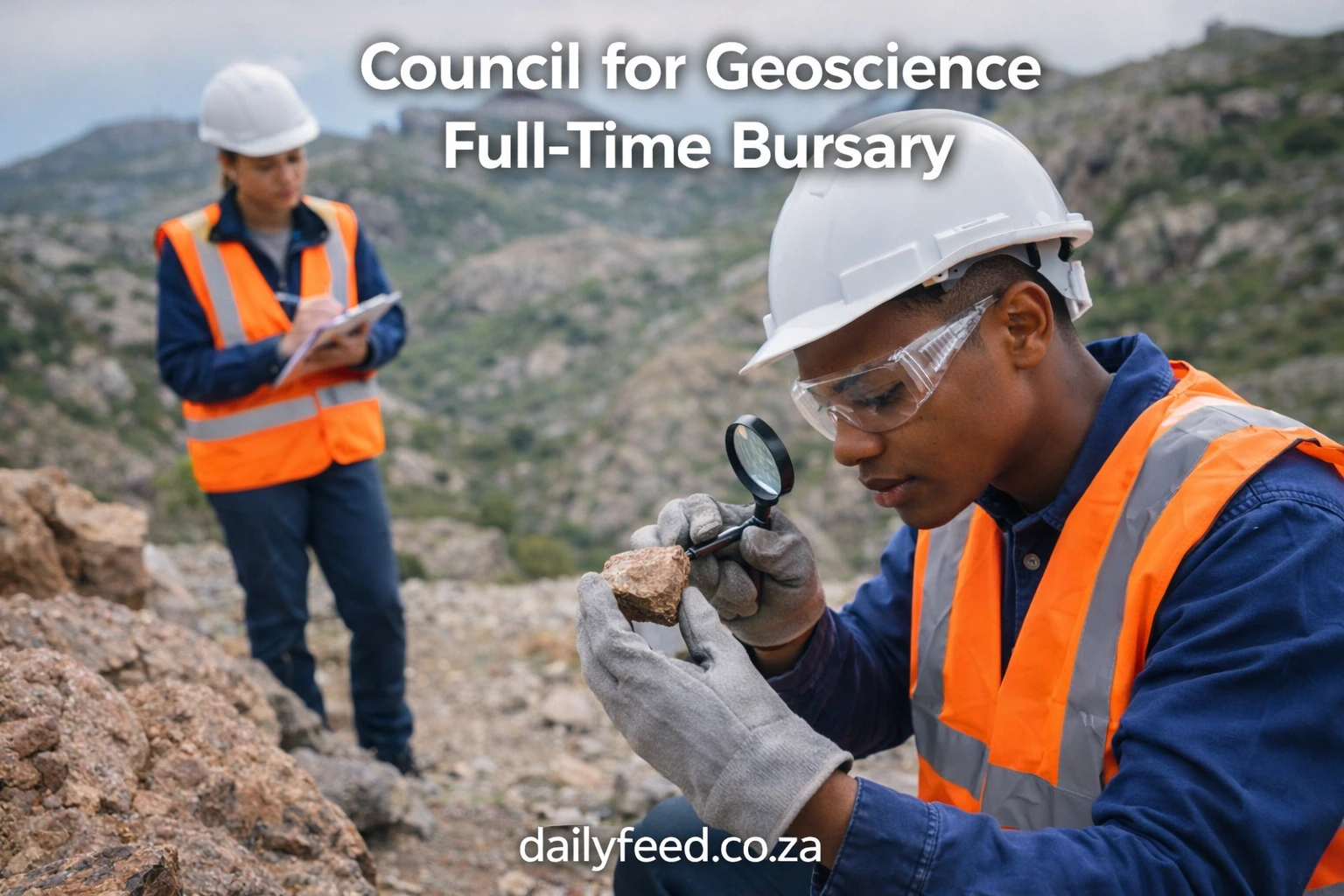
The Council for Geoscience Full-Time Bursary supports South African students in geology and data fields for the 2026 academic year.
A timely chance for students whose studies are tied to South Africa’s future
For many science students, funding determines whether a degree continues or quietly ends. The Council for Geoscience (CGS) Full-Time Bursary for 2026 arrives at a moment when demand for geoscience skills is growing, but financial support remains limited.
This bursary is aimed at South African university students already committed to fields that directly affect water security, mineral resources, environmental protection, and data-driven decision-making. With applications closing soon, it offers practical relief to students who meet the academic requirements and are ready to focus fully on their studies.
What the Council for Geoscience bursary is designed to do-Council for Geoscience Full-Time Bursary
The Council for Geoscience is not just another funding body. It is the national custodian of South Africa’s geoscience data, both onshore and offshore, and plays a central role in understanding natural resources and geological risks.
This bursary exists to build long-term expertise, not short-term credentials. CGS invests in students it believes can contribute meaningfully to the country’s geoscience capacity, either through research, technical work, or applied science.
Recipients are expected to be available for vocational work during their studies and, when required, to give work-back service after completing their qualifications. This makes the bursary a two-way commitment rather than a once-off financial award.
Fields of study supported — and why they matter-Council for Geoscience Full-Time Bursary
The Council for Geoscience Full-Time Bursary covers a wide range of disciplines, reflecting how broad modern geoscience has become.
Supported fields include:
- Geology and Engineering Geology
- Geophysics and Mining Seismology
- Hydrogeology (with a focus on groundwater modelling)
- Geochemistry and Economic Geology
- Environmental Science
- Data Science and Innovation Studies
- Geo-informatics, Remote Sensing, and Computational Geosciences
- Mineral Economics
These are not abstract academic paths. Skills in groundwater modelling affect drought planning. Remote sensing supports land-use decisions. Mineral economics influences national development strategies. CGS funding is closely aligned with real-world application.
ALSO APPLY FOR Beaufort West Municipality Building Control Internship Offers a Practical Way In
What the Council for Geoscience Full-Time Bursary covers — and what it doesn’t
For students, the value of this bursary lies in its comprehensive coverage.
The CGS bursary includes:
- Registration and tuition fees
- Accommodation or transport allowance
- Prescribed books
- Meals
- Field excursions and laboratory analysis
- A once-off laptop allowance for first-time bursary recipients
However, the bursary does not remove academic pressure. Students must pass all modules each year to remain eligible. It also does not allow recipients to be employed elsewhere, as bursars are expected to be available for CGS-related vocational work when required.
This structure makes the bursary best suited to students who are academically focused and able to commit fully to their studies.
Eligibility rules that matter more than people expect
Many bursary applications fail not because of poor marks, but because eligibility criteria are overlooked.
To qualify, applicants must:
- Be South African citizens
- Be unemployed
- Be enrolled full-time at a South African higher education institution in 2026
- Have passed all modules in the previous academic year or semester
- Be available for vocational work and possible work-back obligations
Applicants must also submit all required documentation. Missing even one item — such as an updated academic record or acceptance letter — will result in disqualification.
Late applications are not considered under any circumstances.
ALSO APPLY FOR A Serious And A Hopeful Start: Inside the NEF Graduate Internship Programme 2026
How to apply for Council for Geoscience Full-Time Bursary without common mistakes
Applications must be submitted via email to bursaries@geoscience.org.za with the subject line:
BursaryFT-2026
Required documents include:
- A motivation letter
- An updated CV
- Certified copy of ID
- Latest academic record
- Certified matric results
- University acceptance or admission letter
Importantly, bursary applications must not be sent to the enquiries email address. This is a common mistake that leads to automatic rejection.
How to apply:
Complete the CGS full-time bursary 2026 application form and attach the required documents.
Download Bursary Information:
Download Full-Time Bursary Advert (PDF)
Download Full-Time Bursary Application Form (PDF)
The closing date is 23 January 2026 at 23:59.
Council for Geoscience Full-Time Bursary
Why Council for Geoscience Full-Time Bursary are competitive — and worth it
CGS bursaries attract strong applicants because they combine funding with access to real scientific environments. Past recipients often describe the exposure to national datasets, fieldwork, and applied research as more valuable than the funding itself.
That said, selection is competitive, and there is no guarantee of placement after graduation. Students should view this bursary as a foundation, not a promise of employment.
ALSO APPLY FOR A Serious And A Hopeful Start: Inside the NEF Graduate Internship Programme 2026
Frequently Asked Questions (FAQs)-Council for Geoscience Full-Time Bursary
Can first-year students apply?
Yes, if they have an acceptance letter and meet all eligibility requirements.
Is part-time study allowed?
No. The bursary is for full-time students only.
Do I have to work for CGS after graduating?
Work-back may be required, depending on CGS needs and the bursary agreement.
Can I apply if I failed a module last year?
No. Applicants must have passed all modules in the previous academic period.
What happens if documents are missing?
The application will be disqualified without review.
Click here to Follow the Daily Feed channel on WhatsApp
About The Author
